Check whether the person has been officially identified
When a report says that a missing person has been found, readers should look for an attributable statement from police or another authorized agency.
The statement should clarify whether the person was found alive or deceased, whether their identity has been confirmed, and whether further investigation is taking place.
If the report does not provide that information, it is better to say that the article claims a discovery occurred than to present every detail as confirmed fact.
Look for a date and location
A missing-person report without a clear date or location is difficult to verify.
Dates matter because a photograph may be old or may relate to a different search. Locations matter because several cases can have similar descriptions.
A credible article should make it possible to identify which authority has jurisdiction and where readers can find further official information.
The supplied screenshot does not contain these details. It therefore cannot support a reliable reconstruction of the event.
Check whether police actually made the statement
The phrase “authorities confirmed” should be accompanied by a source.
That source might be a police spokesperson, an official press release, a public information notice, or a statement from a named agency.
If the article does not identify who made the statement, readers cannot easily assess whether the claim is accurate.
Similarly, the phrase “early reports suggest” should lead to identifiable reporting or evidence. Otherwise, it is simply an unattributed claim.
Do not confuse a witness with a suspect
The mention of a man at the scene is likely to encourage speculation.
But the fact that someone was present does not prove that they caused harm. Investigators may need to speak with witnesses, people who discovered the location, relatives, acquaintances, or individuals whose movements are relevant.
A person should not be described as a suspect unless that status has been confirmed by an appropriate source.
Even when someone is formally accused, the legal process must be respected. Allegations are not convictions.
Be careful with photographs and image collages
A collage can make a story appear more convincing because it gives readers several visual elements at once.
But photographs can be taken from unrelated events, reused without permission, or presented without context.
A picture of people standing in a field does not prove that they were searching for the person named in a headline. A photograph of a stream does not prove that the stream was a discovery site. A portrait does not establish identity unless it is reliably attributed.
Readers can use reverse-image search and check the original source where possible. They should also look for captions, dates, and photographer information.
If an image cannot be verified, it should be described as illustrative rather than documentary.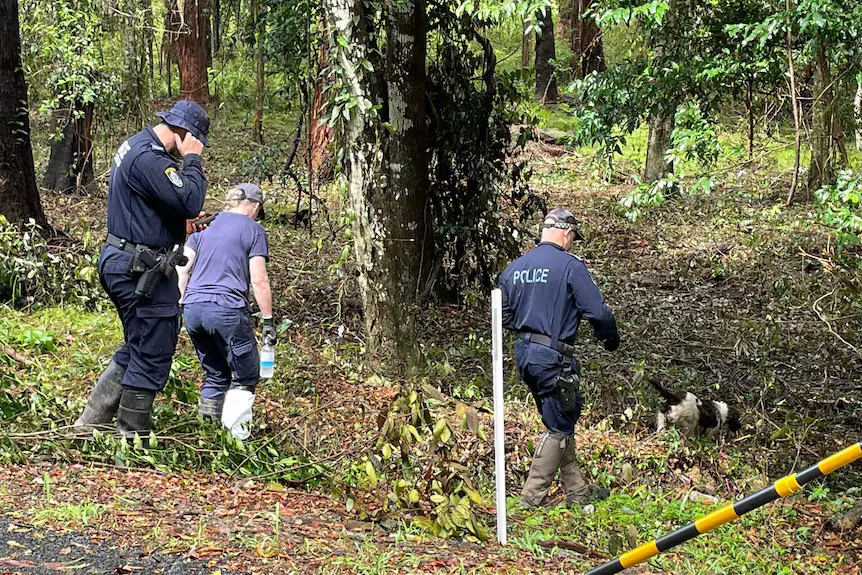
Why emotionally charged wording can mislead
Words such as “mysterious,” “shocking,” “terrifying,” and “unbelievable” can make a story more engaging. But they can also create an impression that evidence is stronger than it really is.
A headline may imply a dramatic revelation while the body contains little verified information.
The best way to assess such a report is to ask what it actually establishes.
Does it name the missing person? Does it identify the location? Does it provide an official statement? Does it distinguish a confirmed discovery from an allegation? Does it explain what investigators have and have not concluded?
If those answers are missing, the article should be treated cautiously.
What is currently supported by the supplied material?
Based on the screenshot and the accompanying text, the following points can be described as claims made by the supplied report:
-
It describes a young woman who was reportedly missing.
-
It says relatives, friends, and volunteers joined efforts to find her.
-
It says the search ended with a tragic discovery in a remote area.
-
It claims that a man was also present when she was found.
-
It says questions remain about the circumstances.
However, the screenshot does not establish the woman's name, age, exact location, disappearance date, discovery date, cause of death, or the man's identity and legal status.
It also does not include a verifiable police statement.
An online search located a page repeating the same general wording, but it did not provide the missing identifying details or an attributable official statement. Another page using a similar headline contained a different narrative, which further demonstrates why the story should not be expanded by guessing that separate accounts describe the same incident.
For now, the responsible conclusion is that the viral report raises questions but does not provide enough verifiable information to answer them.
The questions that still need answers
If the case is to be reported accurately, several basic questions need to be resolved:
Who was the young woman? A confirmed name or official missing-person notice is necessary to distinguish this story from other cases.
Where did she disappear? The country, region, and last confirmed location are essential to understanding the investigation.
When did the disappearance and discovery occur? A reliable timeline would help establish which reports and photographs are relevant.
Was she found alive or deceased? The screenshot implies a tragic outcome, but a clear official confirmation is needed.
Who was the man mentioned in the report? His presence, relationship to the woman, and status in the investigation have not been established.
What have investigators confirmed? Readers need to know whether authorities have identified a cause of death, ruled out an accident, or announced any criminal allegation.
Are the photographs authentic and connected to the case? The images should be attributed before they are used as evidence of a specific location or event.
These are not details that can responsibly be supplied through imagination. They require reliable documentation.
A final reminder: Behind every missing-person headline is a real human life
A missing-person story is not simply a mystery for the internet to solve. It concerns a person, a family, and a community whose lives may have been changed by a frightening and painful event.
The photograph and headline in the supplied material invite readers to ask what happened. That curiosity is understandable. But it should be matched by care in how the story is shared.
The search described in the report may have ended, but the available information leaves important questions unresolved. The mention of a remote location and another person at the scene is not enough to establish a cause, motive, or responsibility.
Until reliable details are available, readers should avoid naming people, assigning blame, or repeating theories as facts.
The most important lesson is that missing-person cases deserve both urgency and accuracy. When someone disappears, concerns should be reported promptly to the relevant authorities. Families should receive compassionate support. Search efforts should be coordinated safely, and evidence should be preserved.
When a case ends in tragedy, the public deserves clear information—but the people involved deserve dignity, privacy, and a fair process.
The real story is not only about how a missing-person search ended. It is also about the questions that remain, the evidence needed to answer them, and the responsibility to avoid turning uncertainty into speculation.