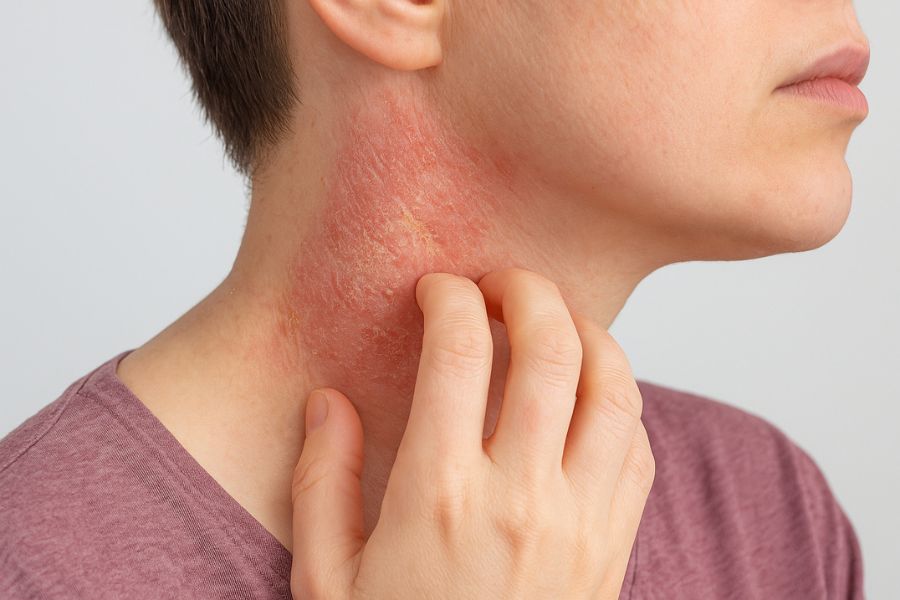
At first, it may have looked like an ordinary skin irritation. A small red spot appeared near the back of an older man's neck, just below his hairline. Perhaps he assumed it was caused by sweat, a new shirt, an insect bite, or the products he used to wash his hair. Like many people, he may have believed that a minor skin problem would eventually disappear on its own.
But then something changed.
More spots appeared. Some became red and inflamed, while others developed dark crusts or scabs. The affected skin looked irritated, uneven, and uncomfortable. The rash seemed to spread from the area behind his ear toward his neck and upper shoulder.
Looking at an image like this, many people immediately wonder the same thing: What could cause skin to become so severely irritated, and when should a person stop treating a rash as a minor inconvenience?
The answer is not always straightforward. Skin conditions can look remarkably similar even when their causes are completely different. An infection, an inflammatory disorder, a reaction to a medication, or another medical problem can sometimes produce redness, bumps, blisters, or crusted lesions.
That is why the appearance of a rash alone is not enough to establish a diagnosis.
When a Small Skin Problem Becomes Difficult to Ignore
The skin is the body's largest organ and one of its most important protective barriers. It helps regulate temperature, limits water loss, and protects underlying tissues from environmental irritants and infectious organisms.
When this barrier becomes damaged or inflamed, visible changes may develop. The skin can become red, swollen, itchy, painful, blistered, or covered with crusts.
A mild rash may improve with appropriate care, but a rash that continues to spread, becomes increasingly painful, develops pus, or forms extensive crusts deserves medical attention.
The location of a rash can also provide useful clues. The back of the neck and the area behind the ears are exposed to sweat, friction, hair products, shampoos, shaving products, clothing, and environmental irritants. These factors can aggravate certain skin conditions.
However, the same area can also be affected by infections and inflammatory diseases that have little to do with hygiene or clothing.
For example, contact dermatitis can occur when the skin reacts to an irritating substance or an allergen. Folliculitis develops when hair follicles become inflamed, sometimes because of bacterial or fungal involvement. Certain viral infections can produce painful clusters of blisters, while bacterial skin infections may cause redness, swelling, drainage, and crusting.
In some cases, scratching makes the situation worse. The skin becomes damaged, new areas become irritated, and microorganisms may enter through breaks in the skin.
A cycle can develop: irritation causes scratching, scratching damages the protective barrier, and the damaged skin becomes even more inflamed.
Why the Dark Crusts Matter
One of the most noticeable features in the photograph is the presence of multiple crusted lesions surrounded by inflamed skin.
A crust forms when fluid, blood, or other material dries on the skin's surface. It can appear yellowish, brown, reddish, or nearly black, depending on its composition and the stage of healing.
Crusting does not automatically mean that a lesion is infected. A healing scratch, an inflamed blister, and several different skin diseases can all produce crusts.
Nevertheless, widespread crusting combined with redness, new lesions, or increasing discomfort raises the importance of a professional examination.
A clinician may need to determine whether the lesions began as blisters, pustules, scratches, or solid bumps. They may also examine the scalp, ears, face, and other parts of the body to understand the pattern.
Sometimes, a skin swab, laboratory test, or small skin sample is necessary to distinguish between possible causes.
The Question That Should Never Be Ignored
Perhaps the most important detail is not how dramatic the rash looks, but how it developed.
Did the lesions appear suddenly or gradually? Are they painful or itchy? Did they begin on one side of the neck? Has the person recently started a medication, changed a hair product, or experienced an illness?
These questions can help narrow the possibilities.
If a rash is rapidly spreading, extremely painful, accompanied by fever, or associated with swelling around the eyes, breathing difficulties, or a person feeling seriously unwell, urgent medical assessment is necessary. Widespread blistering or sores involving the eyes, mouth, or other mucous membranes also require urgent evaluation.
For an older adult with extensive, unexplained crusted lesions, arranging prompt medical assessment is a sensible next step, even if the person otherwise feels well.
The first lesson is simple: unusual skin changes should not automatically be dismissed as irritation. The earlier the cause is identified, the sooner appropriate treatment can begin.
And that leads to another important question: What conditions can create a rash that looks like this?