Water Chestnuts and Hidden Risks: What You Should Really Know
They are crisp, refreshing, and popular in Asian dishes—but how safely are water chestnuts grown, cleaned, and prepared?
Water chestnuts are familiar ingredients in many Asian kitchens. Their delicate sweetness and distinctive crunch make them popular in stir-fries, soups, salads, dumplings, and desserts. They are also enjoyed as snacks, sometimes eaten raw after the outer skin has been removed. Because they are widely available and relatively easy to prepare, many people rarely stop to think about where they grow or what might be carried on their surface.
That is where an important food-safety question begins.
Unlike vegetables grown in ordinary garden soil, water chestnuts develop in aquatic environments. Depending on the type, they may grow in ponds, marshes, flooded fields, or muddy water. These environments can contain soil particles, animal waste, bacteria, and other microorganisms. If the plants are harvested, transported, stored, or prepared under poor hygienic conditions, contamination may reach the food that eventually appears on the dinner table.
Online warnings sometimes describe water chestnuts as dangerous because they supposedly carry enormous numbers of parasites. Such claims can be alarming, but they do not tell the whole story. Water chestnuts are not automatically contaminated, and eating them does not mean a person will become infected. The genuine concern is more specific: certain raw aquatic plants can carry infectious organisms when they come from contaminated water or are handled improperly.
There is also an important distinction between different plants sold under the name water chestnut. The familiar crunchy Chinese water chestnut is not the same plant as the water caltrop, although common names are sometimes used inconsistently. Understanding that difference helps make sense of food-safety warnings and prevents people from treating every product with a similar name as though it carries exactly the same risks.
The good news is that these risks can often be reduced through careful sourcing, washing, peeling, preventing cross-contamination, and thorough cooking. Water chestnuts can still be part of a varied diet, but knowing how to handle them is essential—especially when they are eaten raw.
So what is the real danger? Can parasites actually be associated with aquatic vegetables? Does peeling remove every possible risk? And why is cooking generally safer than eating water chestnuts raw?
The answers are more practical—and more reassuring—than many dramatic warnings suggest.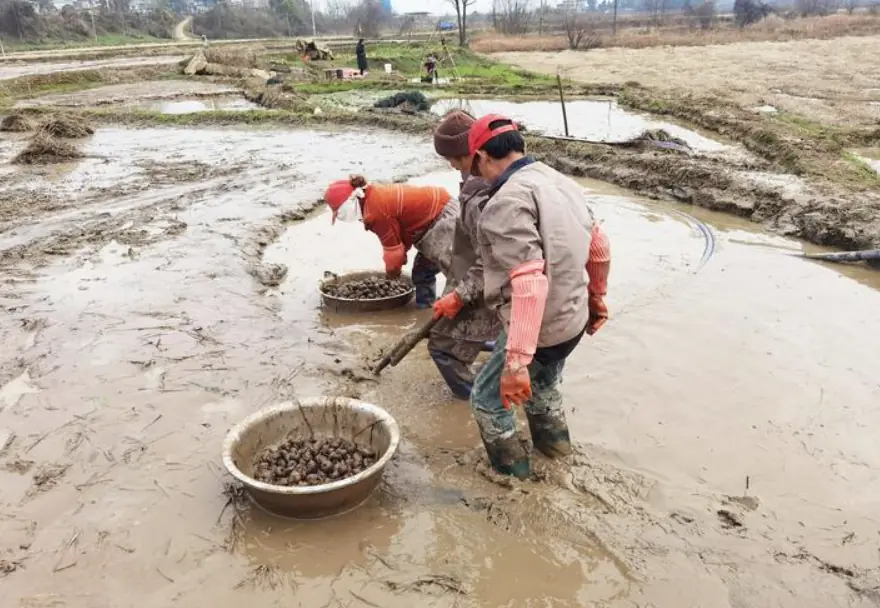
1. First, What Exactly Are Water Chestnuts?
Before discussing hidden risks, it helps to understand what water chestnuts actually are. The name can be confusing because it is used for more than one aquatic plant.
The ingredient commonly found in Chinese and Southeast Asian cooking is the Chinese water chestnut, botanically known as Eleocharis dulcis. It is not a true chestnut and is not closely related to the familiar tree nuts sold in markets during autumn. Instead, the edible part is an underground swollen stem, known as a corm, that develops in wet soil.
When peeled, it has a white or pale ivory interior with a crisp texture and a mildly sweet flavor. Unlike many vegetables, it can retain much of its crunch even after cooking. This makes it especially popular in stir-fries, dumpling fillings, soups, and dishes where a little extra texture is desired.
Another plant, Trapa natans, is also commonly called a water chestnut or water caltrop. Its fruit has a hard, distinctive shape and is botanically unrelated to the Chinese water chestnut. The two should not be confused simply because their common names overlap.
This difference matters when discussing food safety. A warning about one aquatic plant should not automatically be applied to every product sold under a similar name. The growing environment, edible part, harvesting method, and local food practices can all differ.
For everyday cooking, the familiar white, crunchy Chinese water chestnut is usually the product people mean when they talk about adding water chestnuts to stir-fries or salads. It is this food that the following preparation and nutrition discussion primarily addresses.
Why Does It Grow in Muddy Water?
Chinese water chestnuts are adapted to wet growing conditions. They are commonly cultivated in flooded fields or shallow-water environments, where their underground corms develop in mud.
This growing method is not automatically unsafe. Many foods are cultivated in soil, water, or other environments that contain naturally occurring microorganisms. The important question is whether the growing water and soil are clean enough for food production and whether the harvest is handled hygienically.
A properly managed farm can produce water chestnuts that are suitable for consumption. However, contaminated water, animal waste, poor sanitation, and careless handling can introduce hazards at different stages of production.
The fact that a vegetable grows in water does not mean it is full of parasites. It means that its source and handling deserve attention, just as they do for other foods that are eaten raw.
2. The Real Concern: Can Aquatic Vegetables Carry Parasites?
The parasite warning associated with aquatic vegetables is not entirely invented, but it is often presented in an exaggerated way.
Certain parasites have life cycles that involve freshwater environments, aquatic snails, and plants growing in or near contaminated water. One example is Fasciolopsis buski, an intestinal fluke found in parts of South and Southeast Asia.
According to the U.S. Centers for Disease Control and Prevention (CDC), people can become infected with this parasite by eating raw or undercooked aquatic plants that have the infective stage attached to them. The parasite's life cycle involves eggs entering freshwater, developing through stages in suitable snails, and eventually producing forms that attach to aquatic vegetation. A person can become infected when contaminated plants are eaten without adequate cooking.
This is a genuine food-safety concern in areas where the parasite occurs and where aquatic plants may be grown or harvested in contaminated freshwater.
However, several important qualifications are needed.
First, this does not mean every water chestnut carries Fasciolopsis buski. The parasite is not automatically present on every aquatic vegetable, and contamination depends on environmental and sanitary conditions.
Second, the CDC's general guidance about aquatic plants should not be misrepresented as proof that every commercially sold Chinese water chestnut is a common source of this infection. The CDC explains the transmission route and advises against eating raw or undercooked freshwater plants when this parasite risk is relevant. It does not say that all water chestnuts are contaminated.
Third, the risk is not limited to parasites. Fresh produce can also carry bacteria and other microorganisms. These may be introduced through contaminated water, soil, equipment, hands, storage containers, or kitchen surfaces.
The practical message is therefore more useful than the frightening version: raw aquatic vegetables from uncertain or contaminated sources can carry hazards, but the food is not inherently dangerous simply because it grows in water.
How Can a Parasite Reach an Aquatic Plant?
The life cycle of an aquatic parasite can be surprisingly complex.
In the case of Fasciolopsis buski, infected humans or pigs can release parasite eggs into the environment through feces. When these eggs reach suitable freshwater, they can develop and eventually release a stage that infects certain freshwater snails.
Inside the snail, the parasite develops further. Later stages leave the snail and attach to aquatic plants, where they can form a protective cyst-like stage called a metacercaria.
If a person eats a contaminated aquatic plant raw or insufficiently cooked, the infective stage may be swallowed. It can then develop in the digestive system.