Why Do Padlocks Have Tiny Holes at the Bottom? The Hidden Purpose Explained
A tiny hole beneath an ordinary padlock may look like an insignificant detail, but it can help protect the mechanism from one of its biggest enemies: trapped moisture.
A padlock is one of those everyday objects most people rarely think about. We use one to secure a garden gate, lock a storage shed, protect a toolbox, fasten a bicycle chain, or keep a cabinet closed. We insert the key, turn it, hear the familiar click, and move on with our day. Its job seems simple: keep something secure until the right key comes along.
Yet, if you turn a traditional padlock upside down and examine its lower edge, you may notice something unusual. On many models, there is a tiny circular opening near the keyway or along the bottom of the metal body. It is so small that it can easily be mistaken for a manufacturing mark, a screw hole, or even an accidental flaw in the metal.
But that little opening is often there for a very practical reason.
It can help water escape from inside the lock.
That may not sound particularly exciting, especially when compared with the complicated pins, springs, cylinders, and hardened metal components that make a padlock work. However, moisture can gradually become a serious problem for a lock that spends its life outdoors. Rain can reach the body, humidity can collect inside, and temperature changes can encourage condensation. If water remains trapped around the internal mechanism, corrosion and other forms of damage may eventually make the key difficult to turn or prevent the lock from opening altogether.
The small hole can help reduce that risk by giving accumulated moisture somewhere to go.
And there is more to the story. Depending on the model, a similar opening may also be associated with maintenance or lubrication. That does not mean every tiny hole is designed for the same purpose, nor does it mean that every padlock should be sprayed with lubricant through it. The exact design depends on the manufacturer and the type of locking mechanism.
So why do manufacturers include this feature? How does such a small opening help protect a metal lock? Can it prevent freezing in cold weather? Is it safe to put lubricant inside it? And what should you do if your padlock becomes stiff, rusty, or difficult to open?
The answers reveal why a seemingly insignificant detail can make a surprisingly important difference to the reliability and lifespan of an everyday security device.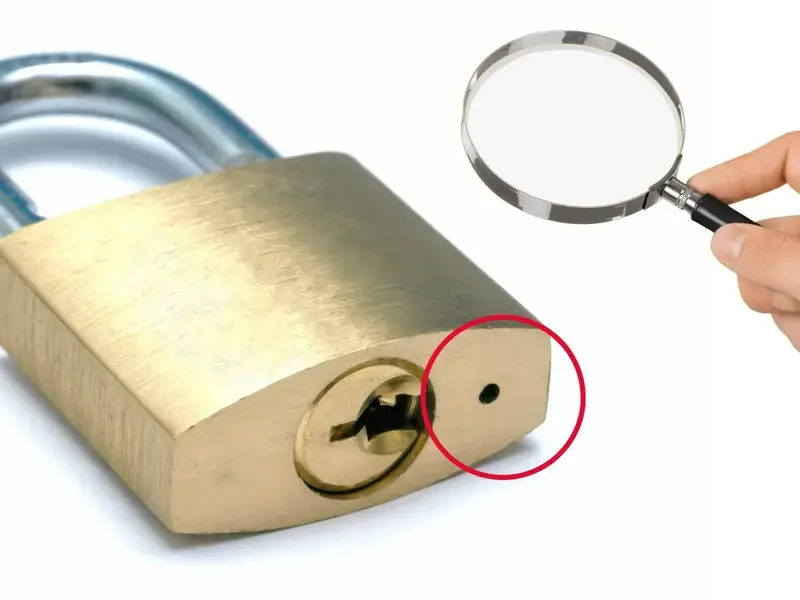
The Small Opening That Helps Protect a Padlock
The most common explanation for the tiny hole found on many conventional padlocks is drainage.
To understand why it matters, imagine a padlock attached to a garden gate. It is exposed to rain, wind, dust, sunlight, and changing temperatures throughout the year. Unlike a lock installed inside a dry building, it cannot always be protected from the weather.
Even when the outer body appears solid, a padlock is not necessarily a completely sealed object. Its shackle openings, keyway, and other small spaces can provide routes through which moisture or airborne particles may enter. Water can also collect around the moving parts when rain runs down the shackle or when the lock is handled with wet hands.
A small amount of moisture may not cause an immediate problem. The lock might continue to open and close normally for weeks or months. However, repeated exposure can gradually increase the amount of water and dirt inside the housing.
This is where the drainage opening becomes useful.
Rather than allowing all the moisture to remain trapped inside the body, a properly positioned drainage hole gives water an opportunity to escape. Gravity helps move liquid toward the lower part of the lock, where the opening can allow it to drain away.
It is a simple principle, but it addresses a problem that manufacturers have had to consider for a long time: outdoor locks must continue working even when their surroundings are not ideal.
The opening does not make a padlock waterproof. It does not guarantee that rain cannot enter, and it cannot remove every trace of humidity. Instead, it provides a route for accumulated liquid to leave the housing, reducing the amount of water that might otherwise remain around sensitive components.
This distinction is important. A drainage hole is a protective design feature, not an unlimited defense against weather damage.
A padlock with a drainage opening can still corrode if it is repeatedly exposed to water, neglected for years, or used in an environment for which it was never designed. The feature simply helps manage one of the conditions that can shorten its working life.
That is why the opening is particularly useful on locks intended for gates, sheds, outdoor storage areas, and other places where exposure to moisture is difficult to avoid.
Why Trapped Water Can Become a Serious Problem
Water is essential in everyday life, but it is not always friendly to metal mechanisms.
Many padlocks contain several small moving components. Depending on the design, these may include pins, tumblers, springs, levers, a cylinder, and other parts that must move in a particular sequence when the correct key is inserted.
These components are manufactured to work with relatively precise clearances. They need enough room to move, but they also need to remain correctly aligned. If corrosion develops on their surfaces, the resulting roughness and deposits can interfere with their movement.
The problem may begin gradually.
A padlock left outside during a rainy season might appear perfectly normal at first. The key still enters the keyway, and the mechanism still turns. But after repeated exposure, small areas of corrosion can begin forming on unprotected metal surfaces.
As the damage progresses, the key may become harder to turn. The internal parts may no longer move as smoothly as they once did. A spring may lose some of its freedom of movement, or a moving component may become obstructed by corrosion products and accumulated dirt.
Eventually, the lock may become unreliable.
It might open only after several attempts. The key may feel unusually stiff. The shackle may fail to release smoothly, even though the correct key is being used. In more severe cases, the lock may become completely stuck.
This is why preventing unnecessary moisture buildup matters.
A drainage hole cannot stop every type of corrosion, but it can help prevent liquid water from sitting inside the lock for extended periods. Removing accumulated water more quickly may reduce the opportunity for moisture-related damage to develop.
There is also another factor: water does not always arrive alone.
Rain can carry tiny particles of dust, soil, and other contaminants. Outdoor air may contain pollutants, while nearby roads, workshops, gardens, and industrial environments can expose a lock to additional debris. When moisture combines with dirt, it can create an unpleasant mixture that makes maintenance more difficult.
A small opening that helps water escape can therefore contribute to keeping the internal environment less hostile to the locking mechanism.
The important point is that the tiny hole is not decorative. On many models, it is part of a practical design intended to help the lock survive ordinary environmental exposure.
What Happens When Water Remains Inside During Cold Weather?
Moisture can be troublesome in warm and humid conditions, but freezing temperatures create another challenge.
When water freezes, it expands. If liquid remains trapped inside a confined space, the formation of ice can interfere with the movement of nearby components. Even a relatively small amount of ice may be enough to prevent a mechanism from operating as intended.