A Soft Bluish Lump Under the Tongue? Here's What It Could Mean – 7 Important Signs You Should Never Ignore
A small bluish lump beneath your tongue may look harmless, but its appearance could reveal something happening inside your salivary glands. Learn what causes this unusual swelling, when it may disappear on its own, and which warning signs mean you should see a doctor.
Imagine brushing your teeth one morning, looking into the mirror, and noticing something you have never seen before: a small, soft, bluish swelling underneath your tongue.
At first, you might assume it is simply a minor irritation. Perhaps you accidentally bit the area while eating, burned your mouth with hot food, or developed a small blister that will disappear within a few days.
But then you look again.
The swelling has a slightly transparent appearance. It seems to sit beneath the surface of the tongue, almost like a tiny bubble filled with fluid. It does not necessarily hurt, but its unusual blue color makes you wonder whether something more serious is happening.
Could it be an ordinary mouth cyst? Is a salivary gland blocked? Could the swelling affect your ability to eat, speak, or swallow?
These are reasonable questions, especially because the underside of the tongue is an area that many people rarely examine closely.
One possible explanation is a condition called a ranula, a type of mucus-filled cyst associated with the salivary glands beneath the tongue. Although the name may sound unfamiliar, ranulas are recognized oral conditions, and many are benign.
However, not every bluish lump beneath the tongue is a ranula.
Other conditions can produce similar-looking changes, and some require medical attention. The location, size, texture, duration, and accompanying symptoms all matter when determining what might be happening.
The most important thing is not to panic when you notice an unusual swelling, but not to ignore it either.
A small lump that initially causes no discomfort may gradually become larger. In some cases, it can interfere with eating, speaking, or swallowing. In other situations, a similar-looking swelling may have a completely different explanation.
Understanding the possibilities can help you recognize when observation is reasonable and when professional examination is necessary.
And one detail deserves particular attention: the bluish appearance may provide a clue, but color alone cannot tell you exactly what the lump is.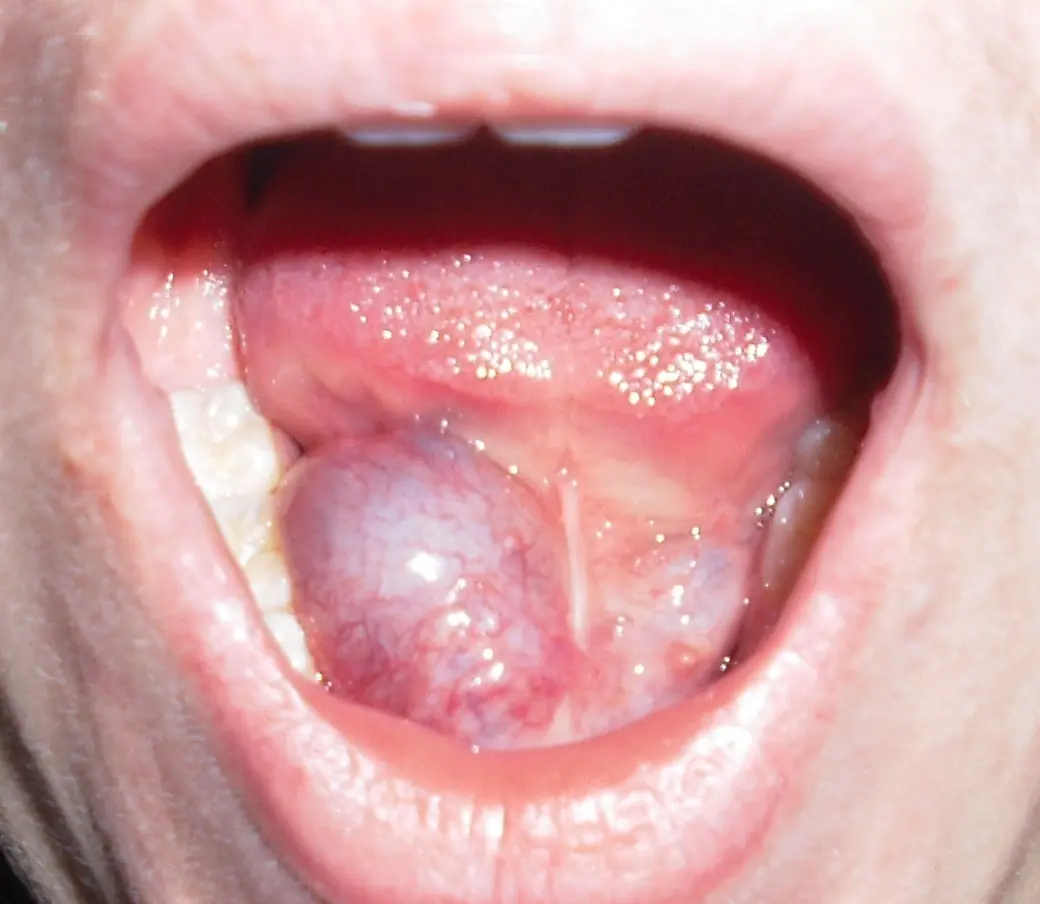
What Could a Soft Bluish Lump Under the Tongue Be?
One of the conditions commonly associated with a soft, fluid-filled swelling beneath the tongue is a ranula.
A ranula is a mucus-filled collection that develops when saliva escapes from a salivary gland or its duct and accumulates in the surrounding tissues.
The name is derived from the Latin word rana, meaning frog. This refers to the appearance of some ranulas, which can resemble the translucent underside of a frog.
Most ranulas develop in the floor of the mouth, beneath the tongue, and are associated with the sublingual salivary gland.
These glands produce saliva that helps lubricate the mouth, begin the digestive process, and make speaking and swallowing easier.
When a salivary duct becomes damaged or blocked, saliva may not flow normally. Instead, mucus can collect in nearby tissues, creating a soft swelling.
A typical ranula may appear:
-
Soft and rounded.
-
Bluish or translucent.
-
Located beneath one side of the tongue.
-
Filled with mucus rather than solid tissue.
-
Painless or associated with mild discomfort.
The swelling may remain relatively small for some time, or it may gradually increase in size.
Some people discover it accidentally while brushing their teeth or examining their mouths. Others notice it when their tongue touches an unusual bump during eating or speaking.
Although a ranula is generally a benign condition, its size and location can influence how much discomfort it causes.
A small lesion may produce very few symptoms. A larger one may push against the tongue, create a feeling of fullness, or make certain mouth movements uncomfortable.
It is important to remember that a visual description is not enough to diagnose a ranula. A dentist, oral medicine specialist, or oral and maxillofacial surgeon may need to examine the area before determining the cause.
7 Important Signs That May Accompany a Lump Under the Tongue
Not every person with a ranula experiences the same symptoms.
Some people notice only a small swelling, while others develop a larger cyst that gradually changes the way their tongue rests inside the mouth.
The symptoms may also change over time as saliva accumulates or drains from the affected area.
Here are seven signs worth understanding.
1. A Soft, Rounded Swelling Beneath the Tongue
The most recognizable feature of a ranula is a smooth, rounded swelling on the floor of the mouth.
It may look like a small bubble beneath the tongue, with a thin covering of tissue stretched over the fluid-filled area.
The swelling can feel soft or fluctuant when examined by a healthcare professional.
Unlike a hard growth, a fluid-filled cyst may feel as though it contains liquid beneath the surface.
However, people should not repeatedly press or squeeze the lump to determine its consistency.
Doing so may irritate the surrounding tissue, cause discomfort, or damage the lesion.
A dentist or oral specialist can assess its texture safely during an examination.
2. A Bluish or Transparent Appearance
A bluish color is one of the features commonly associated with a superficial ranula.
The swelling may appear translucent because the tissue covering it is relatively thin, allowing the underlying fluid and blood vessels to influence its appearance.
Some lesions look pale blue, while others appear slightly purple or almost transparent.
The exact appearance can vary depending on the depth and size of the swelling.
It is important to understand that blue coloration does not confirm a ranula.
Blood-filled vascular lesions, bruising, and other conditions may also create bluish changes in oral tissue.
A professional examination is needed to distinguish between these possibilities.
3. A Feeling of Fullness Beneath the Tongue
A person may not experience pain but may still feel that something is occupying space underneath the tongue.
This sensation can become more noticeable while eating, drinking, or moving the tongue from side to side.
A small swelling may create only mild awareness.
As it becomes larger, however, the person may feel pressure against the lower surface of the tongue.
This is one reason why a painless lump should not automatically be ignored.
The absence of pain does not necessarily mean that the swelling is unimportant.