One Simple Way to Check If Your Honey Is Pure or Fake
The Easy Test That Reveals Whether Honey Is Real or Fake
A jar of honey may look perfect: golden in color, thick as it pours, and sweet enough to make you believe it came straight from a beehive. But appearances can be misleading. Some products sold as honey may contain added sweeteners or be blended with cheaper syrups, making it difficult for ordinary shoppers to know exactly what they are buying.
One of the most widely shared household tricks promises a quick answer. Turn the bottle upside down, watch the air bubble move, and decide whether the honey is genuine. Another popular method involves dropping a spoonful into a glass of water and observing whether it sinks or dissolves. Both tests are simple, inexpensive and easy to try at home.
But there is a question that many short demonstrations leave unanswered: can a single bubble or a glass of water really expose fake honey?
The answer is not quite what many people expect. These tests reveal something about the physical properties of honey, particularly its thickness and how it behaves when mixed with water. Yet those properties can vary naturally, and some sugar syrups can behave in surprisingly similar ways.
Understanding the difference is important. Otherwise, a consumer might reject perfectly genuine honey simply because it flows quickly—or trust an adulterated product because it looks thick and natural.
The best way to approach this popular test is to understand what happens inside the bottle, what the results actually mean, and which warning signs deserve closer attention. The first method takes only a few seconds, but its limitations reveal why choosing good honey requires more than watching it move.
Chapter 1: The Flip-and-Bubble Test — What Happens When You Turn the Bottle Upside Down?
The flip-and-bubble test is one of the easiest ways to observe the consistency of honey. It requires no special equipment, no complicated preparation and no expensive ingredients. All you need is a transparent, securely closed bottle or jar.
The traditional method is simple:
-
Choose a clear container so you can see the honey inside.
-
Make sure the lid is tightly closed.
-
Turn the bottle upside down slowly.
-
Look for the air bubble trapped inside the honey.
-
Observe how quickly the bubble moves through the liquid.
According to the popular explanation, genuine honey is thick and dense, so the air bubble should move slowly. If it travels rapidly, some people believe the product has been diluted with water or mixed with a cheaper sweetener.
This explanation sounds reasonable because honey is generally much thicker than water. Its concentrated sugar composition gives it a distinctive texture, and that texture influences how quickly air bubbles can move through it.
However, the most important point is often overlooked: thickness does not prove purity.
A slow-moving bubble indicates that the liquid is relatively viscous under the conditions of the test. It does not reveal where the sugars came from. A concentrated industrial syrup can also be thick, and a mixture of honey and syrup may behave much like genuine honey.
Likewise, authentic honey does not always have the same consistency. Some varieties are naturally runnier than others, and even the same honey can become thinner when stored in a warm environment.
Why Does the Bubble Move Slowly?
Honey is a concentrated natural sugar solution. Its main sugars are fructose and glucose, together with smaller quantities of other sugars, water, organic acids, minerals, enzymes and various naturally occurring compounds.
Because it contains a high concentration of dissolved sugars, honey generally resists flowing more than water does. This property is known as viscosity.
When a small air bubble is trapped inside a jar, the surrounding honey resists its movement. The bubble may therefore travel slowly, especially when the honey is relatively cool.
Temperature can make a noticeable difference. A jar kept in a cool cupboard may contain thick honey, while the same jar placed in a warmer room may become more fluid. As the honey becomes less viscous, the bubble may move more easily.
That change does not mean the honey has suddenly become fake. It is simply responding to its surroundings.
The natural composition of honey also matters. Bees collect nectar from different flowers, and the resulting honey can vary in its sugar balance and moisture content. Some varieties remain fluid for a long time, while others become thick or crystallize relatively quickly.
Moisture content is another important factor. Honey naturally contains water, and the amount varies from one sample to another. A higher moisture level can make honey thinner. If the moisture level becomes excessive, it may also increase the risk of fermentation during storage.
Consequently, two genuine honeys can produce noticeably different results when their bottles are turned upside down.
What If the Bubble Moves Very Quickly?
If the bubble travels quickly, it may indicate that the honey is relatively thin. That observation can be useful, but it does not automatically mean that the product has been diluted.
There are several possible explanations:
-
The honey is being tested at a relatively warm temperature.
-
Its natural composition gives it a thinner consistency.
-
It contains a higher proportion of water within the normal range for honey.
-
The container has been stored in a warm location.
-
The product may have been mixed with another sweetener or diluted.
The problem is that the test cannot distinguish reliably between these possibilities.
A quick-moving bubble may encourage you to examine the product more carefully, but it is not sufficient evidence to accuse a seller of adulteration.
Does a Slow Bubble Mean the Honey Is Pure?
No. This is the most important limitation of the method.
A thick syrup can also slow the movement of an air bubble. Some industrial sweeteners have a consistency that resembles honey, especially when they are concentrated or blended with other ingredients.
A dishonest supplier could potentially produce a mixture that looks thick and moves slowly. The bubble would not reveal whether the sugars came from flower nectar collected by bees or from another source.
For this reason, the flip-and-bubble test should be treated as a simple observation of texture, not a scientific purity test.
How to Make the Observation More Meaningful
If you want to compare two jars, try to keep the conditions similar. Use transparent containers, allow both samples to reach the same room temperature, and turn them over gently rather than shaking them.
Observe how the bubble moves, but avoid drawing a final conclusion from the result.
It is also helpful to remember that the size of the bubble, the shape of the bottle and the amount of honey inside can influence what you see. A large bubble may behave differently from several tiny bubbles, while a narrow container can change the way the honey moves.
The test is interesting because it demonstrates the physical character of honey. It becomes misleading only when that observation is presented as proof of authenticity.
And if the bubble test cannot provide a definite answer, another popular household method raises an equally interesting question: what happens when a spoonful of honey is dropped into water?
Chapter 2: The Water Test — Does Real Honey Sink to the Bottom?
The water test is perhaps the most familiar household trick for checking honey. It appears frequently in traditional advice and online demonstrations because the result is easy to observe.
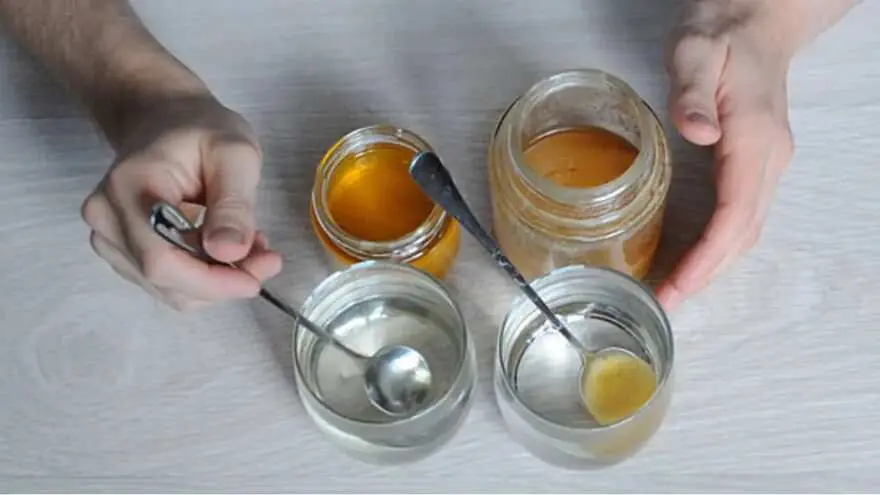
The method usually involves dropping a spoonful of honey into a glass of water without stirring. According to the popular explanation, genuine honey should sink toward the bottom and remain together for a while, whereas fake or diluted honey should spread and dissolve quickly.
There is a physical explanation behind this behavior. Honey is generally denser and more viscous than ordinary drinking water. When it enters the glass, it may sink before gradually mixing with the surrounding liquid.
But the water test has the same limitation as the bubble test: it cannot identify the origin of the sugars.
How to Perform the Water Test
If you want to observe how your honey behaves, follow these simple steps: