Chapter 1: The Strange White Stone That Suddenly Came Out of the Throat
Imagine feeling as though a tiny piece of food has been stuck at the back of your throat for several days. You swallow repeatedly, drink water, and try to clear your throat, but the uncomfortable sensation does not disappear.
Then, one day, a small white or yellowish lump suddenly comes out of your mouth.
It may look like a tiny piece of cheese, a grain of rice, or even a little stone. When examined closely, it may have an unpleasant smell that seems surprisingly strong for something so small.
Many people are shocked when this happens for the first time.
Some assume that a piece of food has become trapped in their throat. Others worry that something unusual is growing inside their mouth.
In many cases, however, the explanation is much less frightening.
The small lump may be a tonsil stone, medically known as a tonsillolith.
Tonsil stones are small, hardened deposits that develop inside the natural pockets and folds of the tonsils. They are generally white or yellowish and can vary considerably in size.
Some are so tiny that a person never notices them. Others become large enough to cause discomfort, bad breath, or the sensation that something is stuck in the throat.
What exactly are the tonsils?
The tonsils are two small masses of soft tissue located at the back of the throat, one on each side.
They are part of the body's immune system and help recognize microorganisms that enter through the mouth and nose.
Their surface is not completely smooth.
Instead, it contains small folds, openings, and pockets known as tonsillar crypts.
These natural spaces allow the tonsils to interact with material entering the mouth, but they can also collect unwanted debris.
Food particles, mucus, dead cells, and bacteria can become trapped inside these pockets.
Over time, the accumulated material may become compacted and harden as minerals, including calcium salts, build up.
The resulting deposit is what doctors call a tonsil stone.
According to Cleveland Clinic, tonsil stones are usually harmless, although they can cause bad breath, throat irritation, coughing, ear discomfort, and difficulty swallowing in some people.
Cleveland Clinic+1
Why does the lump sometimes smell so unpleasant?
One of the most surprising characteristics of tonsil stones is their smell.
A person may brush their teeth regularly, use mouthwash, and maintain good oral hygiene but still experience persistent bad breath.
The reason is that bacteria trapped inside the tonsillar crypts can break down organic material.
During this process, they produce sulfur-containing compounds that have a particularly unpleasant odor.
These compounds are also associated with certain types of bad breath.
When a tonsil stone comes out, the smell may be much stronger than expected.
This can be embarrassing, especially if someone notices the problem while speaking closely with other people.
However, it is important to understand that tonsil stones do not necessarily mean someone has poor personal hygiene.
Some people naturally have deeper tonsillar crypts that collect more debris.
Others develop them more frequently after repeated episodes of tonsillitis.
Why do people feel something stuck in their throat?
A small tonsil stone may sit inside a pocket without causing any noticeable symptoms.
However, when a stone becomes larger or protrudes from the tonsil, it can irritate surrounding tissue.
This may create a persistent foreign-body sensation.
People sometimes describe it as:
-
A tiny object stuck at the back of the throat.
-
A feeling that swallowing does not completely clear the throat.
-
Mild irritation on one side.
-
An unusual sensation when speaking.
-
A small lump that seems to move when swallowing.
The sensation can be frustrating because drinking water or swallowing saliva may not make it disappear.
In some cases, the stone eventually becomes loose and falls out naturally.
Other people notice it while coughing, gargling, or brushing their teeth.
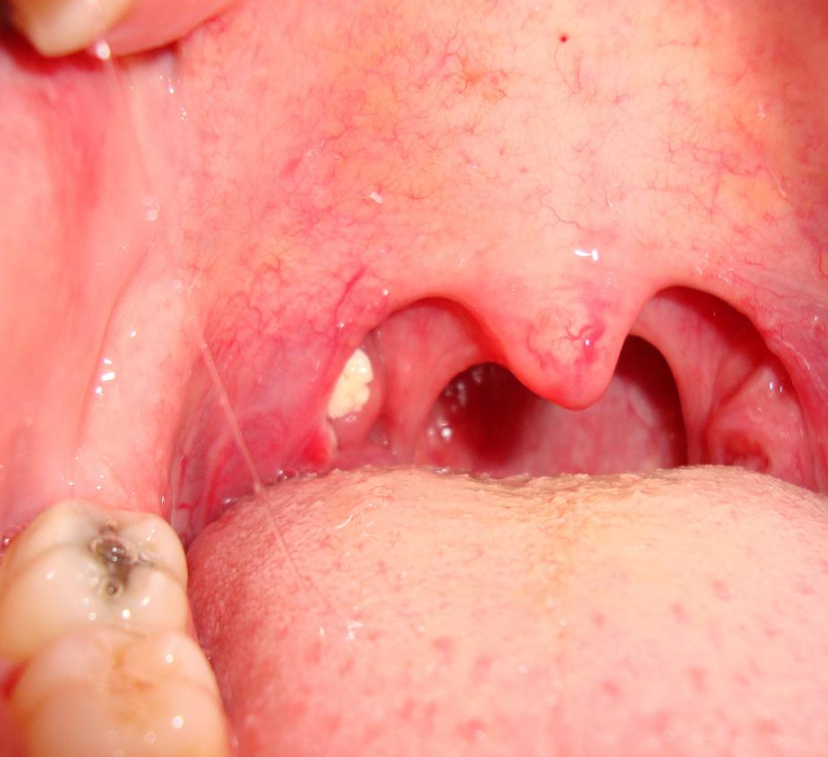
Is a tonsil stone dangerous?
Most tonsil stones are not dangerous.
Small stones frequently disappear without treatment, and many people have them without realizing it.
However, larger or repeatedly occurring stones can cause discomfort and interfere with everyday activities.
A person may experience persistent bad breath, mild throat pain, coughing, or difficulty swallowing.
It is also important not to confuse a tonsil stone with an infection.
A white spot on the tonsil can sometimes be associated with tonsillitis, a bacterial infection, or another throat condition.
If the throat is very painful, the tonsils are swollen, or fever develops, medical evaluation may be necessary.
The appearance of a white lump alone is not enough to establish the diagnosis.
The important lesson is that a tiny white object coming out of the throat is often a tonsil stone rather than a dangerous foreign object.
Understanding why it forms can help people respond calmly and choose appropriate care instead of trying to remove it aggressively.
Chapter 2: Seven Reasons Why Tonsil Stones Develop Inside the Throat
Tonsil stones can develop in people of different ages, and they are more common than many people realize.
Some individuals experience them only once or twice, while others notice small white deposits appearing repeatedly.
The formation of these stones is usually associated with the structure of the tonsils and the accumulation of material inside their natural pockets.
Several factors can make this process more likely.
1. Deep pockets in the tonsils
One of the most important factors is the natural structure of the tonsils.
Some people have relatively smooth tonsils, while others have deeper and more irregular crypts.
These pockets can trap food particles, mucus, dead cells, and bacteria.
When the material remains inside for a prolonged period, it can become compacted and gradually harden.
People with deeper tonsillar crypts may therefore experience recurring tonsil stones even when they brush and floss regularly.