Chapter 1: A Viral Image Raises Questions About a Common Household Water Container
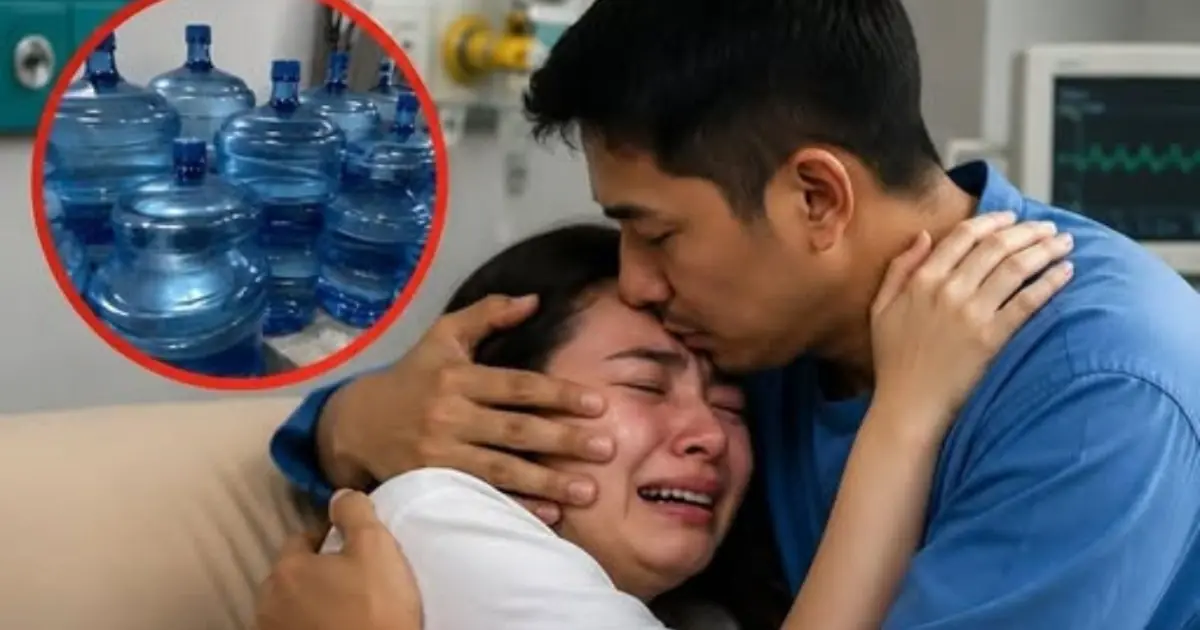
A disturbing image circulating online has captured attention with a dramatic claim: a 29-year-old couple allegedly developed liver cancer, prompting doctors to warn about a common water container still used in many homes.
The image shows an emotional couple embracing in what appears to be a hospital setting. A circular inset displays large blue water containers, suggesting that the household item may be connected to the reported illness.
The headline is designed to make readers stop and think about something they may use every day. Water containers are found in kitchens, offices, restaurants, and family homes. Large refillable bottles are especially common in places where households rely on bottled or delivered drinking water.
But an alarming image is not the same as verified medical evidence.
The photograph does not provide the couple's names, their medical records, the exact type of container involved, or a confirmed explanation of how they developed liver cancer. It also does not identify a specific chemical, contaminant, or exposure that could be independently examined.
For that reason, the claim should be treated cautiously.
There is an important difference between saying that a household water container may require proper cleaning and saying that it caused cancer. The first statement is a practical hygiene concern. The second is a serious medical claim that requires reliable evidence.
Liver cancer is a complex disease. It can develop through several pathways, including chronic viral infections, long-term liver inflammation, cirrhosis, metabolic conditions, and certain environmental exposures.
A diagnosis alone cannot establish what caused the disease.
Even when two people in the same household develop a similar illness, doctors must investigate carefully before identifying a shared cause. They may consider family history, medical conditions, environmental exposures, drinking water quality, and other possible factors.
The viral image does not provide enough information to determine whether the couple's illnesses were connected to one another or to a water container.
That uncertainty does not mean household water safety should be ignored. Clean drinking water and hygienic storage are essential parts of everyday health.
Large refillable water jugs can become contaminated if they are handled improperly, stored in unsuitable conditions, or connected to poorly maintained dispensers. Contamination may involve microorganisms, dirt, or chemicals from an unsafe water source.
However, contamination risks vary widely depending on the water source, container material, manufacturing standards, storage conditions, and cleaning practices.
The most useful response to the viral story is therefore not panic. It is to understand how water containers should be selected, maintained, and used.
Families should also remember that cancer prevention cannot be reduced to avoiding one household object. Liver health depends on many factors, and a person's medical history plays a significant role.
The image may encourage people to examine their drinking water habits, but it should not be shared as proof that a particular container causes liver cancer.
A responsible discussion begins with verified information, practical precautions, and a clear distinction between possible exposure and proven disease.
Chapter 2: What Science Says About Plastic Water Bottles and Cancer
One of the biggest questions raised by the image is whether plastic water containers can release substances that cause cancer.
Plastic is used in many food and beverage containers because it is lightweight, durable, and convenient. Different types of plastic have different chemical compositions and are designed for different purposes.
Some people worry that chemicals from plastic packaging may migrate into drinking water. This concern has led to widespread discussion about substances such as bisphenol A, commonly known as BPA, and tiny plastic particles called microplastics.
Scientific research has examined these questions, but the findings need to be interpreted carefully.
Cancer Research UK explains that there is no reliable evidence from studies of people showing that food and drinks stored in plastic containers cause cancer. Small amounts of certain chemicals may migrate from packaging, but the levels considered in approved food-contact uses are generally regarded as low.
This is an important distinction. The fact that a chemical can be detected does not automatically mean that the exposure is harmful.
Risk depends on several factors, including the chemical involved, the amount absorbed, the duration of exposure, and how the substance affects the body.
A laboratory experiment may identify a potential hazard under particular conditions. However, those findings do not necessarily mean that ordinary use of a household container creates the same risk.
The same principle applies to BPA. The US Food and Drug Administration states that its current assessment supports the safety of approved BPA uses in food containers and packaging.
There are also different types of large water jugs. Some are made from materials such as polycarbonate, while others use different plastics. A container's appearance alone does not reveal its exact composition.
Consumers should follow the manufacturer's instructions and use containers designed for drinking water.
Another topic that has attracted attention is microplastics. These are tiny plastic particles that can enter the environment as larger pieces of plastic break down.
In January 2024, researchers reported detecting large numbers of plastic particles in samples of bottled water using a specialized imaging technique. The findings highlighted how widespread these particles may be, particularly at very small sizes.
However, finding microplastics in water is not the same as proving that they cause liver cancer.
The US FDA says current scientific evidence does not demonstrate that the levels of microplastics and nanoplastics detected in foods and bottled water pose a risk to human health. It also notes that more research is needed to understand potential effects.