Brush twice daily, clean between your teeth, and maintain regular dental checkups.
Notice your sleeping position
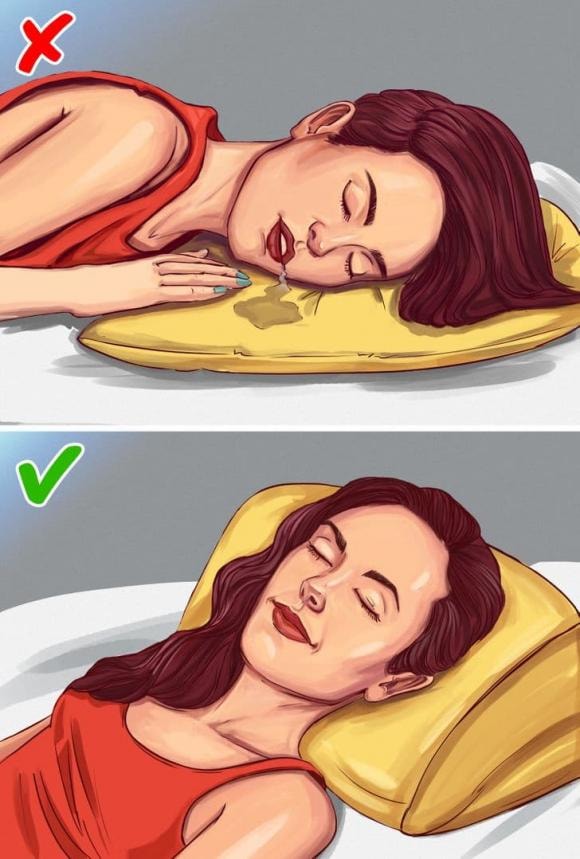
See whether drooling happens mainly when you're on your side or stomach.
Observe your sleep quality
Ask yourself whether you wake refreshed or feel exhausted despite getting enough sleep.
Ask someone you trust
If you share a bedroom, a partner may notice snoring, gasping, mouth breathing, or pauses in breathing that you don't notice yourself.
21. Don't Focus Only on the Pillow
The most important lesson is that the wet pillow is only one piece of information.
Instead of asking:
“Why am I drooling?”
consider asking:
“What else is happening while I sleep?”
Are you snoring?
Do you breathe through your mouth?
Is your nose constantly blocked?
Do you wake with a dry mouth?
Do you have reflux?
Are you exhausted during the day?
Do you ever wake up gasping?
These questions can help distinguish an ordinary sleep habit from a pattern that deserves medical attention.
22. When a Wet Pillow Is Probably Nothing to Worry About
If you've occasionally woken up with drool on your pillow for years and otherwise feel healthy, there's usually little reason to panic.
You may simply:
- Sleep on your side
- Sleep deeply
- Relax your facial muscles
- Open your mouth slightly during sleep
- Swallow less frequently at night
These are normal aspects of sleep.
A wet pillow can be annoying, but it isn't automatically a warning sign.
23. When the Wet Pillow Becomes a Useful Clue
The situation deserves more attention if the pattern changes.
For example, suppose you've never drooled before but suddenly begin doing so almost every night.
At the same time, you start snoring loudly and waking with headaches.
That combination is more meaningful than the drooling alone.
Or perhaps you've developed persistent nasal congestion and now wake with both a dry mouth and a wet pillow.
That points toward a different possible explanation.
Or maybe you notice drooling while awake and difficulty swallowing.
That calls for a different level of attention.
The change and the accompanying symptoms are what matter most.
The Bottom Line
Waking up with a wet pillow can certainly be embarrassing, but in many cases it is simply the result of normal saliva production combined with sleep position, mouth opening, or nighttime breathing habits.
Sleeping on your side or stomach, breathing through your mouth, nasal congestion, allergies, snoring, alcohol, reflux, and certain medications can all potentially contribute.
Occasional drooling by itself is usually not a reason for alarm.
However, persistent or newly excessive drooling deserves more attention when it occurs with loud snoring, gasping, choking, witnessed breathing pauses, significant daytime sleepiness, difficulty swallowing, or sudden neurological symptoms.
And if sudden facial weakness, difficulty speaking, confusion, or one-sided weakness occurs alongside drooling, seek emergency medical attention rather than assuming it is simply a sleep issue.
Ultimately, a wet pillow doesn't tell you exactly what is happening inside your body.
But it can sometimes provide a small clue.
Instead of being embarrassed by it, pay attention to the pattern.
Sometimes the most useful health information is not the symptom itself but what else is happening at the same time.