Chapter 1: A Viral Warning That Leaves More Questions Than Answers
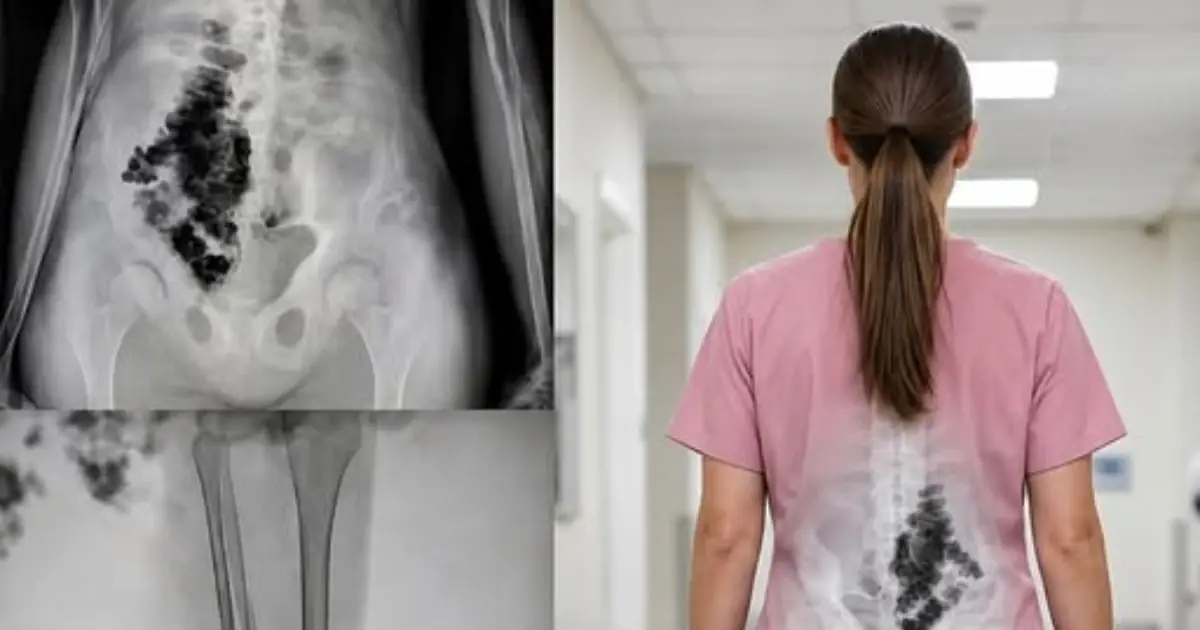
A striking medical image can quickly capture attention, especially when it combines hospital scenes, X-ray images, and a warning about a possible health risk. The image accompanying this story shows a healthcare worker in a pink uniform, medical scans, orthopedic hardware, and a highlighted area around the lower leg and knee.
The accompanying text begins with a warning about people who have received COVID-19 vaccinations. However, the sentence is incomplete, leaving readers without the full claim or any explanation of the circumstances behind it.
That missing information matters.
A medical image may look alarming, but it cannot establish what caused a condition. An X-ray showing a fracture, surgical screws, or another abnormality does not reveal whether the patient received a vaccine, had an underlying illness, experienced an accident, or underwent surgery for an unrelated reason.
The image also appears to combine several different medical visuals. The upper-left scan shows dense areas in the abdomen, while the lower-left image displays orthopedic hardware in a leg. The larger image on the right appears to be a medical illustration showing the spine and lower extremities.
These pictures may be intended to create a dramatic impression, but they do not provide a complete medical record.
To understand a health claim, doctors need more than a photograph. They need information about the patient's medical history, symptoms, examination findings, diagnostic tests, and the timing of any suspected exposure.
The same principle applies to COVID-19 vaccination.
Some people experience temporary reactions after vaccination, while rare serious adverse events have also been identified through safety monitoring. But a health problem that occurs after vaccination is not automatically caused by the vaccine.
The US Centers for Disease Control and Prevention explains that an adverse event is any concerning health problem that occurs after vaccination, whether or not the vaccine caused it. Some events may be related to vaccination, while others may happen by coincidence.
CDC+1
This distinction is essential when interpreting dramatic online warnings.
A person may receive a vaccine and later develop back pain, a fracture, joint discomfort, or another medical condition. The timing deserves attention, especially if symptoms are unusual or severe. However, determining whether the vaccine played a role requires a careful clinical assessment.
It is also important to recognize that bone and joint problems are common for many reasons. Age-related changes, osteoporosis, injuries, arthritis, infections, nutritional deficiencies, and other medical conditions can affect the skeleton.
The image alone cannot distinguish among these possibilities.
Readers should therefore be cautious about posts that use phrases such as “doctors are hiding this” or “everyone who received the vaccine must be worried” without providing reliable evidence.
A responsible health report should identify the condition being discussed, explain how it was diagnosed, describe the evidence linking it to vaccination, and clarify how frequently the event occurs.
Without those details, the warning remains an unverified claim rather than a medical conclusion.
The goal should not be to dismiss people's symptoms. Anyone experiencing persistent pain or unusual changes in health deserves to be taken seriously. The goal is to investigate those symptoms accurately, without allowing an incomplete image or sensational headline to replace medical evidence.
That is the first step toward understanding what the image can—and cannot—tell us.
Chapter 2: What COVID-19 Vaccines Can Actually Cause
COVID-19 vaccines, like other medical products, can cause side effects. Most commonly reported reactions are temporary and relatively mild.
According to the World Health Organization, common reactions include pain, redness, or swelling at the injection site, fatigue, muscle aches, joint pain, and a low-grade fever. Most of these symptoms disappear within a few days.
Tổ Chức Y Tế Thế Giới+1
These reactions are generally part of the body's response to vaccination. They do not mean that a person has developed a serious illness.
Some people may feel tired enough to rest for a day. Others may experience chills, a headache, or soreness in the arm where the injection was given. The intensity of these reactions can vary from person to person.
Not everyone experiences side effects, and the absence of symptoms does not mean that a vaccine has failed to provide protection.
Temporary discomfort versus a serious condition
It is important to distinguish ordinary post-vaccination reactions from symptoms that require medical attention.
A sore arm or mild fatigue that improves over a short period is usually not a reason for alarm. However, symptoms that become severe, persist longer than expected, or interfere significantly with daily activities should be discussed with a healthcare professional.
The CDC identifies several rare but serious adverse events that have been associated with certain COVID-19 vaccines. These include severe allergic reactions, myocarditis, pericarditis, thrombosis with thrombocytopenia syndrome, and Guillain-Barré syndrome. The risks vary according to vaccine type and other factors.
CDC+1
Myocarditis refers to inflammation of the heart muscle, while pericarditis involves inflammation of the tissue surrounding the heart.
These conditions have been reported rarely after COVID-19 vaccination. Cases have occurred most frequently in adolescent and young adult males following certain mRNA vaccine doses, although they have also been reported in other groups.
Symptoms that may indicate heart inflammation include chest pain, shortness of breath, and a sensation of a fast or irregular heartbeat.
Anyone experiencing these symptoms after vaccination should seek prompt medical assessment rather than assuming that the discomfort is harmless.
Severe allergic reactions are another rare concern. Warning signs can include difficulty breathing, swelling of the face or throat, widespread hives, dizziness, or a sudden drop in blood pressure.
A person experiencing difficulty breathing or swelling of the throat needs emergency medical care.
Why accurate information matters
The existence of rare adverse events does not mean that every unusual symptom after vaccination is vaccine-related.
Safety monitoring involves examining patterns across many people, comparing rates of particular conditions, and investigating whether events occur more frequently than expected.
This process helps researchers distinguish a genuine safety signal from events that happen naturally in the population.
For example, older adults may experience fractures, joint pain, or cardiovascular conditions even without vaccination. If these events occur after vaccination, researchers must determine whether the observed frequency differs from the expected background rate.
That is why medical conclusions should be based on carefully collected evidence rather than individual stories alone.
A person's experience can be an important starting point for investigation. It is not, by itself, enough to establish a general causal relationship.
The most useful approach is to acknowledge symptoms, investigate them properly, and communicate the results clearly.
Chapter 3: The Medical Conditions Behind the X-Ray Images
The images accompanying the viral warning show several different medical features, including orthopedic hardware, abnormal-looking areas on an X-ray, and a highlighted knee region.
Understanding what these images represent can help readers avoid drawing conclusions that the pictures cannot support.
What orthopedic hardware means
The lower-left image appears to show metal components used in orthopedic treatment.
Plates, screws, rods, and other fixation devices are commonly used to stabilize broken bones or support healing after certain injuries and operations.
These devices help keep bones in an appropriate position while the body repairs damaged tissue.
The presence of metal hardware does not automatically indicate a complication. In many cases, it is evidence of a previous medical procedure intended to restore function.
Some patients retain orthopedic implants for years. Others may eventually undergo another operation if the device causes discomfort, becomes damaged, or is no longer needed.
An X-ray can help doctors assess the position of the hardware, the alignment of the bone, and the progress of healing.
However, the image does not explain why the original injury occurred.
A fracture may result from a fall, a sports injury, a vehicle accident, a weakened bone, or another cause. In some cases, a fracture occurs after relatively minor trauma because the bone has become fragile.
The patient's history is therefore essential.
Understanding bone and joint pain
Pain around the knee or lower leg can arise from many different conditions.
Osteoarthritis may cause stiffness and discomfort, especially after periods of activity or prolonged sitting. Tendon injuries can produce pain during movement. Ligament damage may cause swelling or instability.
A fracture can cause sudden pain, tenderness, and difficulty bearing weight.
Other conditions, including infections or inflammatory diseases, may produce persistent pain and swelling.
The location of pain alone does not identify the cause. A doctor may need to perform a physical examination and order imaging or laboratory tests.
What an X-ray can reveal
X-rays are useful for evaluating bone structure, fractures, alignment, and certain abnormalities.
They can also show the position of surgical implants.