We Returned From Vacation and Discovered an Unexpected Surprise in Our Bathroom
The first thing we noticed was the strange shape on the bathroom wall. After a week away from home, we expected dust, stale air, and perhaps a few forgotten towels. Instead, something unusual had appeared in the corner, attached firmly to the wall above the tiled floor.
At first glance, it looked like a small, crumpled piece of fabric. Its surface was covered in layers of brown material, and its shape seemed almost too carefully arranged to be a random object. But when we moved closer, we realized that whatever it was, it had not been there when we left.
The discovery quickly turned an ordinary return home into a mystery. Was it something left behind by a previous visitor? Had an insect created it? And more importantly, could something living still be inside?
The answer was far more fascinating than we initially imagined. What appeared to be an oddly shaped household object may have been a remarkable example of how nature can quietly transform an ordinary space while its occupants are away.
The story also carries an important lesson: when an unfamiliar structure appears inside a home, curiosity should never come before safety.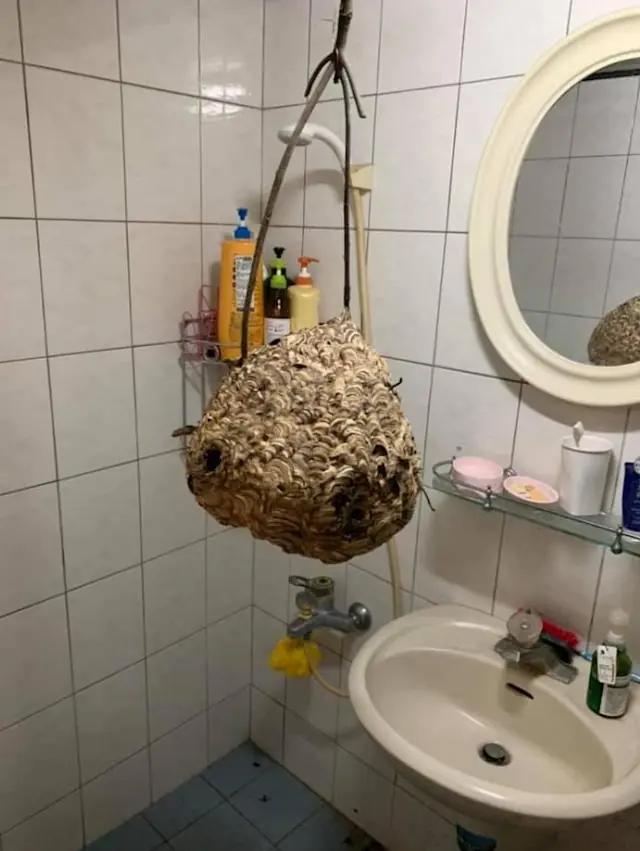
The Mystery Behind the Strange Object
When we first saw the object, its unusual appearance made it difficult to identify. It seemed to have a rough, layered surface, almost like a piece of dried material that had been folded over itself repeatedly. The color was a mixture of brown, tan, and gray, with darker areas near the bottom.
The shape was especially puzzling. It was not perfectly round, nor was it flat like a sheet of paper. Instead, it appeared to have several irregular layers, each forming a slightly different contour. From a distance, it could easily have been mistaken for an old cleaning sponge, a discarded piece of insulation, or a bundle of material that had somehow become attached to the wall.
But there was something about its construction that made us hesitate.
The surface did not look like ordinary dust or dirt. It seemed to have a deliberate pattern, with repeated folds and overlapping sections. The more we examined it from a safe distance, the more it resembled a structure built by insects rather than something manufactured by people.
That possibility changed the way we looked at the entire discovery.
A bathroom is not usually considered a place where insects can establish a large nest. It is regularly cleaned, often exposed to moisture, and frequently used by people. Yet bathrooms also contain hidden spaces, ventilation openings, gaps around pipes, and small areas where insects can enter without being noticed.
If an insect had found a protected corner inside the room, it might have been able to begin building long before anyone realized what was happening.
The apparent mystery was no longer simply about an object appearing while we were away. It became a question about how something living could have entered our home, found a suitable location, and remained undisturbed for days or even weeks.
The image accompanying the story resembles a papery insect nest, possibly belonging to a wasp or hornet. However, the photograph alone cannot establish the species, whether the nest was active, or precisely how it came to be inside the bathroom. The account should therefore be understood as a narrative built around the supplied image rather than a verified report of a specific household incident.
Even so, the situation illustrates a real and surprisingly common possibility: insects sometimes build nests in places that people rarely inspect.
And the process can begin with something so small that it is almost impossible to notice.
How a Nest Can Appear While a House Is Empty
When a family leaves home for a vacation, the house does not become completely sealed from the outside world. Even modern buildings contain small openings that allow air to circulate, water to drain, and pipes or cables to pass through walls.
Some of these openings are necessary for the building to function. Others develop gradually as materials age, weather changes, or small gaps form around windows and doors.
For insects, these openings can provide access to sheltered spaces.
A wasp searching for a suitable nesting location may investigate the underside of a roof, a gap near a window, a ventilation opening, or a protected corner of a building. If the location offers enough shelter from wind and rain, it may become a suitable place to begin constructing a nest.
The first structure is often very small. Depending on the species, it may consist of only a few cells or a small cluster of paper-like material.
At this early stage, a nest can be easy to overlook. It may resemble a tiny patch of dried mud, a small piece of debris, or an irregular mark on a wall.
As the colony develops, workers may add new layers and expand the structure. The nest gradually becomes more noticeable, although it can remain hidden behind furniture, inside a wall cavity, or in an area that receives little attention.
A house that is empty for seven days may provide exactly the kind of uninterrupted environment that allows an insect colony to develop without disturbance.
The absence of people does not necessarily mean that insects will build a large nest in a single week. The development of a colony depends on the species, the season, the availability of food, the temperature, and whether a queen has already established herself.
Some nests begin during spring and grow throughout the warmer months. Others remain small for a considerable period before expanding.
The important point is that the structure may have started long before the family noticed it.
A nest that appears suddenly after a vacation may actually be the result of many small stages of construction.
Why Bathrooms Can Become Unexpected Nesting Places
Bathrooms are not the most obvious locations for wasps or hornets, but certain features can make them attractive.
The room may contain gaps around plumbing, openings near ventilation fans, spaces beneath window frames, or small cavities behind wall panels. These areas can provide shelter from direct sunlight, heavy rain, and strong winds.
In some homes, bathrooms also connect to roof spaces, service shafts, or other parts of the building through openings that are difficult to see from inside the room.
An insect entering through one of these routes may find a quiet place to settle.
The tiled walls and floors do not necessarily prevent nesting. A nest may be attached to a nearby wooden surface, a concealed support, a ceiling edge, or another material that provides a suitable anchor.
Some wasps build exposed nests with visible cells. Others construct enclosed, paper-like structures that resemble a rounded shell.