The cells provide a place for eggs and developing larvae. Adult workers may move between the outer covering and the internal chambers, carrying food or maintaining the nest.
Some species build open combs that can be seen from below. Others create enclosed nests with a more rounded or pear-shaped exterior.
The differences are important because not every papery structure belongs to the same kind of insect.
A small open comb under a roof edge may be associated with paper wasps. A larger enclosed structure may be associated with certain hornets or other social wasps.
The nest in the photograph appears to have a rough exterior rather than a clearly visible open comb. That feature may suggest an enclosed structure, but the image is not sufficiently detailed to establish a precise identification.
The size is also difficult to judge because the photograph does not provide a clear scale.
A structure that looks large in a close-up may be relatively small when compared with a hand or household object. Conversely, a nest partly hidden by a wall or corner may be much larger than it first appears.
For these reasons, a careful identification would require more than a single photograph.
A professional might examine the entrance, the material, the location, the presence of insects, and the overall shape from a safe distance.
The Hidden Life Inside a Wasp Colony
A social wasp colony is organized around a reproductive queen and a group of workers.
In many species, a queen begins the colony by selecting a nesting site and constructing the first cells. She lays eggs and cares for the earliest developing young.
When the first workers emerge, they gradually take over many of the tasks involved in maintaining the nest.
Workers may collect food, gather building materials, care for larvae, defend the colony, and expand the structure.
The queen can then focus primarily on laying eggs.
As the colony grows, the nest becomes more active. Workers travel between the nest and the surrounding environment, bringing back insects, plant materials, or other resources depending on the species.
The colony may become increasingly defensive if people approach the nest or interfere with its structure.
This behavior is one reason a nest inside a bathroom or other occupied room can become a concern.
Even if the nest initially appears inactive, the presence of a colony cannot be ruled out simply because no insects are visible at a particular moment.
Some workers may be outside searching for food. Others may remain inside the nest.
A person who touches or moves the structure could disturb the insects and provoke defensive behavior.
The safest response is therefore to avoid direct contact until the object has been identified.
Could the Nest Have Been Built in Just Seven Days?
The question of timing is one of the most interesting aspects of the story.
A family leaves home for a week and returns to find a structure that appears to have developed during their absence. It is natural to wonder whether an insect colony could build something so noticeable in such a short period.
The answer depends on several factors.
A nest that already existed before the vacation might have continued growing while the house was empty.
A queen that had established herself earlier might have been in the process of expanding the first structure.
A small nest could also have been present in a hidden location and become visible only after a piece of material fell away or a household object was moved.
The apparent speed of development may therefore be misleading.
Different wasp species have different nesting habits and growth rates. Some colonies remain small during the early stages of the season. Others can expand considerably when conditions are favorable and sufficient workers are available.
Temperature, food availability, and the stage of the colony all influence development.
It would be inaccurate to claim that every wasp nest can grow to a large size in seven days. It would also be inaccurate to assume that a structure discovered after a week must have been built entirely during that week.
Without information about the species, the initial condition of the location, and the actual dimensions of the nest, the timeline cannot be established.
The more reasonable explanation is that the family noticed the structure after returning, while its precise age remained unknown.
This distinction matters because sensational stories often present the discovery as though nature had performed an impossible transformation overnight.
In reality, many surprising discoveries are the result of gradual processes that remain unseen until the final moment.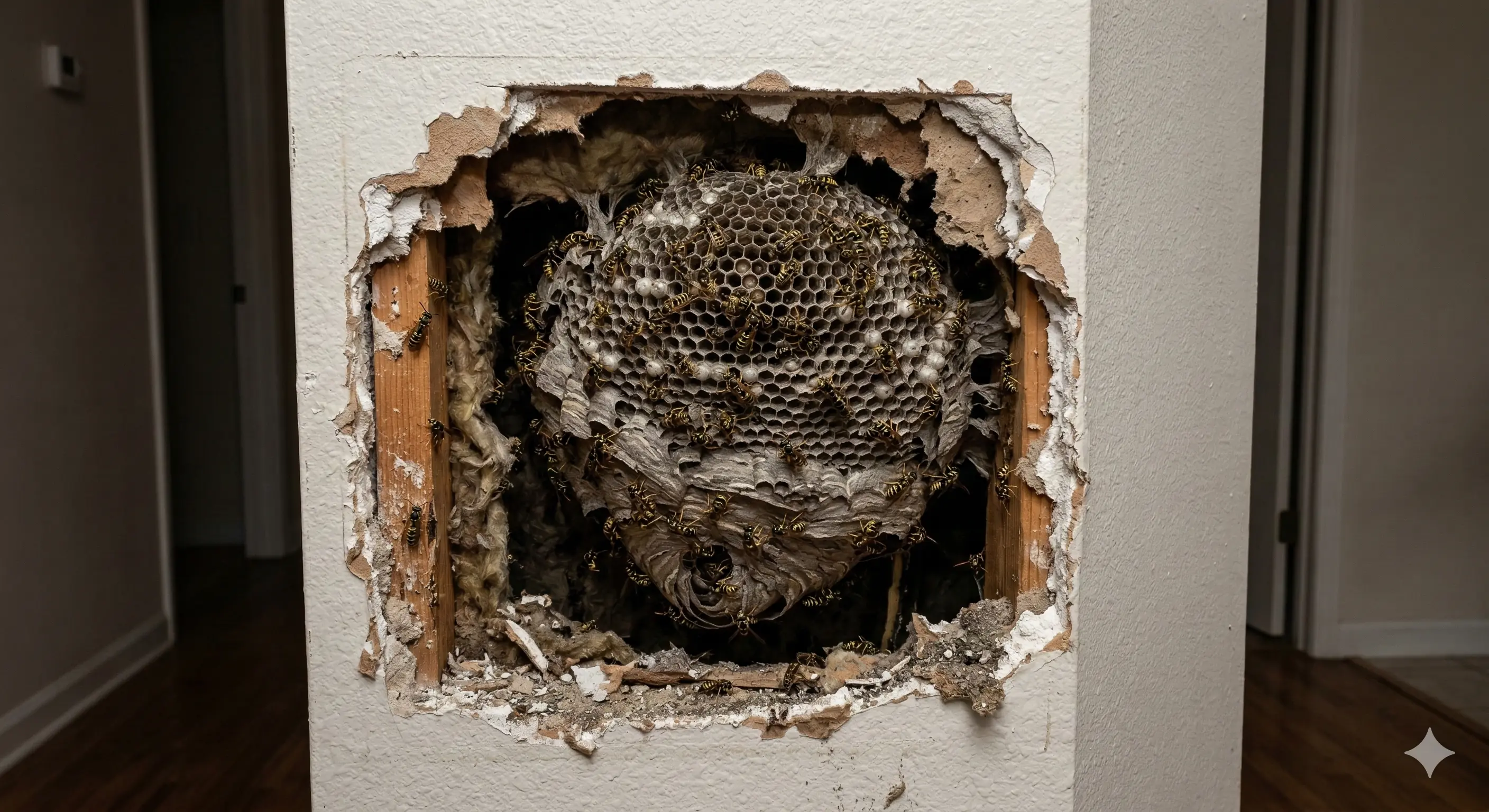
The First Reaction: Curiosity, Surprise, and Caution
The first reaction to an unfamiliar object in a bathroom might be curiosity.
Someone may approach it to determine whether it is made of paper, cloth, foam, dried mud, or another material.
Another person may take a photograph and send it to a family member, hoping that someone will recognize it.
These reactions are understandable. People naturally want to identify unusual things in their homes.
However, when an object may be an insect nest, the investigation should stop before physical contact.
A nest can contain insects that defend themselves when disturbed. Even a small colony may be capable of causing painful stings.
The risk is not limited to the person who touches the nest. Other household members, children, visitors, and pets may also be exposed if the insects become active.
The safest first step is to keep a reasonable distance.
If the object is located in a bathroom, the room can be temporarily closed off so that people do not accidentally approach it.
Pets should be kept away from the area.
There is no need to hit the nest, pull it from the wall, spray it with a household product, or attempt to inspect the inside.
The goal should be to identify the object without making the situation more dangerous.
A clear photograph taken from a safe distance may help a pest-control professional determine what kind of structure is present.
If the object is confirmed to be a nest, the professional can decide whether removal is necessary and what method is appropriate.
Why Removing a Nest Yourself Can Be Dangerous
A nest may look fragile, but its appearance does not reveal how many insects are inside.
Some colonies contain only a few individuals. Others may contain many workers and developing young.
The outer shell can also hide the insects from view.
A person attempting to remove the structure may accidentally damage the nest, causing the colony to react defensively.
Using a broom, stick, vacuum cleaner, or household spray can create additional risks.
The insects may escape into the room, making it difficult to control their movement.
A person may also be stung while trying to leave the area.