Have you recently noticed a small lump on your hand or wrist that wasn't there before? Perhaps it appeared gradually, feels firm beneath the skin, or becomes more noticeable when you bend your wrist or move your fingers. You might have assumed it was nothing serious, especially if it doesn't hurt. But when an unexpected bump appears on your body, it is natural to wonder what caused it and whether it needs medical attention.
The good news is that many lumps on the hand are caused by noncancerous conditions. Some develop when fluid collects near a joint, while others arise from changes in tendons, connective tissue, skin, or bone. Certain lumps may remain unchanged for years, whereas others can grow, become painful, or interfere with everyday activities.
However, the appearance of a lump alone cannot reliably identify its cause. Its location, size, texture, rate of growth, and associated symptoms all provide important clues. Understanding these differences can help you recognize when monitoring may be reasonable and when a medical examination is necessary.
In this article, we will explore the most common causes of lumps on the hands and wrists, the symptoms that deserve attention, how doctors evaluate these growths, and the treatment options that may be available.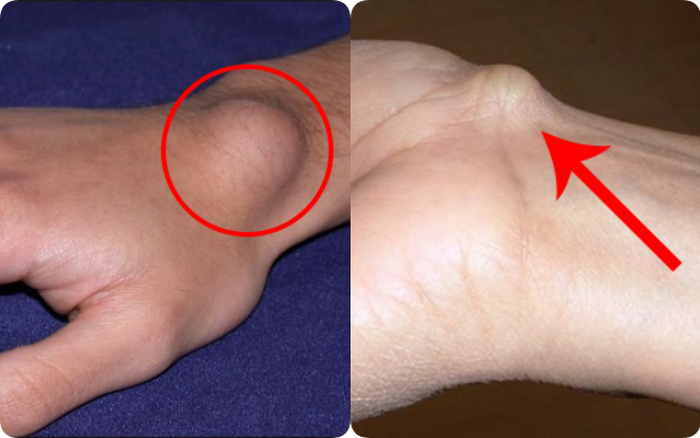
CHAPTER 1: The Most Common Reason for a Lump on the Wrist
One of the first conditions doctors consider when someone develops a rounded lump near the wrist is a ganglion cyst.
Ganglion cysts are common, noncancerous lumps that usually develop near joints or tendons. They contain a thick, jelly-like fluid similar to the fluid that lubricates joints. Although their exact cause is not always clear, they are associated with structures surrounding joints and tendons.
These cysts frequently appear on the back of the wrist, but they can also develop on the palm side of the wrist, near the base of a finger, or elsewhere around the hand.
What does a ganglion cyst look and feel like?
A ganglion cyst often appears as a smooth, rounded bump beneath the skin. Its size can vary considerably. Some are barely noticeable, while others become large enough to attract attention immediately.
The lump may feel firm or rubbery. Despite its firm texture, it is not a solid bone growth. It contains fluid enclosed within a capsule.
One characteristic feature is that its size can change. A ganglion cyst may become more prominent after repetitive hand activity and appear smaller after periods of rest. Some cysts remain stable, while others disappear temporarily and later return.
Pain is not always present. Many people have ganglion cysts without experiencing any discomfort. Others notice aching, tenderness, or restricted movement, particularly when the cyst presses on nearby nerves or interferes with a joint.
For example, a person who spends hours typing may notice a bump on the back of the wrist. Initially, it may not hurt at all. Several weeks later, the person might begin experiencing discomfort when performing push-ups, lifting heavy objects, or bending the wrist backward.
The cyst may be contributing to the discomfort, but other wrist conditions can cause similar symptoms. A medical examination can help distinguish between them.
Why do ganglion cysts develop?
The precise cause is not always identifiable. They may be associated with irritation, repetitive joint movement, or changes in the tissues surrounding a joint or tendon.
They can occur in people of different ages, including those who do not perform strenuous physical activities. Having a ganglion cyst does not necessarily mean that a person has damaged their hand or used it incorrectly.
Although some cysts appear after an injury, many develop without a clear triggering event.
Are ganglion cysts dangerous?
Most ganglion cysts are benign and do not become cancerous. If a cyst is painless and does not interfere with movement, a clinician may recommend observation rather than immediate treatment.
However, a lump that looks like a ganglion cyst should not automatically be assumed to be one. Other conditions can produce similar bumps, and an examination is particularly important if the lump is new, growing, unusually hard, painful, or associated with changes in sensation.
A ganglion cyst near a nerve may cause tingling, numbness, or weakness. A cyst in an awkward location can also make certain movements uncomfortable.
Treatment depends on the symptoms and the effect on daily activities. Some cysts disappear on their own. Others may be drained with a needle by a healthcare professional or removed surgically when symptoms warrant it.
Draining a cyst does not always provide a permanent solution because the connection to the joint or tendon may remain. As a result, the cyst can return.
Important: Never attempt to burst, crush, or puncture a lump on your hand at home. Doing so can damage nearby structures, cause infection, and delay the correct diagnosis.
CHAPTER 2: Other Possible Causes of a Lump on Your Hand
Although ganglion cysts are common, they are not the only explanation for a lump on the hand or wrist. The location and physical characteristics of the bump may help a healthcare professional determine which possibilities deserve consideration.
1. Giant cell tumor of the tendon sheath
Despite its intimidating name, a giant cell tumor of the tendon sheath is usually a noncancerous growth associated with the tissues surrounding a tendon.
It commonly develops in the fingers or hand and may appear as a firm, slowly growing lump. Unlike a ganglion cyst, which contains fluid, this type of growth consists of solid tissue.
These lumps may remain relatively small for a long time. Some are painless, while others cause discomfort or interfere with finger movement, depending on their location.