A person might notice a firm bump near a finger joint that gradually becomes more prominent over several months. Because it can resemble other benign growths, a physical examination alone may not always establish the diagnosis.
Depending on the circumstances, a clinician may recommend imaging or removal of the growth for examination under a microscope.
Although this condition is generally benign, persistent or enlarging lumps should be assessed rather than ignored.
2. Lipoma: A lump made of fatty tissue
A lipoma is a benign growth composed of fat cells. It can develop beneath the skin in many parts of the body, including the hand, although the hand is not among the most common locations.
Lipomas typically feel soft or rubbery and may move slightly when gently pressed. They usually grow slowly and are often painless.
A small lipoma might be discovered accidentally while washing, applying lotion, or noticing a difference between the two hands.
Most lipomas do not require treatment if the diagnosis is clear and they cause no problems. If a lump becomes uncomfortable, interferes with movement, grows, or has uncertain characteristics, a clinician may recommend further evaluation or removal.
Not every soft lump is a lipoma, however. Its texture alone is not enough to confirm the diagnosis.
3. Arthritis-related lumps
Arthritis can sometimes cause visible bumps around the joints of the fingers.
In osteoarthritis, cartilage gradually changes over time, and the body may develop bony enlargements around affected joints. These can make the fingers appear thicker or more knobby than before.
Two commonly recognized examples are Heberden's nodes, which form near the fingertips, and Bouchard's nodes, which develop around the middle finger joints.
These enlargements are usually hard because they involve changes in the joint and surrounding bone. They may occur alongside stiffness, aching, tenderness, or reduced flexibility.
Symptoms can be more noticeable after periods of inactivity or following repetitive hand use.
Arthritis-related changes generally develop gradually rather than appearing as a sudden, isolated soft lump. Nevertheless, a new bump near a joint can have several causes, so an assessment may be appropriate if its origin is uncertain.
Other forms of arthritis, including inflammatory arthritis, can also produce swelling around the joints.
If several joints become swollen, warm, painful, or stiff—especially if symptoms affect both hands—it is worth discussing the pattern with a healthcare professional.
4. A cyst near a finger joint
Ganglion cysts do not occur only on the wrist. Small cysts can develop near the base of a finger or close to a fingertip joint.
A digital mucous cyst is a particular type of cyst that commonly develops near the last joint of a finger, often in association with osteoarthritis.
It may appear as a small, smooth bump near the nail. Sometimes it causes a groove or other change in the nail as it grows close to the nail-forming tissue.
These cysts are often painless, but they can become irritated or interfere with normal finger movement.
Because the skin over a mucous cyst can become thin, it may occasionally break down and leak fluid. If the skin opens, becomes red, or begins draining, medical evaluation is important because infection can develop.
Do not squeeze or puncture a cyst near a fingertip. The area is delicate, and an infection near a joint can have serious consequences.
5. Trigger finger and tendon-related swelling
Trigger finger is a condition in which a finger becomes difficult to bend or straighten smoothly. It can produce tenderness, a small nodule, or a sensation of thickening near the base of the affected finger, usually on the palm side.
The problem involves the tendon and the tunnel through which it moves. When the tendon or surrounding tissue becomes irritated or thickened, the finger may catch or lock during movement.
Some people notice clicking when they bend the finger. Others experience stiffness in the morning or need to use their other hand to straighten the affected finger.
The lump, when present, may be more noticeable when the finger is bent.
Trigger finger is not the same as a ganglion cyst, even though both conditions can produce a bump near a tendon. Treatment may include activity modification, splinting, medication recommended by a clinician, corticosteroid injection, or a procedure in persistent cases.
Anyone experiencing repeated locking, significant pain, or loss of finger movement should seek medical advice.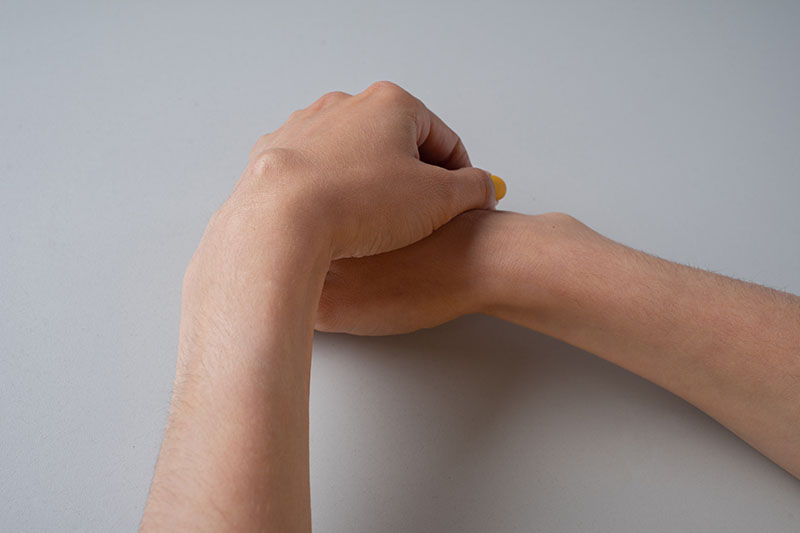
6. Dupuytren's disease
Dupuytren's disease affects the connective tissue beneath the skin of the palm. It can begin with a small, firm nodule that gradually becomes more noticeable.
Over time, the tissue may thicken and form cords beneath the skin. These cords can pull one or more fingers toward the palm, making it difficult to straighten them completely.
The ring finger and little finger are frequently affected.
Early in the condition, a person may notice a firm lump in the palm without much pain. The most significant change may occur gradually, as the finger begins to bend and cannot be fully extended.
Dupuytren's disease is not caused simply by holding tools or performing manual work, although people sometimes associate its appearance with their occupation.
Not everyone with a small palm nodule develops substantial finger contracture. Monitoring may be appropriate in mild cases, while more advanced disease may benefit from specialist treatment.
If a lump in the palm is accompanied by progressive tightening or difficulty placing the hand flat on a table, an appointment with a healthcare professional is advisable.
7. Skin cysts and other superficial growths
Some lumps arise in the skin itself rather than from a joint, tendon, or bone.
For example, an epidermoid cyst can form when skin cells become trapped beneath the surface. It may appear as a rounded bump and sometimes has a tiny central opening.