Do You Sleep Like This? Your Position May Reveal Something About You
Your favorite sleeping position may reveal more about your comfort, habits and physical needs than your personality. Discover what eight common sleep positions really mean—and what sleep experts say about the claims behind them.
Think about the moment you finally get into bed at night. Do you lie flat on your back with your arms beside you? Curl into a tight ball with your knees drawn toward your chest? Stretch out across the mattress as though you need every inch of space? Or wrap both arms around a pillow and settle into a position that feels almost impossible to change?
Most people have a preferred way of sleeping, even if they do not consciously choose it. Some return to the same position every night, while others move repeatedly without remembering any of it the next morning. It can become such a familiar habit that the body seems to know exactly where it belongs as soon as the head touches the pillow.
That familiarity has helped create a popular belief: the way you sleep reveals what kind of person you are. Online illustrations often attach personality labels to different positions, describing back sleepers as confident, curled-up sleepers as sensitive, and people who spread their arms and legs across the mattress as carefree or independent. One viral illustration even claims that sleeping positions determine how lazy someone is.
It is an entertaining idea, but there is an important distinction between personality folklore and scientific evidence. There is no reliable scientific test that can determine whether someone is lazy, confident, shy, sensitive or outgoing simply by looking at their sleeping position. Sleep posture is influenced by comfort, body structure, pain, breathing, temperature, mattress support, pregnancy, medical conditions and personal habits.
That does not make sleeping positions uninteresting. Quite the opposite. The way you settle into bed can offer clues about what feels comfortable, whether certain parts of your body need support and whether your sleep habits may be affecting your rest.
The eight illustrated positions provide a useful starting point. Some resemble familiar ways of sleeping on the back, side or stomach. Others show variations involving the arms, knees and pillows. Each can be explored from two perspectives: the popular personality interpretation and the more practical explanation of what the position may mean for sleep comfort and physical health.
Before deciding what your favorite position says about you, it helps to understand why the body chooses one position over another—and why the position you begin the night in may not be the one you wake up in.
Why Do People Have a Favorite Sleeping Position?
Sleep may look like a passive activity, but the body continues to make adjustments throughout the night. Muscles relax, breathing patterns change, and the brain moves through different stages of sleep. People also shift their weight, bend their knees, turn their heads and adjust their arms in response to pressure and discomfort.
A preferred sleeping position is therefore not necessarily a deliberate personality choice. It is often the position that feels most comfortable under a particular set of circumstances.
Comfort and habit work together
Many people develop sleep habits over years. Someone who has slept on their side since childhood may naturally return to that position because it feels familiar. Another person may prefer lying on their back because they dislike pressure on their shoulders or hips.
Habit can influence comfort, and comfort can reinforce habit.
This does not mean that a person cannot change positions. It simply explains why some people feel awkward when trying to fall asleep in an unfamiliar posture.
The mattress, pillow and bedding also influence the position a person prefers. A mattress that is too firm may create uncomfortable pressure around the hips and shoulders for a side sleeper. A pillow that is too high may push the neck into an uncomfortable angle. Someone who sleeps in a warm room may stretch out to reduce contact between parts of the body.
Small environmental differences can change how a person settles into bed.
The body responds to discomfort
Pain is another major influence.
People with shoulder discomfort may avoid sleeping on the affected side. Someone with lower-back pain may bend the knees or place a pillow beneath them. People with hip discomfort may change the angle of their legs to reduce pressure.
These adjustments are not signs of laziness or weakness. They are often attempts to find a position that feels less uncomfortable.
However, a position that provides temporary relief is not necessarily ideal for every person throughout the night. Persistent pain, numbness or tingling should not be ignored simply because changing position seems to help.
Breathing can influence sleep posture
Breathing patterns can also affect the position people choose.
Some people find that breathing feels easier when their upper body is slightly elevated. Others notice that sleeping flat on their back makes snoring more noticeable.
For people with obstructive sleep apnea, sleeping on the back can worsen breathing interruptions in some cases. This happens because gravity can encourage the tongue and soft tissues in the throat to move backward, narrowing the airway.
Side sleeping may reduce breathing disturbances for some people with position-dependent sleep apnea, although it is not a replacement for medical assessment or prescribed treatment.
Temperature matters more than many people realize
The body regulates its temperature during sleep. Room temperature, bedding, clothing and personal comfort all influence how someone positions their arms and legs.
A person who feels hot may stretch out, move away from heavy blankets or avoid curling into a tight position. Someone who feels cold may draw the knees toward the body and keep the arms close to the chest.
This means that an apparently distinctive sleeping posture may reflect the temperature of the bedroom rather than a deep personality characteristic.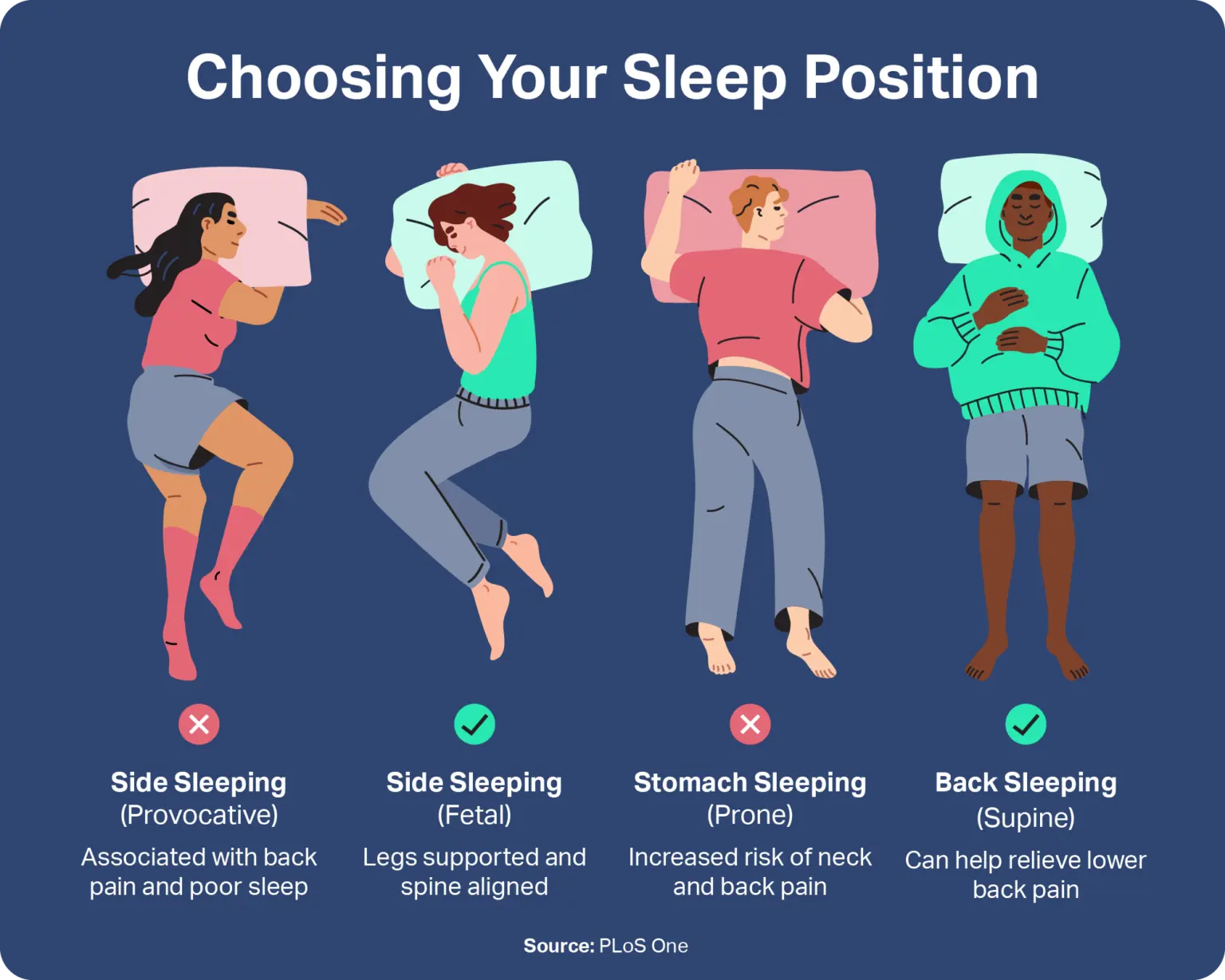
What the Eight Sleeping Positions in the Illustration May Mean
The illustration presents eight different ways a person might arrange their body in bed. It is tempting to assign each position a personality label, but those labels should be treated as entertainment rather than established psychological facts.
A more useful approach is to examine the posture itself: where the arms are placed, how the legs are arranged, whether the body is stretched out or curled, and what kind of support the position may require.
Position 1: Sleeping on the Back With the Arms Raised
In the first illustration, the person lies on their back with the arms raised beside the head. The legs are relatively straight, and the body appears relaxed.
This resembles a back-sleeping position sometimes informally called the starfish posture, particularly when the arms and legs are spread farther apart.
The popular personality interpretation: Online descriptions sometimes associate this posture with openness, confidence or a relaxed attitude. Others suggest that people who sleep this way are comfortable taking up space.
These descriptions may be fun to read, but there is no strong scientific evidence that raised arms during sleep reveal a person's personality.
The practical explanation: Raising the arms may simply feel comfortable. Some people naturally rest their hands near their head, especially when the shoulders and upper back feel relaxed.
However, keeping the arms overhead for a prolonged period may not suit everyone. Depending on shoulder mobility, joint health and sleeping support, this position may contribute to discomfort, numbness or tingling.
A person who regularly wakes with shoulder pain or arm numbness may benefit from adjusting the position or seeking professional advice.
What to consider: If this is your favorite position, check whether your shoulders feel relaxed rather than pulled upward. Your pillow should support your head without forcing your neck into an awkward angle.
If your arms frequently become numb, do not assume that the sensation is simply part of your sleeping personality. Persistent or recurring symptoms deserve assessment.
Position 2: Sleeping Straight on the Back With Arms Beside the Body
The second illustration shows a person lying on the back with the arms resting close to the sides and the legs extended.
This is one of the simplest-looking sleeping postures.
The popular personality interpretation: Some online descriptions call this the soldier position and associate it with discipline, order or a preference for structure. The idea is that a person who lies straight and keeps the arms close to the body may be naturally organized.
Again, these claims are not reliable psychological conclusions. A straight posture does not demonstrate that someone is disciplined, serious or controlling.
The practical explanation: Back sleeping allows the body to rest with the weight distributed across a relatively broad surface. For some people, this feels comfortable because there is less direct pressure on the shoulders and hips than when lying on the side.
The position may also make it easier to keep the spine in a relatively neutral alignment, provided the mattress and pillow offer appropriate support.
But back sleeping is not ideal for everyone. It can worsen snoring and obstructive sleep apnea in some people. It may also be uncomfortable for people with certain types of lower-back pain.
What to consider: If you sleep on your back, pay attention to the natural curve of your lower back. A small pillow beneath the knees may help some people feel more comfortable by reducing tension around the lower back.