The Little Girl Who Asked a Texas Rancher for Milk at Dawn — What He Found Inside an Abandoned Shed Changed Two Young Lives Forever
At 5:30 a.m., a frightened seven-year-old appeared at a rancher's barn holding an empty baby bottle. She said she had no money for milk. But when he followed her through the rain, he discovered a baby hidden in an abandoned shed—and a heartbreaking secret that would soon bring the authorities to his ranch.
The first thing I noticed was the bottle.
It was small, made of cloudy plastic, and completely empty. The little girl holding it stood beneath the edge of my barn roof, trying to stay out of the rain. Her sandals were too large for her feet, her clothes were damp, and her dark hair had come loose from its braid.
She looked no older than seven.
I had been awake since before sunrise, as I usually was. At sixty-three years of working the same Texas ranch, I had learned to recognize the ordinary sounds of morning: cattle shifting in their stalls, wind brushing against the metal fencing, and the occasional call of a bird from the trees near the creek.
But that morning, there was something different.
A child was standing alone outside my barn.
When I approached, she lowered her eyes and tightened her fingers around the empty bottle.
“I'm sorry, sir,” she whispered. “I don't have money for milk.”
For a moment, I could not find the right words.
“You don't need money,” I told her. “We can get you some milk.”
She did not smile. She did not even seem relieved.
Instead, she looked past me toward the kitchen and asked a question that made my stomach tighten.
“Can you make it warm? My baby brother doesn't like it cold.”
I looked at the bottle again.
“Where is your brother?”
She hesitated.
“Close.”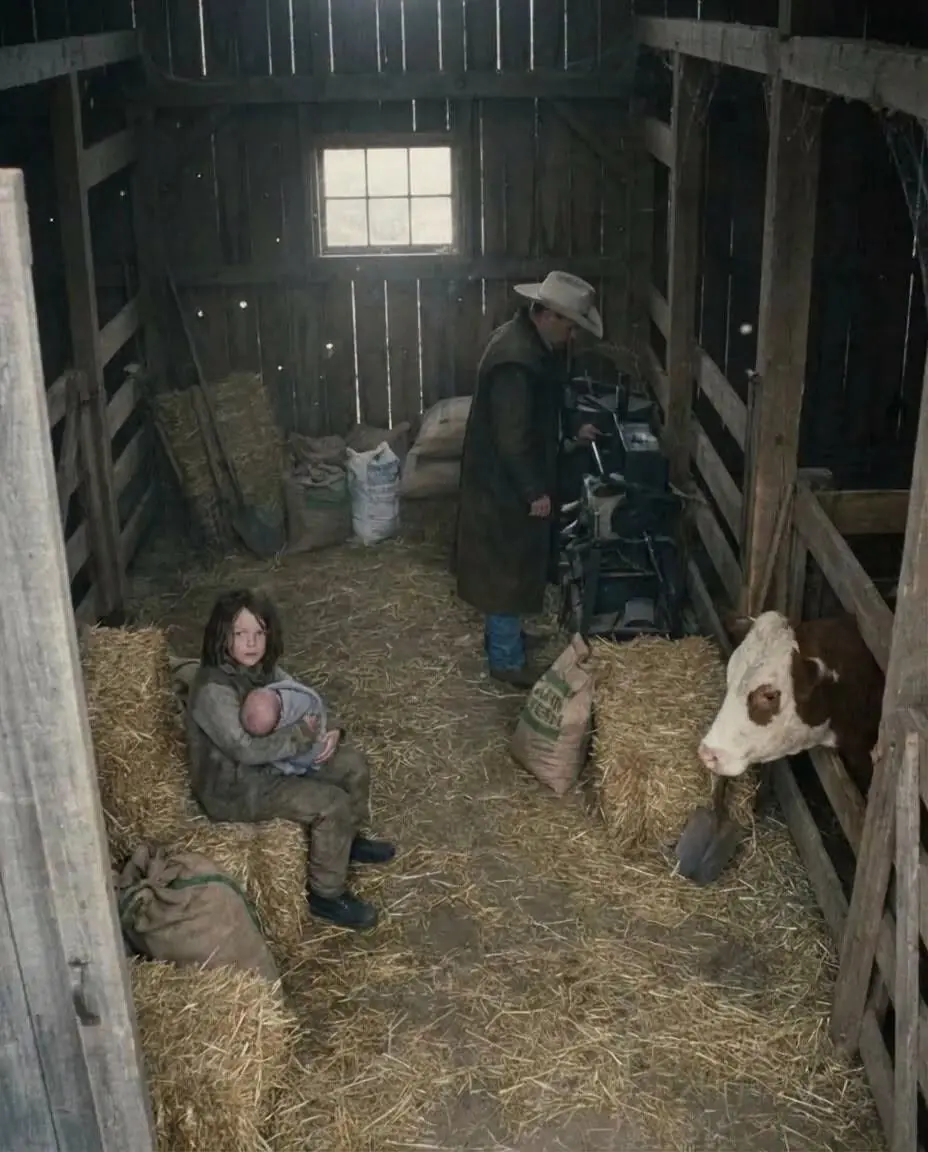
I had lived long enough to understand that children sometimes hesitate because they are shy. But this little girl seemed frightened of saying too much. Her eyes kept moving toward the trees behind my north pasture, as if she expected someone to appear at any moment.
I warmed the milk and prepared a clean bottle. While I worked, she stood near the doorway without sitting down. She watched every movement I made, as though she had learned not to trust adults too quickly.
When I handed her the bottle, she held it carefully with both hands.
“What's your name, sweetheart?”
“Lily.”
“I'm going to walk with you, Lily. I want to make sure you get back safely.”
Her face changed immediately.
“No,” she said, almost too quietly to hear.
“I'm not going to hurt you.”
She stared at the floor for several seconds before finally nodding.
I expected her to lead me toward a nearby house or perhaps a trailer along the county road.
Instead, she walked behind the barn, crossed the wet pasture, and disappeared between the trees.
The farther we went, the more uneasy I became. The path was muddy, the grass was soaked, and the creek was running higher than usual after the overnight rain.
Then I saw the old equipment shed.
It had not been used in years. One side of the roof sagged, the wooden door hung crookedly, and weeds had grown around the foundation. I had considered tearing it down more than once, but other work always came first.
Lily pushed the door open.
A faint cry came from inside.
I stepped forward—and saw a baby lying on a pile of straw, wrapped in a thin gray blanket.
He was so small that the blanket seemed to swallow him. His cheeks looked pale, and his little hands moved weakly as he cried.
Lily hurried toward him.
“It's okay,” she whispered. “I brought your milk.”
She lifted him carefully and placed the bottle near his mouth. The baby began drinking.
I stood frozen in the doorway.
“Lily,” I asked, keeping my voice as calm as I could, “how long have you and your brother been staying here?”
“Three days.”
Three days.
I looked around the shed. There was no proper bed, no heater, no clean crib, and no sign that an adult had been caring for the baby.
“Where are your parents?”
Lily's eyes filled with tears.
“They said we were going on a trip. They told me to wait here with him. They said they would come back.”
I crouched beside her.
“Did they leave you food?”
She shook her head.
“Did they tell you when they would return?”
“After they finished their work.”
“What work?”
She looked down at the baby.
“I don't know.”
That was when I understood that this was not a child who had simply wandered away from home.
Something had happened, and two children were in danger.
I took out my phone and called emergency services.
But before I could finish explaining where we were, Lily grabbed the sleeve of my jacket.
“Please don't let them take my brother,” she begged. “I promised Mama I would look after him.”
I looked at the baby, then at the little girl whose hands were still trembling.
I knew I had to help them both.
What I did not yet know was that the truth about their parents would be far more complicated—and far more deliberate—than anything I had imagined.
The First Phone Call
The dispatcher asked me to describe what I had found.
I told her there was a little girl, perhaps seven years old, and an infant who appeared to be around six months old. They were inside an abandoned equipment shed on my property. The baby was cold, hungry, and crying weakly. The girl said they had been there for three days.
The dispatcher immediately changed her tone.
She told me to keep both children warm, avoid moving the baby unnecessarily, and wait for emergency responders. She also asked whether either child appeared injured or had trouble breathing.
I checked as carefully as I could without frightening Lily.
The baby's breathing was shallow but regular. His skin felt cool. His lips were not blue, but he looked exhausted. Lily kept one hand against his blanket, as if she believed he might disappear if she let go.
“What's his name?” I asked.
“Ben,” she answered.
“That's a good name.”
“He's six months old,” she added quickly, as though she needed me to understand that he was still very little. “He can't eat crackers like me. He needs his milk.”
I nodded.
“You did the right thing coming to get help.”
She looked at me with an expression I still remember.
“Will you be mad because I took the milk?”
That question hurt more than anything else she had said.
“No, Lily. Nobody is mad at you.”
“But I didn't pay.”
“You don't have to pay for helping your brother.”
She looked down at the bottle.
For the first time, her shoulders relaxed a little.
I took off my jacket and placed it around her. It was too large, and the sleeves covered most of her hands, but she did not object. I then sat near the doorway so she could see that I was not going to leave them alone.