Have you ever been walking down the street, riding a bicycle, jogging through a park, or simply passing a house when a dog suddenly starts running after you? For some people, the experience is frightening. Even a relatively small dog can cause someone to panic, while a large dog running directly toward them may feel like a serious threat.
But why do dogs chase people in the first place? Are they naturally aggressive, trying to protect their territory, looking for attention, or simply following an instinct they cannot control?
The answer is more complicated than many people realize. Dogs chase people for several different reasons, and the behavior does not always mean the animal intends to bite. Some dogs are responding to movement, others are frightened or territorial, and some have learned that chasing is an exciting and rewarding activity.
Understanding what motivates a dog to chase is the first step toward responding safely and preventing the behavior from becoming a bigger problem.
Veterinary professionals and qualified animal behavior specialists generally emphasize that chasing should be understood in context. A dog's body language, environment, history, breed tendencies, and previous experiences can all influence its reaction.
This article explores the most common reasons dogs chase people, the warning signs to recognize, what to do if a dog runs toward you, and how owners can teach their pets to behave more safely around strangers.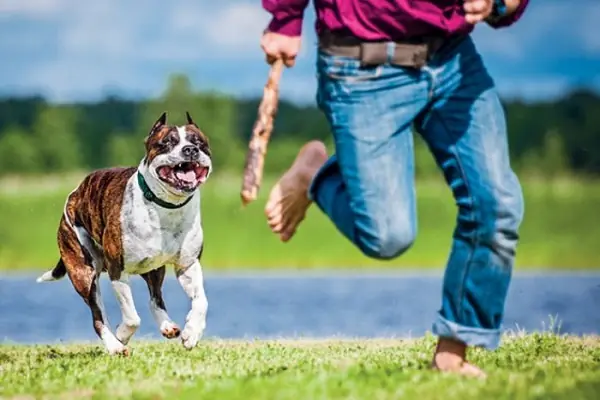
Chapter 1: Why Do Dogs Chase People?
Chasing is a natural canine behavior. Dogs have inherited many instincts from their wild ancestors, including the tendency to follow, pursue, and investigate moving objects.
Although domesticated dogs have lived alongside humans for thousands of years, their instincts have not disappeared. A person running past a dog can trigger a response similar to the one produced by a squirrel, rabbit, or another moving animal.
However, instinct is only part of the explanation.
The same chasing behavior can have completely different motivations depending on the individual dog.
1. The Natural Instinct to Chase Moving Objects
One of the most common reasons dogs chase people is their sensitivity to movement.
A person running, cycling, skating, or walking quickly may attract a dog's attention much more strongly than someone standing still. The movement can activate the dog's natural pursuit response.
This is particularly noticeable in dogs with strong prey-drive tendencies. Certain terriers, sighthounds, and other breeds have historically been selected for tasks involving chasing or pursuing moving animals.
For these dogs, a rapidly moving target can be extremely stimulating.
The dog may begin by watching the person, then move closer, accelerate, and eventually run after them. It may not understand that chasing a human can cause fear or physical injury.
Importantly, prey drive does not automatically mean a dog is aggressive toward people. Many dogs with strong chasing instincts live peacefully with humans. Their behavior simply needs to be managed through appropriate training and supervision.
2. Herding Instincts
Some dogs chase people because they have strong herding instincts.
Breeds developed to manage livestock, such as Border Collies, Australian Shepherds, and Australian Cattle Dogs, are particularly sensitive to movement. Their historical working responsibilities involved controlling the direction and movement of animals.
When these dogs encounter running children, cyclists, or groups of people, they may attempt to control their movement.
Some may circle around a person, follow closely, bark, or move toward their heels. Others may attempt to nip at ankles or clothing.
This behavior can be confusing because the dog may not appear angry. It may simply be performing a behavior that comes naturally to it.
Nevertheless, herding behavior directed toward people can become dangerous, especially when children are involved.
A dog that repeatedly chases or nips at someone's legs should receive appropriate training rather than being allowed to continue because its behavior appears playful.
3. Territorial Behavior
Dogs can also chase people because they perceive them as intruders.
Territorial behavior is especially common around familiar locations, including homes, yards, driveways, farms, and areas where a dog regularly spends time.
A dog may tolerate people walking past its property for weeks without reacting. Then, one day, it suddenly runs toward someone who approaches the gate or walks close to the boundary.
The dog may bark loudly, growl, charge toward the person, or follow them along a fence.
In some cases, the behavior is connected to guarding the home or protecting access to resources. The dog may perceive unfamiliar people as potential threats even when they have no intention of entering the property.
Territorial behavior can become stronger when dogs repeatedly practice chasing people away.
For example, imagine a dog barking at a pedestrian. The pedestrian continues walking and eventually disappears from view. From the dog's perspective, its behavior may appear successful: it barked and chased, and the unfamiliar person left.
This can reinforce the pattern.
Owners should therefore avoid allowing dogs to patrol property boundaries without supervision, particularly when the animal has already demonstrated aggressive or highly reactive behavior.
4. Fear and Anxiety
Not every dog that chases someone is confident or dominant. Some dogs react aggressively because they are frightened.
Fear-based chasing can happen when an unfamiliar person approaches too quickly, makes direct eye contact, reaches toward the dog, or enters an area where the animal feels trapped.
A frightened dog may initially try to create distance by barking or moving away. If the person continues approaching, the dog may feel that it has no other option but to defend itself.
In this situation, chasing can be part of a defensive response.
Dogs experiencing fear may display several warning signals:
-
Ears pinned backward or held tightly against the head.
-
A lowered body posture or tucked tail.
-
Repeated lip licking or yawning in an uncomfortable situation.
-
Stiff body movements.
-
Growling, barking, or showing teeth.
-
Attempts to retreat before suddenly moving forward.
Not every frightened dog displays all these signals. Some may appear confident while experiencing significant stress.
The important point is that fear-related chasing should not be dismissed as simple misbehavior. Punishing a frightened dog may increase its anxiety and make future reactions more intense.