At first glance, this position may seem strange. Why would trained aviation professionals deliberately sit on their hands during one of the most important stages of a flight? Are they following a secret safety rule? Is it designed to prevent injuries? Or does it have something to do with how flight attendants prepare for an emergency?
The answer is closely connected to aviation safety procedures, emergency preparedness, and a technique commonly known as the brace position.
Although the exact procedure can vary depending on the airline, aircraft type, and applicable aviation regulations, flight attendants are trained to adopt specific seated positions during takeoff and landing. These positions are designed to help protect their bodies, reduce the risk of injury, and keep them prepared to respond if something unexpected happens.
The hand placement is not simply a matter of comfort or personal preference. It can be part of a carefully practiced safety routine.
But there is much more to this seemingly simple movement than most passengers realize.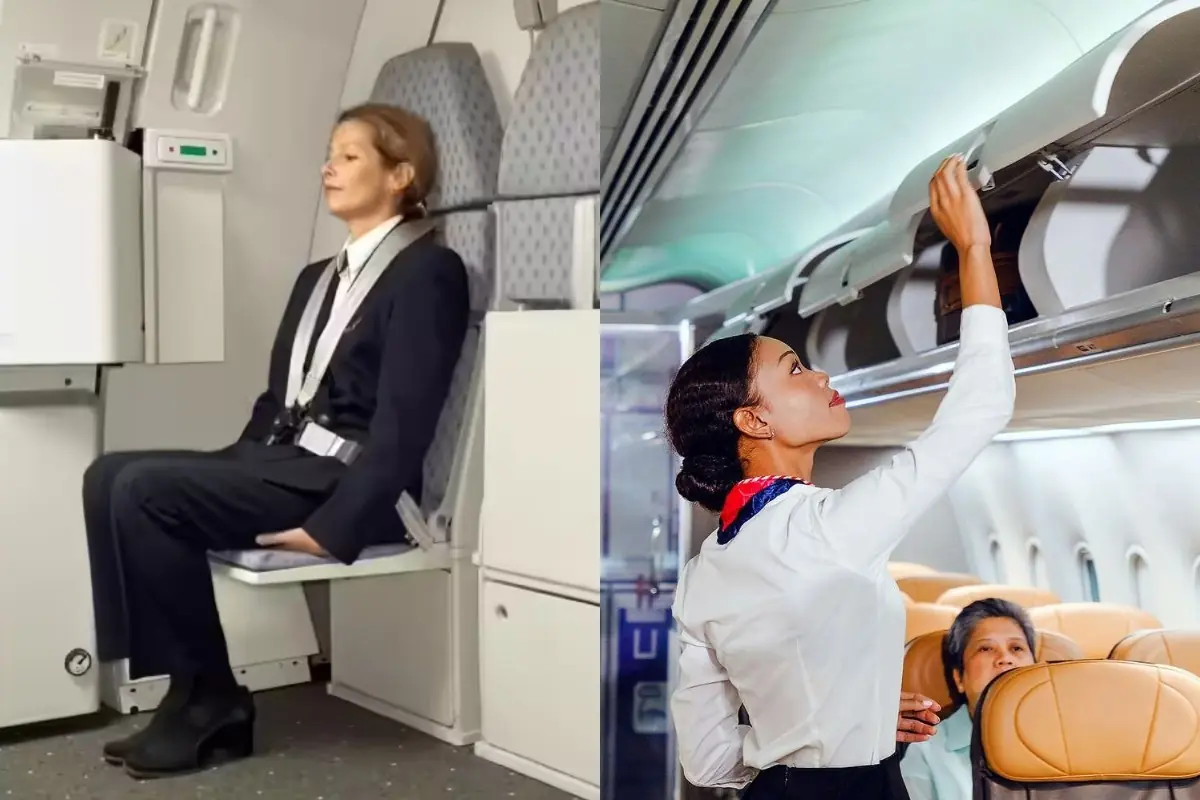
1. It Is Part of a Special Safety Position
The first and most important reason flight attendants may place their hands underneath their thighs is that they are adopting a designated safety position.
During takeoff and landing, cabin crew members often sit in special crew seats known as jumpseats. These seats are usually positioned near emergency exits or other important areas of the aircraft.
Unlike ordinary passenger seats, jumpseats are designed specifically for crew members who must remain ready to perform emergency duties.
Before takeoff, flight attendants typically complete their final cabin checks, secure equipment, confirm that passengers are seated, and take their assigned positions.
Once seated, they may adopt a posture that includes:
-
Sitting upright with their backs against the seat.
-
Keeping their feet flat on the floor or in the designated position.
-
Keeping their knees and legs in a prescribed alignment.
-
Placing their hands underneath their thighs or in another approved position.
-
Keeping their bodies as stable as possible.
This posture is part of their preparation for the possibility of sudden deceleration, turbulence, or an emergency landing.
The precise hand position is not universal. Some airlines and aircraft procedures may specify different hand placements, so passengers should not assume that every flight attendant follows exactly the same technique.
2. The Position Helps Protect Their Hands and Arms
One reason for placing the hands underneath the thighs is to keep the arms and hands in a controlled position.
During a sudden impact, an unsecured hand or arm can move unpredictably. A person may instinctively reach forward, grab an object, or try to brace against a nearby surface.
Such movements can increase the possibility of injury.
By positioning their hands beneath their thighs, flight attendants can help keep their arms close to their bodies and reduce unnecessary movement.
This is especially important because cabin crew members need their hands to perform their professional duties.
They may need to operate emergency equipment, open or assess exits when conditions permit, assist passengers, and provide first aid.
Protecting their hands and arms is therefore one part of maintaining their ability to respond after an incident.
However, the position should not be interpreted as a guarantee against injury. It is a precaution designed to improve body positioning during potentially dangerous situations.
3. It Helps Reduce Uncontrolled Movement During Sudden Deceleration
An aircraft traveling at high speed has considerable momentum.
During a normal takeoff, the aircraft accelerates along the runway before lifting into the air. During landing, it decelerates after touching down.
These are expected movements, and aircraft are designed to handle them safely.
However, an abnormal event can sometimes cause sudden deceleration or unexpected movement.
If a person is sitting without maintaining a stable posture, their upper body and limbs may move abruptly.
A prescribed crew safety position helps reduce unnecessary movement and encourages a more controlled body posture.
Keeping the hands secured beneath the thighs can be one element of that posture.
The objective is not to make the body completely rigid. Instead, crew members are trained to maintain the position specified by their airline's procedures so that their bodies are appropriately positioned if an impact occurs.