This is one reason the position is practiced repeatedly during safety training.
4. It Is Closely Related to the Brace Position
Many passengers have heard the phrase brace for impact during safety demonstrations or in-flight announcements.
The brace position is a protective body posture used in certain emergency situations.
Its purpose is to reduce the likelihood of injury by helping occupants position their bodies appropriately before a possible impact.
For passengers, the exact brace position depends on the aircraft seat design, available space, and instructions provided by the airline.
Flight attendants also have their own approved procedures because their seats, responsibilities, and working environment are different from those of passengers.
A crew member may be instructed to sit upright, place their feet in a specified position, keep their head and body aligned, and position their hands beneath their thighs or elsewhere as required.
The important distinction is that the crew brace position is not necessarily identical to the passenger brace position.
Flight attendants receive specific training on the procedure that applies to their assigned aircraft and airline.
5. It Allows Them to Remain Focused During a Critical Stage of Flight
Takeoff and landing are often described as critical phases of flight because aircraft are relatively close to the ground and have less time and altitude available to respond to certain emergencies.
This does not mean that these phases are inherently unsafe. Commercial aviation is designed around extensive safety procedures, and takeoff and landing are performed under carefully controlled conditions.
Nevertheless, cabin crew members must be particularly attentive during these stages.
They are not simply passengers waiting for the aircraft to reach cruising altitude.
Their responsibilities include remaining alert, monitoring the cabin, and being ready to respond if the flight crew or aircraft situation requires their attention.
Adopting a standardized seated position can help flight attendants establish a consistent routine.
Rather than shifting around, adjusting their clothing, or resting their hands on unsecured objects, they follow a familiar sequence that prepares them for the next phase of the flight.
This routine also helps reduce unnecessary distractions.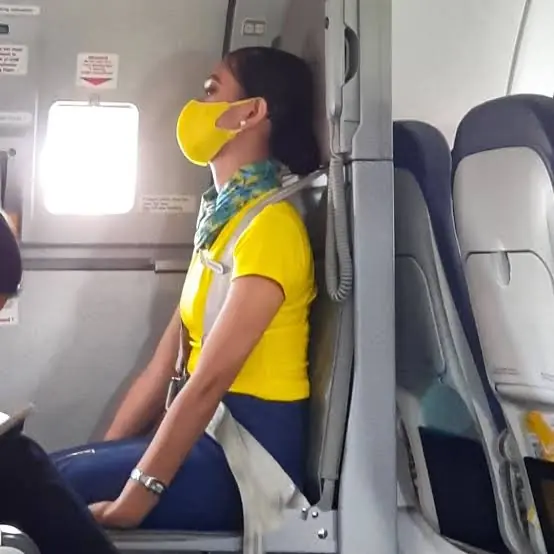
6. Flight Attendants Are Trained to Mentally Review Emergency Procedures
The period immediately before takeoff and landing is not necessarily a time when flight attendants are completely inactive.
In many airlines, crew members use this time to mentally review important emergency information.
Depending on company procedures, this may include recalling:
-
The location and operation of their assigned emergency exit.
-
The commands they may need to use during an evacuation.
-
The position of nearby emergency equipment.
-
Their responsibilities if an evacuation becomes necessary.
-
How to communicate with other crew members.
-
The conditions under which an exit should or should not be opened.
This mental preparation is sometimes described as a silent review.
The idea is simple: emergency procedures should be familiar enough that crew members can respond quickly under pressure.
A flight attendant who has repeatedly practiced these procedures is better prepared to act than someone who must think through every step for the first time.
The hands-under-thighs position may therefore be part of a broader routine that combines physical positioning with mental readiness.
7. Why Don't They Simply Hold the Armrests?
Passengers often place their hands on the armrests during takeoff because it feels comfortable and gives them something to hold.
However, flight attendants are trained professionals who follow specific crew safety procedures.
Their jumpseats may have different configurations from passenger seats, and their prescribed posture may require their hands to remain in a particular location.
Placing the hands beneath the thighs can help keep them close to the body without relying on an external object.
It also avoids unnecessary reaching or movement.
There is no single universal rule that every flight attendant must always put their hands underneath their thighs. The position depends on the applicable procedure.
The key principle is that crew members should use the approved posture for their assigned seat and aircraft.
8. Why Do Flight Attendants Sit Facing the Cabin?
Another detail that many passengers notice is that some flight attendants sit facing the passenger cabin rather than facing the direction of travel.
This arrangement may look unusual, but it is a deliberate feature of many crew-seat installations.
Jumpseats are frequently positioned near exits and may face toward the cabin.
This allows flight attendants to maintain awareness of the passenger area and their assigned emergency exit.
In certain configurations, crew seats are installed facing rearward, meaning that the crew member's back faces the direction of aircraft travel.