Did You Know That Waking Up at 3 or 4 in the Morning Could Be a Sign of Something Important?
Frequent early-morning awakenings may reveal hidden health concerns.
⏱️ 1 min read 13/08/2026 01:07
At first, my grandma noticed a small, hard bump near the end of one finger.
It didn’t seem like a big deal.
Then another bump appeared on a different finger. Over time, several of her finger joints began to look enlarged and knobby. She started wondering: Why are these bumps spreading? Is it something serious? And can they be stopped?
If you or an older family member has noticed something similar, there may be a common explanation.

Firm, bony-looking bumps that develop at the finger joints closest to the fingernails are often called Heberden’s nodes.
They are commonly associated with osteoarthritis of the hands. The bumps develop because the joint undergoes structural changes, including the formation of small bony growths called osteophytes, or bone spurs.
Osteoarthritis becomes more common with age, and the small joints of the hands—including the joints closest to the fingertips—are among the areas it can affect.
That means what looks like a mysterious "lump" may actually be a change occurring within the joint itself.
One important point is that the bumps themselves aren't necessarily "spreading" from one finger to another.
Instead, multiple finger joints can develop osteoarthritis-related changes over time.
A person may first notice a bump on one finger, followed months or years later by similar changes in other fingers. Osteoarthritis can affect several joints, and hand osteoarthritis commonly involves the joints near the fingertips as well as the middle finger joints.
This gradual progression can make it appear as though the bumps are moving or spreading.
Age is one of the strongest risk factors for osteoarthritis.
As we get older, tissues within joints can gradually change. In osteoarthritis, cartilage and other joint tissues can deteriorate, while the bone may remodel and form osteophytes around the joint.
Other factors can also contribute, including:
So if several women in the same family have developed similar finger changes, genetics may play a role.
No.
This is one reason people sometimes ignore them.
When these bony enlargements first appear, the affected joints may be swollen, tender, stiff, or painful. But once the nodes have fully developed, the pain and tenderness may decrease in some people—even though the bumps remain.
Some people may have noticeable changes in the shape of their fingers but continue to use their hands relatively well.
Others may experience stiffness, reduced movement, weakness, or pain when gripping objects.
Finger bumps aren't the only possible sign of hand osteoarthritis.
Someone may also notice:
Stiffness:
The fingers may feel stiff, particularly after periods of inactivity.
Swelling or tenderness:
An affected joint may look larger or feel sore when touched.
Reduced movement:
It may become harder to completely bend or straighten certain fingers.
Changes in finger shape:
Over time, some affected fingers can become slightly crooked or develop a more knobby appearance.
Pain during use:
Opening jars, gripping objects, writing, or performing repetitive hand movements may become uncomfortable.
This is extremely important.
A photograph or description alone cannot determine what a lump on the finger represents.
Other conditions can produce swelling or lumps around the fingers. For example, some forms of inflammatory arthritis can affect the finger joints, and certain cysts can also appear near the end joints.
The appearance, location, consistency, associated symptoms, and medical history all matter.
That's why a new, rapidly changing, very painful, red, or unexplained lump deserves professional evaluation rather than being automatically labeled "arthritis."
Consider seeing a healthcare professional if the bumps are new, continuing to change, or accompanied by significant pain or stiffness.
An examination may be enough to suggest osteoarthritis, while an X-ray can sometimes show characteristic joint-space changes, bone remodeling, or osteophytes. Blood tests may be used when another type of arthritis is suspected.
Seek medical attention sooner if a finger becomes very red, hot, severely swollen, suddenly painful, or difficult to move, particularly if there is fever or you feel generally unwell. Those features can point to problems other than ordinary osteoarthritis.
If the bumps are caused by osteoarthritis-related bony changes, there isn't a simple cream or home remedy that can make the underlying bone growth disappear.
Treatment generally focuses on controlling pain, maintaining hand function, and helping the person continue everyday activities.
Depending on the situation, a healthcare professional may recommend approaches such as appropriate exercise, heat or cold therapy, reducing aggravating repetitive movements, supportive devices, or medication when appropriate.
Importantly, don't try to squeeze, puncture, cut, or "break" a hard finger bump at home.
If it is actually a cyst, infection, gout-related deposit, or another condition rather than a bony node, attempting to remove it yourself could cause injury or infection.
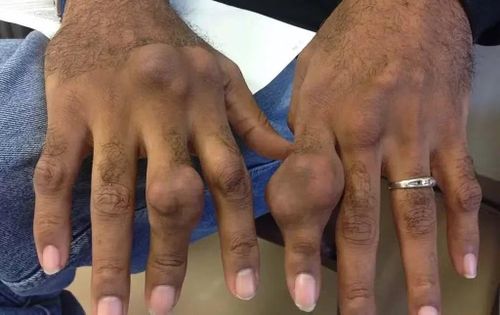
If your grandma has developed several hard bumps on the joints closest to her fingernails, Heberden’s nodes associated with hand osteoarthritis are one possible explanation—especially if the bumps are firm and have developed gradually over time.
They may appear on multiple fingers because osteoarthritis can affect several joints, rather than because one bump is literally spreading to another finger.
Still, the appearance of a finger lump alone isn't enough to make a diagnosis.
If the bumps are new, rapidly changing, painful, red, warm, or interfering with her ability to use her hands, it's worth having them examined.
Sometimes a small change in the fingers is simply part of aging. But sometimes the location, speed of change, and accompanying symptoms can provide important clues about what is really happening inside the joint.
Frequent early-morning awakenings may reveal hidden health concerns.
Doctors Say Your Sleeping Position Could Affect Your Health
Doctors warn that consuming beets may lead to noticeable changes
These 3 Everyday Vegetables Come with Hidden Risks When Prepared the Wrong Way
Bladder Cancer Often Starts Quietly: 5 Early Symptoms to Watch For
How drinking water first thing in the morning can benefit your body?
Easy Tips to Keep Ripe Avocados Fresh Without Browning or Getting Mushy
7 common signs of calcium deficiency - check if you have any of them
How does your body respond to eating cauliflower regularly?
If Your Nails Are Constantly Breaking, Here’s What Could Be Behind It… 👀
Before You Reach for Another Guava, Here’s What Experts Want You to Know…
Seeing More Veins Than Usual? Here’s What Your Body Could Be Telling You…
If you notice this symptom when you wake up, your kidneys may be at risk
Doctors Explain: Why You May Keep Waking Up With a Dry Mouth at Night…
Unusual body odors may signal serious liver problems early.
5 Powerful Red Foods That Support Healthy Kidneys
Over 60? Your Daily Banana Habit May Have More Effects Than You Think…
Is Eating Avocados Every Day Really Good for You? Doctors Reveal the Facts…
Heart Attack Warning Signs Can Be Subtle—Here Are 5 Changes Worth Paying Attention To
Frequent early-morning awakenings may reveal hidden health concerns.
Doctors Say Your Sleeping Position Could Affect Your Health
Doctors warn that consuming beets may lead to noticeable changes
These 3 Everyday Vegetables Come with Hidden Risks When Prepared the Wrong Way
Bladder Cancer Often Starts Quietly: 5 Early Symptoms to Watch For
How drinking water first thing in the morning can benefit your body?
A simple plastic bottle may help improve your laundry results at home.
Easy Tips to Keep Ripe Avocados Fresh Without Browning or Getting Mushy
7 common signs of calcium deficiency - check if you have any of them
How does your body respond to eating cauliflower regularly?
If Your Nails Are Constantly Breaking, Here’s What Could Be Behind It… 👀
Before You Reach for Another Guava, Here’s What Experts Want You to Know…
Seeing More Veins Than Usual? Here’s What Your Body Could Be Telling You…
If you notice this symptom when you wake up, your kidneys may be at risk
Doctors Explain: Why You May Keep Waking Up With a Dry Mouth at Night…
Unusual body odors may signal serious liver problems early.