Doctors Reveal Why Walnuts May Be a Powerful Food for Heart, Brain and Long-Term Health
A small handful of walnuts may offer more than a satisfying crunch. Their distinctive brain-like shape has made them a familiar symbol of intelligence, but their real value lies in what they contain: plant-based omega-3 fatty acids, fibre, antioxidants, vitamins and minerals. Research has linked regular walnut consumption with improvements in certain cholesterol measures and explored its possible role in supporting brain and metabolic health. But how much can these little nuts really do—and what does the science actually say?
The answer is more interesting than their appearance suggests. Walnuts are not a miracle food, and eating them cannot guarantee protection against heart disease or memory loss. Yet their nutritional profile makes them a useful addition to a balanced diet. To understand why, it helps to look first at the heart, then at the compounds that protect cells, and finally at the research into the brain.
Chapter 1: A Small Nut With a Remarkable Nutritional Profile
Walnuts are easy to recognize. Their wrinkled halves resemble tiny brains, their shells are hard and protective, and their rich, slightly bitter flavour makes them popular in everything from breakfast bowls to baked desserts. Yet the most interesting feature of a walnut is not its unusual appearance. It is the combination of nutrients packed into such a small serving.
Unlike many snack foods that provide mostly refined carbohydrates or added salt, walnuts contain a mixture of unsaturated fats, plant-based omega-3 fatty acids, protein, fibre and naturally occurring plant compounds. They also provide minerals such as magnesium, copper and manganese, along with several B vitamins and vitamin E in smaller amounts.
This combination helps explain why walnuts are frequently included in discussions about heart-healthy eating patterns. They are energy-dense, but much of their fat is unsaturated. They provide alpha-linolenic acid, commonly shortened to ALA, which is an essential omega-3 fatty acid that the human body cannot produce in sufficient amounts on its own. It must therefore come from food.
Walnuts are particularly notable among commonly eaten nuts because they provide a meaningful amount of ALA. This does not make them identical to oily fish, which supply the long-chain omega-3 fats EPA and DHA, but it gives walnuts a distinctive place in plant-based diets.
Their fibre and protein also contribute to a more satisfying snack. Instead of eating a handful of sweets that may leave someone hungry again soon, a modest portion of walnuts can provide fat, fibre and protein together. These nutrients take longer to digest than many refined carbohydrates and may help people feel satisfied between meals.
However, it is important to understand what the word healthy means in this context. Walnuts are not medicine. They cannot reverse years of unhealthy eating, erase the effects of smoking or replace treatment for high cholesterol. Their potential value comes from being part of a broader dietary pattern that includes vegetables, fruit, whole grains, beans, appropriate protein sources and unsaturated fats.
The research is encouraging, especially for cardiovascular health. Studies have examined how walnuts affect blood cholesterol, the number of cholesterol-carrying particles in circulation, inflammation-related markers and other measures associated with long-term health. The findings do not mean that everyone will experience the same result, but they help explain why nutrition experts often recommend nuts as part of a balanced diet.
There is another reason walnuts attract attention: their possible relationship with brain health. The nutrients they contain are involved in normal cell function, and researchers have investigated whether eating walnuts regularly may influence cognitive performance as people grow older. The results are more complicated than the familiar claim that walnuts are a “brain food,” and that distinction matters.
Before exploring the brain research, it is worth looking at the benefit for which the evidence is more consistent: the heart.
Chapter 2: A Champion for Heart Health
Heart health is influenced by many factors, including blood pressure, cholesterol levels, blood sugar, physical activity, smoking, sleep, age and family history. No single food can control all of these. Nevertheless, the type of fat people eat can influence their blood lipid profile, which is one reason walnuts have received attention in cardiovascular nutrition research.
Walnuts contain predominantly unsaturated fats, including polyunsaturated fatty acids. These fats can be useful when they replace foods rich in saturated fats in an overall balanced diet.
The distinction is important. Simply adding walnuts on top of an already excessive daily calorie intake is not necessarily beneficial. Their potential value is greatest when they replace less nutritious snacks or sources of saturated fat, rather than becoming an additional source of calories without changing the rest of the diet.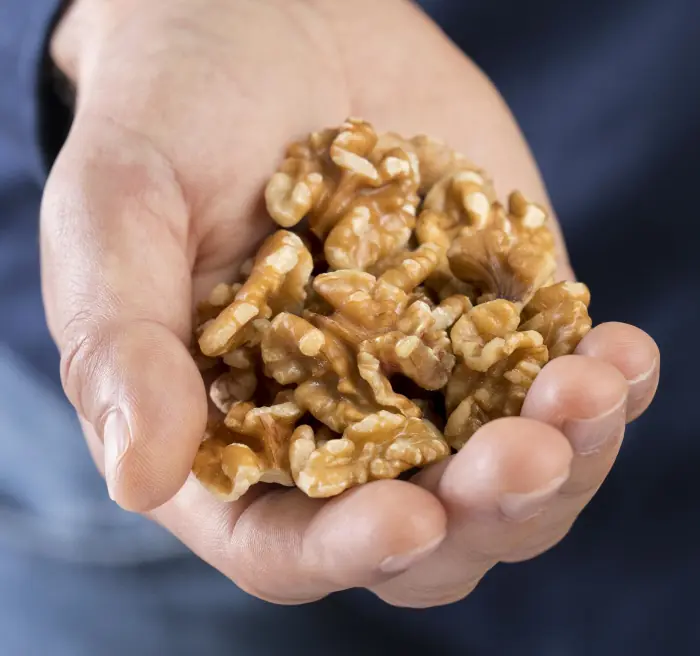
How walnuts may influence LDL cholesterol
Low-density lipoprotein cholesterol, usually called LDL cholesterol, is often referred to as “bad cholesterol.” LDL particles transport cholesterol through the bloodstream. When LDL levels remain elevated, cholesterol can contribute to plaque formation in artery walls, increasing the risk of cardiovascular disease over time.
Walnuts may help improve the blood lipid profile, particularly when included in place of foods containing less favourable fats.
A systematic review and meta-analysis of 26 controlled clinical trials involving 1,059 participants found that walnut-enriched diets produced modest reductions in total cholesterol and LDL cholesterol compared with control diets. The pooled results showed an average LDL reduction of approximately 5.5 milligrams per decilitre. Triglyceride levels also fell modestly in the analysis.
The American Journal of Clinical Nutrition+1
These findings are meaningful because they are based on multiple controlled trials rather than on a single observation. However, the average change was not enormous. It should be understood as one possible contribution to cardiovascular risk reduction, not as a substitute for medical treatment when treatment is needed.
What a two-year study found
One of the notable investigations into walnuts and cardiovascular health involved older adults who consumed walnuts regularly over a two-year period.
The study, reported by the American Heart Association in 2021, found that participants who ate approximately half a cup of walnuts daily had modest reductions in LDL cholesterol. Their average LDL level fell by around 4.3 milligrams per decilitre. Researchers also observed reductions in the number of total LDL particles and small LDL particles.
American Heart Association+1
The results attracted attention because cholesterol measurements do not tell the whole story. The number and characteristics of lipoprotein particles can also be relevant when assessing cardiovascular risk.
Still, the study should not be interpreted as proof that eating walnuts prevents heart attacks in every individual. It measured changes in risk-related markers, not a guarantee that participants would avoid cardiovascular disease.