You open the refrigerator, take out a package of deli ham, and prepare to make a sandwich. Everything looks perfectly ordinary at first. The slices are pink, slightly glossy, and neatly stacked together.
Then, as you move one slice beneath the kitchen light, something unusual catches your attention.
A shimmering rainbow-like sheen appears across the surface. Depending on the angle, the ham seems to reflect shades of green, blue, purple, gold, or even pink. It almost looks as though a thin layer of oil or an unusual chemical coating has been spread over the meat.
Your first reaction may be to stop and take a closer look.
Is the ham spoiled? Has bacteria started growing on it? Could the strange colors be a sign of contamination? And perhaps most importantly, is it still safe to eat?
This phenomenon is more common than many people realize. It can occur in cooked ham, roast beef, turkey slices, corned beef, and other processed or cooked meats. In many cases, the rainbow appearance is not caused by spoilage at all.
Instead, it is an optical effect known as iridescence.
The phenomenon occurs when light interacts with the microscopic structure of the meat's surface. The arrangement of muscle fibers and the way light reflects and interferes with itself can produce colors that change depending on the viewing angle.
In other words, the meat may appear to change color even though its actual pigments have not changed in the way they would during spoilage.
But there is an important distinction.
Although rainbow-like iridescence can be completely harmless, it does not guarantee that the meat is fresh or safe. Deli ham can still become contaminated or spoil because of improper storage, excessive time in the refrigerator, or handling that introduces harmful microorganisms.
That means the appearance of a rainbow sheen should not be the only factor used to decide whether food is safe.
Understanding what causes this unusual effect can help you avoid throwing away perfectly good food unnecessarily while also recognizing the warning signs that should never be ignored.
And the explanation begins with something surprisingly simple: the way light interacts with the tiny structures inside a slice of meat.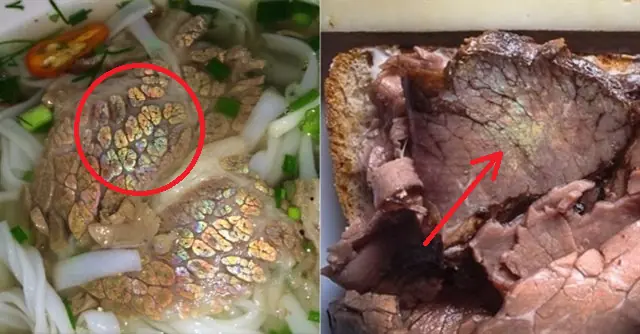
CHAPTER 1: THE RAINBOW EFFECT THAT CAN APPEAR ON PERFECTLY NORMAL HAM
The first thing to understand is that the rainbow-like appearance on deli ham is often an optical phenomenon rather than evidence of a chemical reaction or bacterial growth.
Scientists and food specialists commonly describe this effect as iridescence.
Iridescence occurs when a surface reflects light in a way that produces different colors depending on the angle from which it is viewed. Similar effects can be seen on soap bubbles, certain insect wings, mother-of-pearl, and the surface of compact discs.
Deli meat can display a comparable effect because its structure is not completely smooth or uniform.
Cooked meat contains long muscle fibers arranged in organized bundles. During processing, cooking, slicing, and handling, these fibers may become exposed in patterns that interact with incoming light.
When light strikes the surface, some wavelengths may be reflected differently from others. The reflected light can interfere with light waves traveling along slightly different paths, producing a pattern of colors.
This is known as optical interference.
The result can be a shimmering appearance that changes as you move the slice, tilt your head, or shift the light source.
One moment, the meat may look mostly pink. A second later, green or blue tones may appear across a section of the surface. Under a different angle, those colors may disappear almost entirely.
This changing appearance is one of the characteristics that helps distinguish iridescence from an actual change in the meat's pigmentation.
The effect can be especially noticeable in sliced cooked meats because cutting exposes organized muscle structures that may reflect light in particular directions.
Some slices show the rainbow sheen more clearly than others. Even two pieces from the same package may look different depending on how the muscle fibers are oriented.
The lighting in your kitchen can also influence what you see.
Bright overhead lights, sunlight entering through a window, and concentrated LED lighting may make the effect more visible. Under softer lighting, the same slice may appear completely ordinary.
This explains why someone might open a package of ham and see nothing unusual, only to notice a colorful shimmer when holding a slice closer to a light source.
It can be surprising because the colors look almost artificial.
However, the presence of green, blue, or purple reflections does not automatically mean that the meat contains harmful chemicals or has begun to decompose.
The phenomenon is generally associated with the physical structure of the meat and the behavior of reflected light.
That distinction is important because consumers sometimes confuse iridescence with discoloration caused by spoilage.
True spoilage can involve changes in odor, texture, and appearance resulting from microbial activity and other chemical processes. Iridescence, by contrast, can appear on properly cooked meat that is otherwise normal.
Still, there is a reason to be cautious.