Step 1: Look at how the colors behave
Move the slice slightly beneath the light.
If the rainbow colors shift, change intensity, or disappear when you alter the angle, this is consistent with iridescence.
The effect may be especially visible on certain areas of the meat where the muscle fibers are arranged in a particular direction.
Remember, however, that this observation cannot establish food safety by itself.
Step 2: Check the storage history
Ask yourself a few questions.
Was the ham refrigerated promptly after purchase? Has it been kept at 40°F (4°C) or below? How many days has the package been open? Was it left at room temperature for an extended period?
If you cannot establish that the meat was stored safely, it is better not to take unnecessary risks.
Follow the product's use-by instructions and established refrigerated storage guidelines.
Step 3: Inspect the surface and package
Look for unusual slime, visible mold, leaking packaging, or other changes that suggest deterioration.
A slightly moist surface can be normal for deli meat, but a distinctly slimy or sticky coating is concerning.
Do not attempt to remove mold, wash away slime, or use another slice from the same package as a way to avoid discarding questionable meat.
Step 4: Consider the smell, but don't rely on it alone
An unpleasant or unusual odor is a reason to discard the ham.
However, a normal smell does not prove that the meat is free from harmful microorganisms.
This is particularly important when considering Listeria.
Step 5: Be extra cautious if you are in a high-risk group
Pregnant women, older adults, and people with weakened immune systems should follow specific food safety recommendations for refrigerated ready-to-eat meat.
For pregnant women and other higher-risk individuals, deli meat should be reheated to 165°F (74°C) or until steaming hot before consumption, in accordance with CDC guidance.
If the meat shows signs of spoilage or has been stored improperly, heating it should not be treated as a way to make it safe.
A few common myths worth correcting
Myth 1: Rainbow-colored ham always contains dangerous chemicals.
Not necessarily. Iridescence is generally an optical effect caused by the interaction of light with the physical structure of the meat.
Myth 2: If the ham smells normal, it is safe.
Not always. Some harmful bacteria do not produce noticeable odors or visible changes.
Myth 3: Washing the ham removes harmful bacteria.
Washing does not reliably eliminate microorganisms and may spread contamination to kitchen surfaces.
Myth 4: Cooking spoiled deli meat makes it safe again.
Heating can destroy many microorganisms, but it cannot reliably reverse all forms of food spoilage or eliminate every hazard associated with improperly stored food.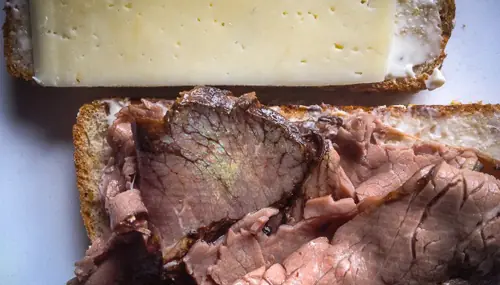
Myth 5: Every green or purple reflection means the meat is spoiled.
No. A shifting rainbow sheen can be a normal optical phenomenon.
The bigger lesson about food safety
The refrigerator is designed to slow bacterial growth, not stop every microorganism from multiplying.
Ready-to-eat meats still require careful storage, clean handling, and attention to recommended use periods.
A simple routine can help:
-
Keep refrigerated foods at 40°F (4°C) or below.
-
Refrigerate deli meat promptly after purchase.
-
Use opened packages within the recommended storage period.
-
Keep meat properly sealed.
-
Avoid cross-contamination with raw foods.
-
Discard products that have been stored unsafely or show signs of spoilage.
-
Follow additional precautions if you are pregnant, older, or immunocompromised.
These habits are much more effective than relying on color alone.
FINAL THOUGHTS: THAT RAINBOW SHINE MAY NOT BE WHAT YOU THINK
Seeing a rainbow-like sheen on deli ham can be surprising, especially when the colors appear suddenly under the kitchen light.
But in many cases, there is a simple explanation.
The effect is called iridescence, an optical phenomenon that occurs when light interacts with the microscopic structure of the meat. It can produce shifting green, blue, purple, and gold reflections without necessarily indicating spoilage.
The same effect can appear on turkey, roast beef, and other cooked meats.
Still, an iridescent appearance does not guarantee that a product is safe to eat. Deli ham can become contaminated or spoil because of improper refrigeration, prolonged storage, or unsafe handling. Some dangerous bacteria, including Listeria monocytogenes, may be present without producing obvious changes in smell, color, or texture.
That is why the safest approach is to consider the complete picture: storage history, package instructions, refrigerator temperature, texture, and any unusual odor or visible growth.
For most people, rainbow-colored reflections alone are not a reason to panic. But when food safety is uncertain, throwing the product away is often the wiser decision.
The next time you notice a shimmering slice of ham, remember that the colors may be nothing more than light playing across the structure of the meat.
Just don't let a harmless-looking explanation replace proper food safety practices.
Because when it comes to the food you eat, understanding what you see is important but knowing what you cannot see is just as important.