A nail clipper is one of those everyday objects most people use without ever thinking twice about its design.
You probably keep one in your bathroom cabinet, travel bag, desk drawer, or somewhere else within easy reach. You use it to trim your fingernails and toenails, perhaps every week or two, and then put it away.
Simple, right?
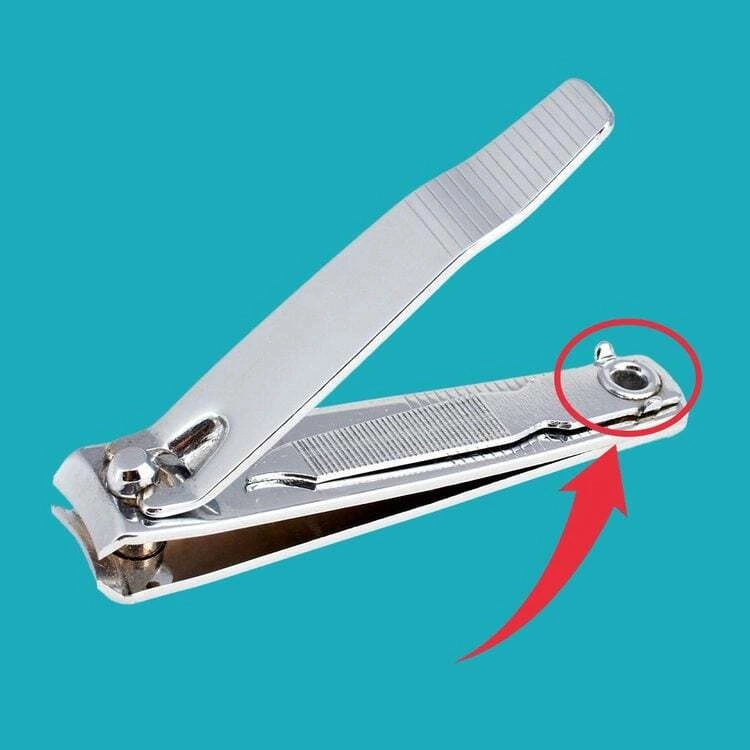
But if you take a closer look at a traditional nail clipper, you may notice a small round hole near the end of the metal lever.
At first, it can seem completely unnecessary.
Why would a tool designed simply for cutting nails need a hole?
Is it there for manufacturing?
Is it decorative?
Does it have something to do with how the clipper works?
The answer is more practical than many people realize.
That tiny opening is often part of the clipper's lever and pivot design, and depending on the model, it can also serve additional purposes.
Here's what that little hole is really about.

The Nail Clipper Is a Small Mechanical Tool
Before looking at the hole itself, it helps to understand how a nail clipper works.
Although it looks simple, a traditional nail clipper is essentially a small lever-operated cutting mechanism.
Most standard clippers have several important components:
-
Two opposing cutting edges
-
A metal body
-
A lever
-
A pivoting pin
-
A hinge or attachment point
When you press down on the lever, the force from your finger is transferred through the mechanism.
The lever amplifies your force and pushes the cutting blades together.
That allows the relatively small amount of pressure from your fingertip to generate enough force to cut through a nail.
In other words, the nail clipper is a compact example of basic mechanical engineering.
And that small hole is part of this carefully designed structure.
So What Is the Tiny Hole For?
On many conventional nail clippers, the small hole is associated with the lever attachment or pivot area.
The lever needs to be connected to the clipper body in a way that allows it to move while remaining securely attached.
The small opening can accommodate the retaining pin or attachment component that holds the lever in position.
This allows the lever to pivot properly.
When you lift the lever, the cutting mechanism opens.
When you press it down, the mechanism closes.
The hole therefore isn't necessarily an independent "feature" designed for a special trick.
It can simply be part of the mechanism that makes the tool function.
Why Does It Look Like Such a Perfect Little Circle?
That's largely because the component passing through the opening is cylindrical.
Manufacturers need to create a clean, precisely positioned opening that allows the lever and pivoting hardware to work smoothly.
A circular hole is mechanically practical because it distributes stress evenly around the opening.
It also works naturally with a round pin or shaft.
The result is a tiny feature that looks almost decorative but is actually related to the clipper's construction.
But Not Every Nail Clipper Has the Same Hole
This is important.
Not all nail clippers are designed identically.
Some models have a visible circular opening.
Others may have a slot, indentation, or completely different attachment mechanism.
Some modern clippers use different lever constructions that make the opening less obvious.
So if your nail clipper doesn't have a small hole, that doesn't mean anything is missing.
It simply means the manufacturer used a different design.
The Hole Can Also Be Useful for Manufacturing and Assembly
Tiny mechanical components need to be assembled with precision.
A hole can help manufacturers position, secure, or manipulate parts during the assembly process.
The exact function depends on the particular design.
In mass-produced metal tools, even a small opening can serve multiple purposes.
It may help with:
-
Attaching the lever
-
Holding a pivot component
-
Positioning parts during manufacturing
-
Allowing mechanical movement
-
Securing the tool's components
That's one reason it's difficult to give a single universal explanation for every nail clipper.
Could the Hole Be Used to Attach the Nail Clipper to Something?
Sometimes, yes.
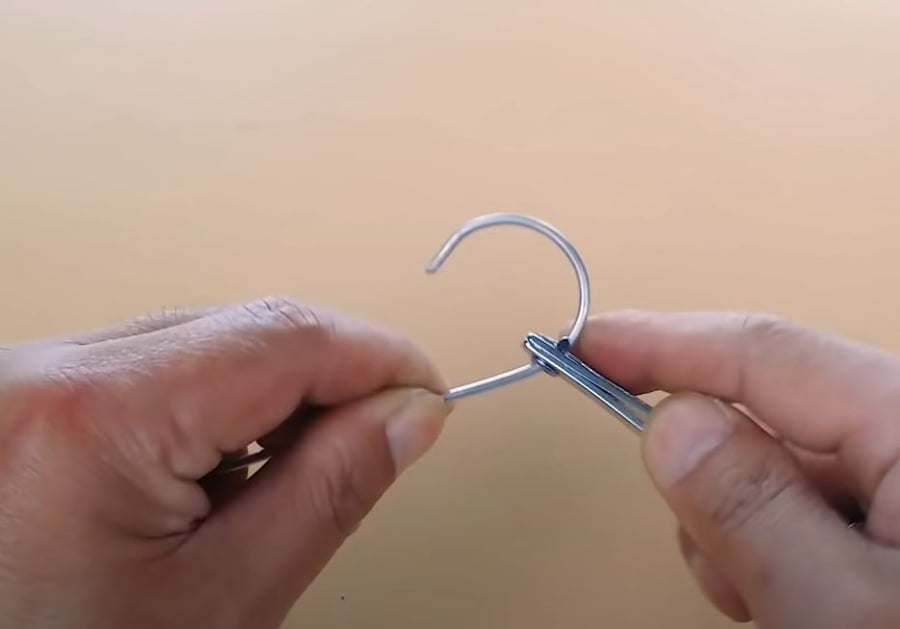
Depending on its location and construction, a hole can also make a small tool easier to attach to a key ring, storage hook, or other object.
However, this isn't necessarily the primary purpose of the hole on every nail clipper.
Some people may use it as a convenient attachment point, but the mechanical design of the clipper remains the more important consideration when examining openings near the lever or pivot.
What About the Famous "Key Ring" Idea?
You've probably seen people online claim that the little hole is specifically designed to attach the nail clipper to a keychain.
That can be true for certain designs, but it's not a universal explanation.
Nail clippers come in many shapes and configurations.
If the opening is large enough and positioned appropriately, it can certainly be useful as an attachment point.
But if the hole is directly integrated into the lever mechanism, its structural function is likely more important.
So the viral claim that "the hole was invented specifically for your keychain" should be treated cautiously.
The actual purpose depends on the clipper's design.
Why Does the Lever Need to Move?
This is where the mechanical design becomes interesting.
Imagine trying to cut a nail with two pieces of metal that don't move.
You would have to manually force the cutting edges together.
That would require much more effort.
The lever solves this problem.
Your thumb applies force at one end.
The lever pivots around its attachment point.
That movement transfers force to the cutting section.
The result is a much stronger cutting action than your finger could produce directly.
This is a classic example of mechanical advantage.
The Tiny Tool Uses a Simple Principle
You don't need an engineering degree to understand the basic concept.
Think about a seesaw.
If you push down on one side, the other side moves upward around a central pivot.
A nail clipper works using a related principle.
The lever rotates around a pivot point and transfers force to another part of the mechanism.
The small hole helps accommodate the hardware that allows this controlled movement.
That's why something as ordinary as a nail clipper can actually be a neat example of everyday engineering.
Why Nail Clippers Are So Strong
Have you ever wondered how such a tiny tool can cut a surprisingly tough toenail?
The answer is the combination of:
Lever length + pivot placement + blade geometry.
Your finger doesn't need to produce enormous force.
Instead, the mechanism converts a relatively modest downward push into a stronger cutting force at the blades.
This is the same basic idea behind many tools that multiply human strength.
The nail clipper simply packages the concept into something small enough to fit in your palm.
The Hole Isn't Just "Random Manufacturing"
It's easy to assume that tiny holes in inexpensive products are meaningless.
But mechanical products are usually designed around specific constraints.
Manufacturers have to think about:
-
Strength
-
Movement
-
Friction
-
Material thickness
-
Assembly
-
Durability
-
Cost
-
User comfort
Even something as inexpensive as a nail clipper has to survive repeated cycles of opening and closing.
The lever needs to remain aligned.
The pivot needs to stay secure.
The cutting edges need to meet correctly.
Small structural details can therefore have a big impact on how well the tool performs.
Why the Design Has Changed So Little
The basic nail clipper design has remained remarkably recognizable for generations.
That's because it works.
A good mechanical design doesn't need to change dramatically simply because technology advances.
The clipper is:
-
Small
-
Cheap
-
Durable
-
Easy to use
-
Easy to manufacture
-
Effective
There's little reason to replace a proven mechanism with something unnecessarily complicated.
The tiny hole is part of that broader philosophy of simple, functional engineering.
Does the Hole Have Anything to Do With Nail Clippings?
Usually, no.
Some people assume the hole might somehow be designed to catch or collect nail clippings.
That's generally not its primary purpose.
Many nail clippers have separate designs for managing clippings, including small plastic or metal catchers.
If your clipper doesn't have such a catcher, the clippings will simply fall wherever you're trimming them.
The small hole near the lever isn't typically designed as a nail-catching compartment.
Can You Use It to Clean Under Your Nails?
This is another common internet suggestion.
Some nail clippers include additional tools or features designed for cleaning under nails.
But a structural hole in the lever should not automatically be treated as a nail-cleaning tool.
Using sharp metal components underneath the nail can damage the nail bed or surrounding skin.
If your clipper has a specifically designed nail-cleaning attachment, that's a different matter.
But the little hole itself isn't something you should insert under your nails.
What If the Hole Is on the File Attachment?
Some nail clippers come with a fold-out nail file.
That file may have a hole or opening of its own.
In that case, the hole could have a different function, such as:
-
Attachment
-
Pivoting
-
Manufacturing
-
Storage
-
Design reinforcement
This is another reason why looking at the exact model matters.
Not every "tiny hole" on a nail clipper serves the same purpose.
A Small Hole Can Also Reduce Material
From a manufacturing perspective, removing a tiny amount of material can sometimes make a component lighter or easier to produce.
However, manufacturers don't generally punch holes into mechanical components without considering how the opening affects strength.
The location matters enormously.
A hole near a high-stress point must be carefully engineered.
That's why the position and diameter of the opening can tell you something about the function it serves.
Why Precision Matters
A nail clipper may be inexpensive, but its blades need to align accurately.
If the blades don't meet correctly, the clipper may:
-
Crush rather than cut the nail
-
Leave jagged edges
-
Require excessive force
-
Feel loose
-
Wear out quickly
The pivot and lever system helps maintain alignment.
A tiny shift in the mechanism can noticeably affect performance.
That's why manufacturers pay attention to seemingly insignificant features.
What Happens If the Lever Becomes Loose?
If the lever becomes loose or the pivot wears down, you may notice that the clipper doesn't work as smoothly.
It may feel:
-
Wobbly
-
Weak
-
Misaligned
-
Difficult to press
-
Less effective at cutting
In many cases, replacing the clipper is easier than attempting to repair such a small mechanism.
Given how inexpensive most nail clippers are, replacement is usually the practical choice.
Why You Should Keep Nail Clippers Clean
Regardless of what the tiny hole does, hygiene matters much more than most people realize.
Nail clippers can collect:
-
Nail fragments
-
Skin particles
-
Dirt
-
Moisture
-
Microorganisms
If multiple people share the same clipper, the importance of cleaning becomes even greater.
After use, wipe the blades and surrounding metal surfaces clean.
If the manufacturer provides specific cleaning instructions, follow them.
And ideally, personal nail tools shouldn't be casually shared between household members.
The Hole Doesn't Make the Clipper More Hygienic
There's a common tendency to assume that every opening has some cleaning-related purpose.
But the hole doesn't necessarily help clean the tool.
In fact, small gaps can sometimes collect dirt or moisture if the clipper isn't maintained properly.
The best approach is simple:
Keep the entire tool clean and dry.
Could the Hole Be a Design Feature?
Sometimes manufacturers intentionally incorporate functional elements that also improve the appearance of a product.
A small circular opening can make the clipper look more balanced or visually distinctive.
But in a mechanical tool, appearance is usually secondary to function.
If the hole is positioned around the lever's attachment point, there's a strong practical reason for it to exist.
Why People Find This Detail So Fascinating
The interesting thing about the nail clipper hole isn't necessarily that it has one magical secret purpose.
It's that we've probably looked at this object hundreds of times without asking how it works.
That's true of many everyday objects.
A zipper has tiny teeth.
A soda can has a pull tab.
A tape measure has a loose metal hook.
A shopping cart has a child seat.
A pen cap may have a small opening.
These details can look random until you understand the engineering behind them.
The nail clipper is another example of how ordinary objects often contain surprisingly thoughtful designs.
A Quick Way to Examine Your Own Nail Clipper
If you're curious, take your nail clipper and look closely.
Find the small hole.
Then move the lever up and down.
Watch how the parts around it move.
You'll notice that the lever isn't simply sitting on top of the clipper.
It's attached to a mechanical system that allows it to rotate around a fixed point.
The next time you use the tool, pay attention to how little effort is required to produce the cutting force.
That's the lever mechanism doing its job.
So, What Is the Real Answer?
The exact purpose depends on the design of your particular nail clipper.
But on many traditional models, the small hole is connected to the lever's attachment and pivot mechanism.
It helps accommodate the hardware that allows the lever to move and remain securely connected to the body of the clipper.
On some models, a similar opening may also serve as an attachment point or have additional manufacturing or design functions.
So there isn't necessarily one universal secret behind every hole.
The important takeaway is this:
That tiny opening is generally there for a reason.
It's part of the mechanical design rather than a meaningless decoration.
Final Thoughts
The humble nail clipper is a perfect example of how much engineering can be hidden inside an everyday object.
What looks like a simple piece of metal is actually a carefully designed lever-and-pivot system.
The small round hole near the lever may look insignificant, but on many traditional clippers it is associated with the mechanism that secures and allows the lever to move.
And that's what makes these little details so fascinating.
We use everyday objects so often that we stop noticing how they're designed.
But when you pause and examine them, you often discover that seemingly random features have practical purposes.
So the next time you pick up your nail clipper, take a second look at that tiny hole. It isn't necessarily a useless gap or a decorative detail - it may be one of the small pieces that helps the entire tool work as smoothly as it does.
Sometimes, the most interesting engineering isn't hidden inside a complicated machine.
It's sitting quietly in the palm of your hand.