Few things are more frustrating than opening your refrigerator or freezer and discovering that everything is covered in a thick layer of frost. Ice may be building up along the walls, food packages may be stuck together, drawers may refuse to slide properly, and the freezer may look more like a snowy winter landscape than a place to store groceries.
For many homeowners, the immediate reaction is to assume that something inside the refrigerator has broken. They may begin searching for repair services, worrying about expensive replacement parts, or wondering whether the entire appliance is nearing the end of its life.
But before calling a technician, there is one simple step worth considering: a safe manual defrost and a quick check of the refrigerator's airflow and door seals.
In some situations, frost buildup is caused by moisture entering the freezer, a door that is not closing properly, blocked airflow, or ice that has accumulated over time. A careful defrost may temporarily—or in some cases completely—resolve the problem without requiring a repair visit.
However, it is important to understand that not every frost-covered refrigerator has the same cause. Some refrigerators are designed to defrost automatically, and repeated frost buildup may indicate a problem with the defrost system, a door seal, a fan, or another component. The goal is to try the safe, simple steps first while knowing when professional help is necessary.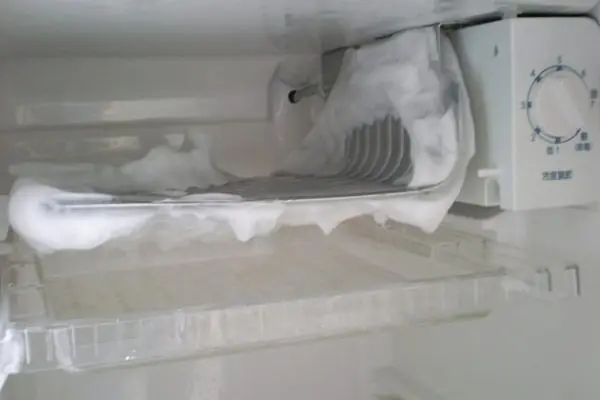
Why Your Refrigerator or Freezer May Be Covered in Frost
Frost forms when moisture enters a cold environment and freezes. Every time the refrigerator or freezer door opens, warm air from the room enters the appliance. That warm air contains moisture. When it comes into contact with cold surfaces, the moisture can condense and eventually freeze.
A small amount of frost may develop naturally in some freezer compartments, particularly in older models or manually defrosted freezers. However, excessive frost can interfere with normal operation and make the appliance less efficient.
There are several common reasons this happens.
One of the most frequent causes is a door that is not completely sealed. Even a small gap can allow warm, humid air to enter continuously. The moisture freezes on cold surfaces, and the buildup gradually becomes thicker.
Another possibility is that the door is being opened too frequently or left open longer than necessary. This is particularly common in busy households where family members repeatedly open the freezer to search for food.
Food containers may also interfere with the door closing properly. A large package, a poorly positioned drawer, or an item sticking out from the shelf can prevent the door from sealing tightly.
Blocked air vents can create another problem. Refrigerators depend on airflow to distribute cold air throughout their compartments. When food is packed too tightly against vents, air circulation may become restricted. Certain areas may become unusually cold, while other areas may not receive enough cooling.
In some cases, frost buildup may be caused by a malfunctioning automatic defrost system. Modern frost-free refrigerators periodically heat the evaporator area to melt accumulated ice. If a component in this system fails, frost may gradually accumulate until it begins affecting the refrigerator's performance.
Understanding the difference between a simple moisture problem and a mechanical issue can help you avoid unnecessary repairs while also preventing a small problem from becoming a bigger one.
The Simple Fix: Give Your Refrigerator a Proper Defrost
If your freezer is covered in frost and the buildup is substantial, a complete manual defrost may be the first practical step to try—provided your refrigerator's manufacturer instructions allow it.
This process removes accumulated ice and gives you an opportunity to inspect the interior for possible causes of the frost.
Before starting, remember that food safety matters. Perishable food should be kept at safe temperatures during the process. If you have a large amount of frozen food, consider transferring it to another freezer or a properly insulated cooler with ice packs. Avoid leaving food at room temperature for extended periods.
Step 1: Remove the Food
Begin by taking food out of the freezer and refrigerator compartments as appropriate for your model and the amount of ice you need to remove.
Organize the food so that items remain cold. Frozen food can often be kept together in an insulated cooler, where the frozen items help keep one another cold. If you have access to another freezer, temporarily transferring the food may be the easiest option.
This is also a good opportunity to check expiration dates and discard food that has been forgotten for months.
Remove baskets, drawers, and removable shelves if your manufacturer's instructions allow it. Be careful with plastic components because they may become brittle when cold and can crack if forced.