However, witness accounts must be evaluated carefully.
A frightening event can happen in seconds, and people may remember different details. Some may have been standing close to the collision, while others saw it from across the street.
Investigators compare accounts rather than relying on a single description.
They may also ask whether a witness noticed the vehicle braking, swerving, accelerating, or striking another object before it reached the pedestrians.
These details can help establish what happened, but they do not automatically prove why it happened.
Surveillance and other recordings
Modern city streets often contain cameras on buildings, businesses, traffic infrastructure, or nearby vehicles.
Investigators may seek available footage to determine the vehicle's movement before the collision.
Video can help clarify the timeline, but it also has limitations. A camera may not show the entire street, and the angle may obscure important details.
A recording can establish that a vehicle crossed a particular point, but it may not explain whether the driver experienced a medical event, a mechanical problem, or another issue.
That is why investigators usually combine video with physical evidence, witness statements, and medical or vehicle examinations.
The Driver Was Arrested and Later Indicted
The driver was identified in later reports as Elvin Suarez, 61.
Following the crash, police arrested him and filed charges that included driving while intoxicated and manslaughter-related offenses.
On July 15, 2026, the Manhattan District Attorney's Office announced that Suarez had been indicted on multiple charges connected to the collision. Prosecutors alleged that he had been driving while intoxicated and at a high rate of speed.
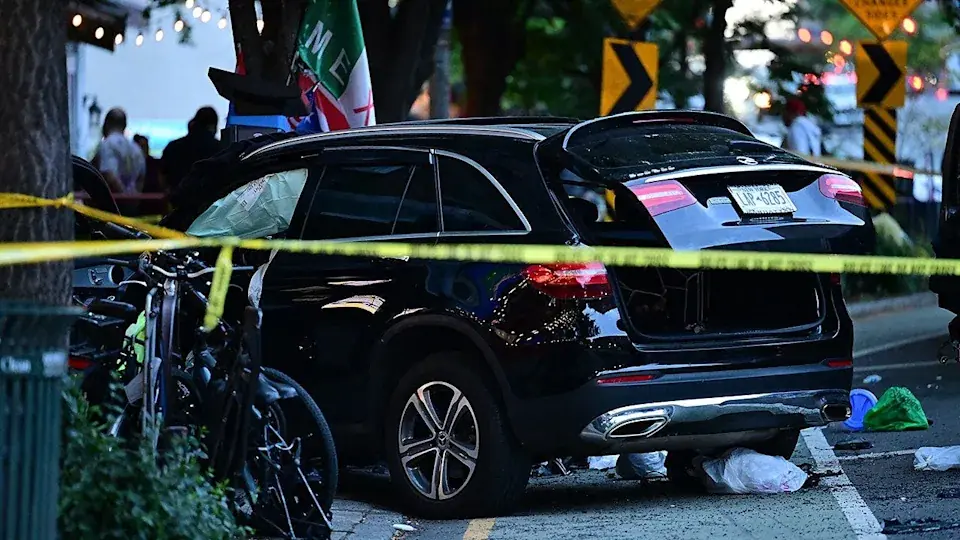
The indictment included charges of aggravated vehicular homicide, manslaughter in the second degree, aggravated vehicular assault, and aggravated driving while intoxicated, among other offenses.
These are serious allegations, and they must be described accurately.
An arrest means that authorities have taken a person into custody in connection with a suspected offense. An indictment means that a grand jury has formally charged the person. Neither is the same as a conviction.
A criminal case must proceed through the legal process, and the accused is entitled to the presumption of innocence unless proven guilty.
That principle is important even in cases involving devastating consequences.
The victims and their families deserve justice, and the public deserves an accurate account of what happened. Those goals are best served by careful reporting that distinguishes allegations from findings made by a court.
Why the charges matter
The charges reflect the seriousness of the consequences prosecutors say resulted from the driver's actions.
When a collision causes deaths or serious injuries, authorities may investigate whether the driver violated traffic laws, operated a vehicle while impaired, or acted in a way that created an unreasonable danger to others.
Different charges address different alleged conduct and consequences.
Vehicular homicide and manslaughter charges concern deaths allegedly caused by the operation of a vehicle. Vehicular assault charges concern serious injuries. Driving while intoxicated charges address alleged impairment behind the wheel.
The precise elements of each offense depend on the law and the facts of the case.
The legal process must determine whether the evidence satisfies those elements.
For families who have lost someone, the process can feel painfully slow. But a careful investigation and fair trial are important because the outcome may have significant consequences for everyone involved.
Why Driving While Intoxicated Is So Dangerous
Alcohol can affect the skills required to operate a vehicle safely.
It may reduce attention, slow reaction time, impair judgment, and make it more difficult to coordinate movement.
A driver may feel confident while their ability to respond to changing conditions has already been affected.
That confidence can be dangerous.
Driving requires constant decisions: how far to follow another vehicle, when to slow down, whether a pedestrian is about to cross, and how to respond when traffic changes suddenly.
Even a brief delay in recognizing a hazard can make a difference.
At city speeds, a vehicle can travel a substantial distance while a driver reacts. If the driver is impaired, distracted, or otherwise unable to respond promptly, the risk of a collision can increase.
Alcohol impairment is particularly dangerous in busy urban areas because the road environment contains many potential hazards.
Pedestrians may step into a crosswalk. Cyclists may be traveling beside traffic. Vehicles may stop unexpectedly. A parked car may begin moving into the road.
A safe driver must be prepared to respond to these conditions.
The tragedy on Amsterdam Avenue demonstrates why driving under the influence is treated as a serious public safety issue.
A decision made before getting behind the wheel can affect people who have no connection to the driver and no opportunity to protect themselves.
A safer choice is always available
People who have been drinking should not drive.
They can arrange a ride, use public transportation, contact a trusted person, or remain somewhere safe until they are sober.
The decision may require inconvenience or additional expense, but those costs are small compared with the potential consequences of an impaired-driving collision.
Friends and family can also help by discouraging someone from driving after drinking.
Taking away someone's keys or arranging a ride may feel uncomfortable in the moment, but it can prevent a tragedy.
The responsibility belongs to the driver, yet prevention is often strengthened when people around them take the risk seriously.
The Sidewalk Should Be a Place of Safety
One of the most disturbing aspects of the crash was that pedestrians were struck after the vehicle left the roadway.
Sidewalks are designed to separate people on foot from moving traffic. They provide space for walking, waiting, shopping, and meeting others.
But a curb is not an absolute barrier.
A vehicle that travels at high speed, loses control, or crosses a median can enter an area intended for pedestrians.
This is why street design matters.
Physical separation, properly designed medians, protected pedestrian areas, clear crossings, and lower vehicle speeds can help reduce the likelihood that a driver will reach people on foot.
No single measure can prevent every crash. However, several layers of protection can make a street more forgiving when a driver makes a mistake or a vehicle experiences a problem.
A safer street is one where a single error does not automatically become a fatal event.
The importance of speed
Speed affects both the likelihood of a crash and the severity of its consequences.
A vehicle traveling faster requires more distance to stop. It also carries more energy, which can make an impact more destructive.
When a vehicle strikes a pedestrian, the person has very little physical protection.
The difference between a collision at a lower speed and one at a much higher speed can be enormous.
This is one reason cities use speed limits, traffic calming, raised crossings, narrower lanes, and other design features to encourage slower driving in areas with many pedestrians.
Drivers should also recognize that the posted speed limit is not always the safest speed for every condition.
A busy street, poor visibility, wet pavement, or a crowded sidewalk may require additional caution.