The marks were small, slightly reddish, and appeared to form unusual circular patterns around the base of the hairline.
She assumed they would disappear within a few days.
But days turned into weeks, and the marks remained.
Two months later, the situation had become increasingly concerning. Instead of fading, the reddish patches seemed more noticeable. Some areas appeared darker than before, while others developed irregular, ring-shaped borders. The skin around the affected area looked irritated, and the unusual patterns raised questions that no parent would want to face: What was happening to her child's skin, and why wasn't it getting better?
For parents, discovering a persistent skin condition in a young child can be frightening. Many childhood rashes are harmless and temporary, but a skin problem that continues for two months, particularly one that appears to be getting worse, deserves proper medical attention.
So, what could cause these unusual circular marks on an eight-year-old child's neck?
The answer may involve several different skin conditions, some relatively harmless and others requiring specific medical treatment. Understanding the possibilities can help parents know what to look for and when to seek professional advice.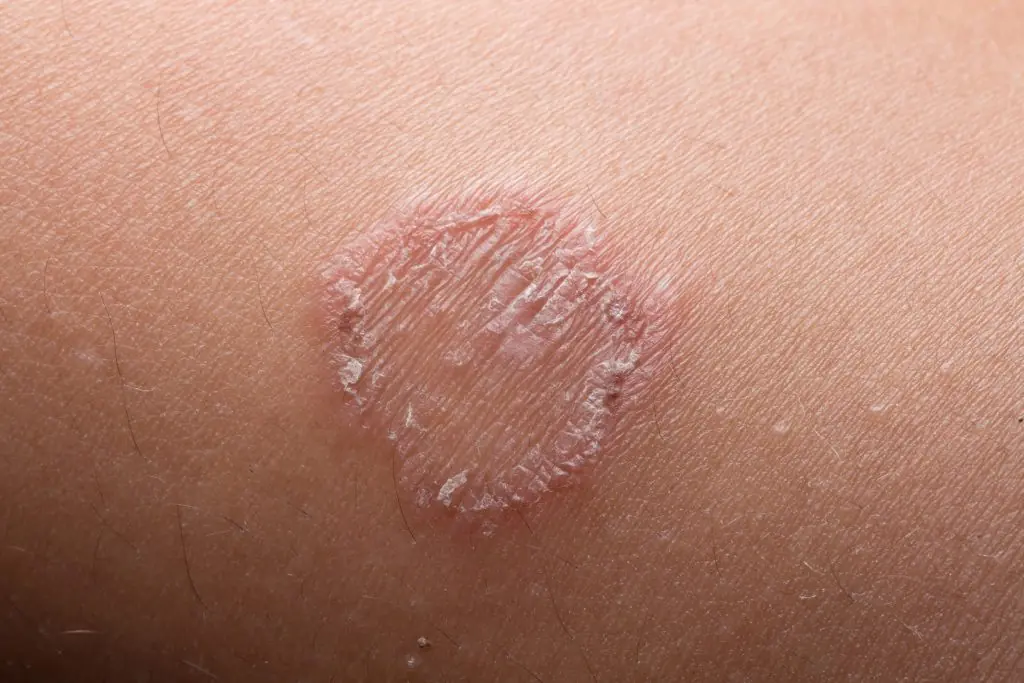
1. The Appearance of the Marks: What Makes Them Unusual?
Looking at the photograph, several reddish, irregularly shaped marks can be seen across the back of the child's neck. Some appear circular or crescent-shaped, while others resemble incomplete rings or curved patches.
They are concentrated around the nape, just below the hairline, although the affected areas appear to extend toward the sides of the neck.
The shape of a skin lesion can sometimes provide useful clues to a dermatologist. For example, certain fungal infections produce circular patches with more noticeable outer borders. Other inflammatory skin conditions can create ring-like patterns without being caused by an infection.
However, appearance alone cannot establish a diagnosis.
A dermatologist would want to know whether the marks are itchy, painful, warm, scaly, raised, or spreading. They would also examine whether the skin in the center of each ring looks different from the surrounding area.
The fact that the condition has persisted for approximately two months is particularly important.
A rash that changes over time may provide more diagnostic information than a single photograph. This is why keeping a record of its progression can be helpful.
2. Could It Be Ringworm?
One possibility doctors may consider is tinea corporis, commonly known as ringworm.
Despite its name, ringworm is not caused by a worm. It is a fungal infection affecting the outer layers of the skin.
Ringworm frequently appears as circular or oval patches with a reddish, slightly raised, scaly border. The center may appear relatively clearer or less inflamed, creating the familiar ring-shaped appearance.
Children are particularly susceptible because they frequently come into contact with other children, shared surfaces, sports equipment, and household pets.
The infection can spread through:
-
Direct skin-to-skin contact with an infected person.
-
Contact with infected cats, dogs, or other animals.
-
Shared towels, clothing, bedding, or personal items.
-
Contaminated surfaces and sports equipment.
On the neck, fungal infections may sometimes be mistaken for eczema, irritation, or an allergic reaction.
One important clue is the progression of the rash. Untreated ringworm can gradually expand, and new patches may develop as the fungus spreads to nearby areas.
A doctor can often evaluate suspected ringworm through a skin examination and, when necessary, a skin scraping examined under a microscope.
If confirmed, treatment usually involves an appropriate antifungal medication. The exact treatment depends on the location, severity, and extent of the infection.
Parents should avoid using steroid creams on a suspected fungal infection without medical advice. Steroids can temporarily reduce redness while allowing certain fungal infections to become more extensive or harder to recognize.
3. Another Possibility: Granuloma Annulare
Another condition that can produce unusual circular marks in children is granuloma annulare.
This is a relatively uncommon inflammatory skin condition that often appears as small, firm bumps arranged in circular or ring-shaped patterns.
Unlike typical fungal infections, granuloma annulare usually does not produce a scaly border. The affected areas may be skin-colored, pink, reddish, or slightly darker than the surrounding skin.