Checking the “Clubbing Finger” Sign: A Simple Way to Identify Early Warning Signs of Lung and Heart Disease
Many serious diseases develop silently, showing few symptoms in their early stages. However, doctors note that some warning signs can appear on the hands, long before obvious symptoms begin.
One such sign is known as finger clubbing — a physical change in the fingers that may be associated with lung cancer, chronic lung disease, and certain cardiovascular conditions.
The good news is that this sign can be checked easily at home.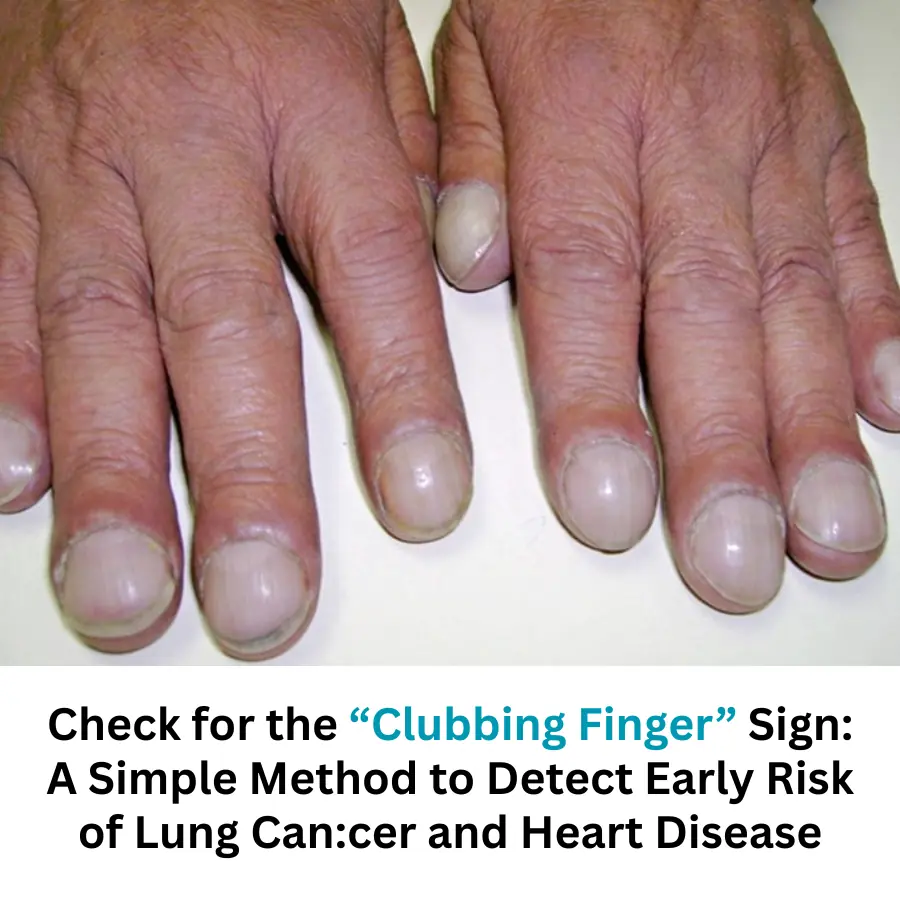
What Is Finger Clubbing?
Finger clubbing is a condition in which:
-
The fingertips become enlarged or rounded
-
The nails curve downward more than normal
-
The angle between the nail and nail bed increases
These changes usually develop gradually and are often painless, which is why many people do not notice them.
Why Can Finger Clubbing Be a Warning Sign?
Medical research suggests that finger clubbing is linked to long-term low oxygen levels in the blood.
This condition may occur in people with:
-
Lung cancer
-
Chronic lung diseases
-
Congenital or acquired heart disease
-
Certain gastrointestinal or liver conditions
In these cases, reduced oxygen delivery may trigger changes in blood flow and tissue growth at the fingertips.
The Simple Home Test: The Schamroth Window Test
Doctors recommend a quick self-check known as the Schamroth Window Test.
How to Perform the Test
-
Place the nails of both index fingers against each other
-
Align them nail-to-nail
-
Observe the small gap between the nail beds
How to Interpret the Result
-
Normal result: A small diamond-shaped gap (“window”) is visible
-
Possible clubbing: The gap is reduced or completely absent
If the window is missing, further medical evaluation may be needed.

Important Notes About the Test
-
This test is not a diagnosis
-
Some people naturally have nail variations
-
Finger clubbing develops over time, not suddenly
The test is meant as a screening tool, not a replacement for professional examination.
When Should You See a Doctor?
You should consider medical evaluation if:
-
Finger shape changes progressively
-
Nails appear more curved or swollen
-
Clubbing is accompanied by symptoms such as:
-
Persistent cough
-
Shortness of breath
-
Chest pain
-
Fatigue or dizziness
-
Early medical assessment can help identify underlying conditions sooner.
Why Early Detection Matters
Conditions such as lung cancer and heart disease have better outcomes when detected early.
Doctors emphasize that:
-
Early-stage diseases may respond better to treatment
-
Monitoring subtle physical signs can save time
-
Waiting for severe symptoms may delay care
Finger clubbing does not always indicate cancer, but it should never be ignored.
What Finger Clubbing Does NOT Mean
Medical experts clarify:
-
Not everyone with clubbing has cancer
-
Not all lung or heart diseases cause clubbing
-
Clubbing alone cannot confirm any diagnosis
It is simply a signal to investigate further.
Final Message
Your hands may reveal more about your health than you realize.
Checking for the clubbing finger sign takes only seconds,
but it may help prompt earlier medical attention for serious conditions.
When in doubt, always consult a healthcare professional.