Don’t Be Fooled by Supermarkets: What Are You Really Buying When You See Unfamiliar Meat?
A tray of meat can look perfectly ordinary until you take a closer look. In the photograph circulating online, a large pile of pale, tubular pieces of animal tissue is displayed on a counter. Some pieces have been cut open, revealing distinctive folded interiors. The accompanying warning tells shoppers not to be fooled by supermarkets and suggests that the meat being sold may not be what customers think it is.
It is an unsettling message—but an important question comes first: what does the photograph actually show, and what can it prove?
The pieces appear consistent with animal intestines or other tubular offal, possibly pork intestines. However, an image alone cannot establish the exact animal species, where the products came from, how they were processed, or whether a supermarket has mislabelled anything. Nor does the photograph prove that a retailer is secretly selling one kind of meat as another.
That distinction matters. Consumers deserve clear labels and honest information, but they also deserve accurate reporting rather than fear built around an unexplained photograph. To understand what may be on the counter, shoppers need to know how offal is identified, what food labels should tell them, and which checks can help them make safer, more informed choices.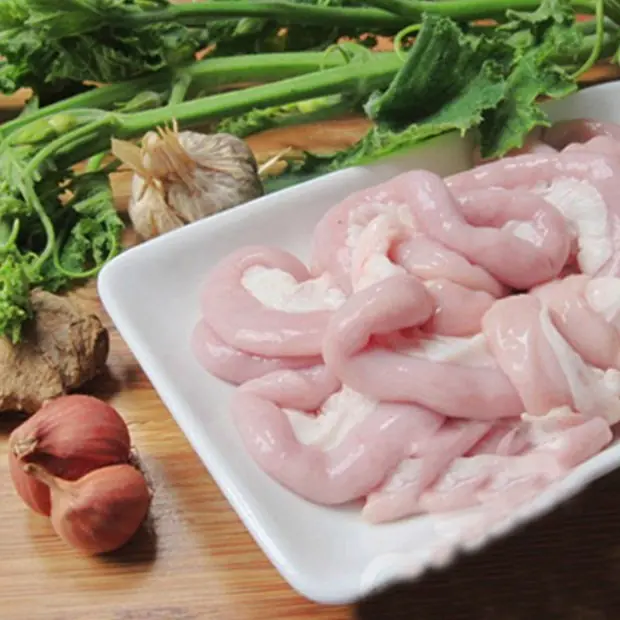
Chapter 1: What Is Actually Shown in the Photograph?
The shape of the pieces offers a useful clue. Many are tubular, some are folded or coiled, and several have been cut across so that their inner structure is visible. These features are consistent with intestines, which are commonly sold as edible offal in markets around the world.
In particular, the photograph resembles displays of pork intestines, including sections of small or large intestine. But the image is not clear enough to identify every piece with certainty. Different organs can look similar after cutting, cleaning, blanching, or arranging them for sale. Other animal species also have edible intestines.
The word offal refers broadly to edible parts of an animal other than ordinary skeletal-muscle cuts. Depending on the food traditions and regulations of a country, this category can include intestines, stomach, liver, heart, kidneys, tongue, and other organs.
Offal is not automatically fake meat, spoiled meat, or an indication of supermarket deception. It is a recognized food category in many countries and is used in traditional dishes across Asia, Europe, Africa, and the Americas.
The real consumer question is whether the product is accurately identified, legally sourced, properly inspected, handled hygienically, and stored at a safe temperature.
That is where the discussion becomes more important than the photograph itself.
Chapter 2: Why Do People Around the World Eat Animal Intestines?
For some shoppers, the sight of a tray filled with intestines may be surprising. For millions of other people, however, these products are familiar ingredients that have been prepared in family kitchens for generations.
Intestines are not a newly invented food, nor are they exclusive to one country or culture. They are part of a much broader tradition of using edible parts of an animal rather than limiting meals to familiar muscle cuts.
In English-speaking communities in the United States, pork intestines are often called chitterlings or chitlins. In China, pork intestines may be braised with soy sauce and spices, stir-fried with vegetables, or cooked in hot pots. In Korea, dishes such as gopchang and makchang feature different sections of animal intestines, often grilled and served with sauces and vegetables. In Vietnam, intestines are used in boiled, grilled, stir-fried, and hot-pot dishes. In Spain and other European countries, intestines are used in regional recipes and traditional sausages.
The preparation methods vary considerably, but the basic idea is similar: an edible part of an animal is cleaned, prepared, seasoned, and cooked into a dish.
A tradition built around using more of the animal
For earlier generations, making full use of an animal was often a practical necessity. Meat was valuable, and families and butchers had strong reasons to use edible organs and other parts that might otherwise be discarded.
Over time, these ingredients became part of regional food cultures. Recipes were passed between generations, and communities developed distinctive ways of preparing them.
In the American South, chitterlings became associated with particular family and holiday traditions. Their history is also connected to the difficult experiences of enslaved African Americans, who developed food traditions under severe economic and social constraints. The history is complex, and it should not be reduced to a simple story about inexpensive food. For many families, the dish remains connected to heritage, memory, and shared meals.
In East Asia, intestines are valued for their texture and ability to absorb seasonings. Some cooks simmer them slowly until tender; others grill them to develop a browned exterior. In Vietnam, they may be served with herbs, dipping sauces, rice dishes, or hot pot.
The same ingredient can therefore carry very different meanings depending on the country, household, and recipe.
Why the texture is distinctive
Intestinal tissue is not the same as ordinary skeletal muscle. Its structure includes layers of tissue, smooth muscle, and connective components. These differences create a texture that may be firm, chewy, or tender depending on the section and how it is cooked.
Large intestines are generally thicker than small intestines. Some sections have a substantial wall, while others are narrower and more delicate. The texture also changes with cleaning, blanching, simmering, grilling, and frying.
This is one reason why two products both described as pork intestines may look and feel quite different.
Why some people avoid offal
Not everyone enjoys these foods, and there is no reason that they should.
Some people dislike the appearance of raw organs. Others find the texture unfamiliar or the smell unpleasant. Some avoid offal for cultural, religious, medical, or personal dietary reasons.
Those preferences are entirely reasonable.
The important point is that an ingredient should be identified honestly. People who do not want to eat intestines should be able to recognize the product and choose something else. People who do enjoy them should be able to purchase them with confidence that they are correctly labelled and safely handled.
The presence of intestines in a supermarket or butcher's display is not, by itself, evidence that customers are being deceived.
The real questions are what the product is, where it came from, and how it was processed.
Chapter 3: What Happens Before Intestines Reach a Supermarket?
A tray of cleaned intestines may look like a simple food product, but getting it ready for sale involves several stages.
Unlike a familiar cut of pork or beef, intestines require specialized handling because they are part of the digestive tract. Their contents must be removed, and the tissue must be processed in a way that reduces contamination risks.
The exact process varies according to the animal species, the section of the digestive system, the intended product, and the rules in the country where it is produced.
1. Separation at the processing facility
The process generally begins at an authorized slaughterhouse or meat-processing facility.
After slaughter, the digestive organs are separated from the carcass. Workers identify the relevant sections and handle them according to the facility's procedures.
This stage requires care. If the gastrointestinal tract is punctured or its contents spill, microorganisms may spread to surrounding tissues, equipment, or other products.
Food-safety guidance therefore emphasizes careful handling during the removal of the digestive tract and the prevention of cross-contamination.
2. Removing the contents
Intestines are not ready for retail sale immediately after they are separated.
Their contents must be removed through appropriate processing methods. Depending on the product, the tissue may be opened, flushed, turned inside out, or otherwise prepared.
Different sections require different techniques.
Small intestines, large intestines, and other digestive organs do not necessarily have the same structure or intended use. A processor must know which product is being prepared and follow the appropriate procedure.
3. Cleaning and inspection
After the contents have been removed, the intestines may be rinsed and cleaned to remove remaining material and visible impurities.