This reduces the need to move around the kitchen while handling raw intestines.
Step 1: Prepare the kitchen first
Before beginning, collect everything you need.
This may include:
-
A suitable pot.
-
Clean knives and cutting boards.
-
A bowl or container for raw product.
-
Seasonings and cooking ingredients.
-
Paper towels.
-
Soap and warm water.
-
Suitable cleaning and disinfecting products.
Keep raw intestines away from vegetables, bread, cooked food, and other items that will not receive further cooking.
Use separate utensils for raw products and ready-to-eat ingredients.
Step 2: Keep children away from the preparation area
Young children should not be present while raw chitterlings are being handled.
Arrange for another adult to supervise them in a different area.
This helps reduce the possibility of transferring microorganisms from hands or surfaces to children's toys, bottles, pacifiers, and other belongings.
Step 3: Store raw intestines correctly
The CDC advises freezing raw chitterlings if they will not be cleaned and cooked within two days.
If frozen, they should be thawed in the refrigerator in a bowl or bucket covered with plastic wrap. This helps prevent liquid from dripping onto refrigerator shelves or other foods.
The CDC also advises using raw chitterlings within two days after thawing.
Do not leave raw intestines on the kitchen counter to thaw for an extended period.
Step 4: Wash your hands
Wash hands thoroughly with soap and warm water for at least 20 seconds before preparing the product.
Repeat handwashing after handling raw intestines, touching contaminated packaging, or cleaning the preparation area.
Handwashing is one of the simplest and most important ways to reduce the spread of microorganisms.
Step 5: Follow the CDC's initial boiling advice
For raw chitterlings, the CDC advises boiling them in water for at least five minutes before cleaning.
This step helps reduce germs that could spread to hands and countertops during the cleaning process.
It should not be mistaken for the complete cooking stage.
Step 6: Clean the intestines carefully
Follow the product's preparation instructions and appropriate food-safety guidance.
Remove unwanted material as required for the particular product. Use clean equipment and avoid splashing liquid around the kitchen.
Do not use cleaning chemicals, household detergents, or disinfectants directly on food.
Disinfectants are for suitable kitchen surfaces and equipment, not for making raw intestines safe to eat.
Step 7: Cook until thoroughly done
After cleaning, boil and simmer the intestines until they are thoroughly cooked and tender.
The CDC specifically recommends that chitterlings be well cooked before serving.
Do not taste them while raw or partially cooked.
If the product is packaged with cooking instructions, follow those directions in addition to relevant food-safety recommendations.
Step 8: Clean and disinfect the kitchen
After preparation, wash pots, pans, knives, cutting boards, and utensils thoroughly.
The CDC recommends using a solution of one tablespoon of household bleach to one gallon of water on surfaces that have been touched by raw chitterlings, their juices, or contaminated hands.
Follow the CDC's instructions for applying, rinsing, and drying the solution. Never mix bleach with other cleaning chemicals.
Wash hands again before preparing other foods or touching children.
Step 9: Keep cooked food separate
Once the intestines are cooked, place them on a clean plate or in a clean container.
Do not put cooked food back onto a plate that previously held raw intestines unless it has been thoroughly washed.
Use clean serving utensils.
These precautions may seem demanding, but they help protect everyone who will eat the meal.
Chapter 9: Nutritional Value — Are Intestines Healthy to Eat?
Another question shoppers may ask is whether animal intestines have nutritional value.
Like other edible animal tissues, intestines can provide protein. Their nutritional composition depends on the specific section, the amount of fat remaining, and how the product is prepared.
It would be inaccurate to describe all intestinal dishes as either healthy or unhealthy without considering the full recipe and portion size.
Protein content
Protein is necessary for building and maintaining body tissues.
Animal intestines contain protein, although the exact amount varies by species and anatomical section.
A portion of boiled intestines will not necessarily have the same nutritional profile as a portion of fried intestines or intestines cooked with a rich sauce.
Consumers who want precise nutritional information should consult the product label or a reliable food-composition database.
Fat and calories
The fat content of intestines can vary.
Some preparations retain more fat than others. Additional oil, butter, or fatty ingredients can significantly increase the energy content of a dish.
Deep-fried intestines may contain substantially more calories than a simpler boiled or simmered preparation.
For people monitoring their energy intake, cooking method and portion size matter.
Sodium in prepared dishes
Intestines are often seasoned with salt, soy sauce, fermented sauces, or prepared spice mixtures.
These ingredients can add considerable sodium.
People who need to limit sodium intake should consider the entire recipe rather than focusing only on the main ingredient.
A dish containing intestines may have a very different nutritional profile depending on whether it is lightly seasoned or heavily salted.
The role of portion size
Even foods that provide useful nutrients should be considered within an overall eating pattern.
A balanced diet includes a variety of protein sources, vegetables, fruits, grains, and other foods appropriate to a person's needs.
There is no reason to treat intestines as a necessary health food, and there is no reason to assume that eating them occasionally is automatically harmful when they are properly sourced and prepared.
People with specific medical or dietary requirements should follow advice from their healthcare professionals.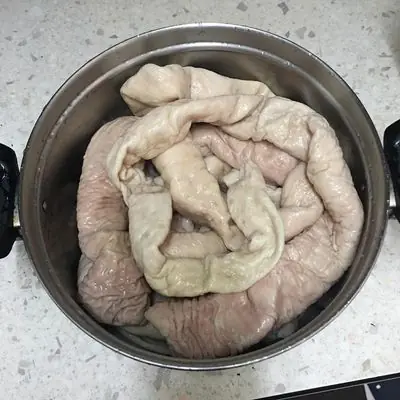
Does eating offal have to be part of a healthy diet?
No.
Some people enjoy offal as part of their cultural food traditions. Others prefer ordinary muscle meat, fish, poultry, plant-based proteins, or other ingredients.
A balanced diet does not require everyone to eat intestines.
The most important issues are food quality, safe preparation, nutritional balance, and personal choice.
Chapter 10: Why Some Intestines Look Different From Others
The photograph shows a large collection of pale tubular pieces. Their shapes and cut surfaces vary, which may lead viewers to assume that they are all the same product.
That assumption may not be correct.
The digestive system contains different sections, and each has its own structure.
Small intestines
The small intestine is generally narrower and has a more delicate wall than the large intestine.
Depending on the animal and the section, it may be sold whole, cleaned, cut into short pieces, or prepared for other food uses.
Some small-intestine products are used in soups, grilled dishes, or sausage production.
Large intestines
The large intestine is generally thicker and more substantial.
Its texture can be firmer, and certain sections are valued in traditional recipes for their distinctive bite.
Large intestines may be simmered slowly, grilled, stir-fried, or prepared with strong seasonings.
Rectal sections and other tubular tissues
Certain sections near the end of the digestive tract can have thicker walls and different shapes.
They may be sold under specific local names, depending on the market and the anatomical section.
The names used in shops are not always identical from one country to another.
That is why a shopper should ask for the precise product name rather than assuming that every tubular piece is the same.
Why cut surfaces look unusual
When an intestine is cut across its width, the interior can reveal natural folds and ridges.
These structures are part of the digestive tract. They are not necessarily artificial patterns added during food processing.
The appearance can vary according to the section, species, preparation, and angle of the cut.
This is one reason the pieces in the photograph may look unusual to someone who is accustomed only to familiar meat cuts.
Why color varies
Raw intestines may appear pale pink, cream-colored, or light beige.
Their appearance can change after cleaning, blanching, freezing, or cooking.
However, color alone cannot confirm the exact species or determine whether the product is safe.
A shopper should not try to identify the animal solely by comparing the color of the product with an online photograph.