Cleaning is not merely a cosmetic step. It forms part of a broader hygiene process intended to reduce contamination.
However, a clean appearance does not prove that a product is microbiologically safe. Harmful bacteria cannot always be seen, smelled, or detected by looking at the surface.
This is why food safety depends on more than visual inspection.
4. Sorting by type and intended use
Once processed, intestinal sections may be sorted according to size, thickness, appearance, and intended use.
Some are sold as food ingredients. Others may be used as natural sausage casings or supplied to manufacturers and restaurants.
Products can be packaged whole or cut into shorter portions. They may be sold fresh under refrigeration or frozen for longer storage.
These differences explain why the image in the original post may show many shapes and sizes together. A mixed display could contain several sections or products, but the photograph alone cannot confirm exactly what every piece is.
5. Inspection, packaging, and storage
Before retail sale, edible offal may be subject to veterinary inspection, hygiene controls, temperature requirements, and labelling rules, depending on the jurisdiction.
Packaging should protect the product from contamination and communicate important information to the buyer.
The label should identify what is being sold, provide relevant storage instructions, and indicate whether the product is raw, cooked, frozen, or otherwise processed.
A product that looks clean but has been stored incorrectly may still be unsafe. Conversely, an unfamiliar-looking product may be perfectly legitimate when it has been properly inspected and handled.
Why the supply chain matters
Consumers rarely see the slaughterhouse, processing facility, transport vehicle, or storage room. They usually encounter the product only at the final retail stage.
That makes traceability important.
A responsible supply chain should allow the product to be connected to its source and the businesses that handled it. If a safety problem is discovered, traceability helps authorities identify affected batches and determine where they were distributed.
The photograph cannot show any of this information. It cannot establish whether the products came from a licensed facility, whether they passed the required checks, or whether they were stored at the correct temperature.
That is why the label and the seller's records matter more than a dramatic close-up.
Chapter 4: The Truth About the Supermarket Warning
The warning in the social media post is designed to make shoppers suspicious: "Don't be fooled by supermarkets. They are selling you meat from..." The unfinished wording encourages people to imagine that the product is something hidden, strange, or deliberately misrepresented.
But a warning is not proof.
The accompanying photograph does not show a supermarket label, a receipt, a supplier's document, a laboratory result, or an inspection report. It does not identify a retailer or demonstrate that a particular business sold one product under the name of another.
In fact, the article linked from the post carries an important disclaimer at the bottom of its page: it describes the story as a work of fiction created for entertainment purposes, with any resemblance to real people, events, or organizations being coincidental.
That disclaimer is significant. It means the linked page should not be treated as an investigative report proving that supermarkets are deceiving customers.
What the photograph can and cannot establish
The photograph can show that someone arranged a large quantity of pale, tubular animal tissue on trays or a counter.
Its appearance is consistent with cleaned animal intestines, possibly pork intestines. The cut ends and folded interiors resemble structures that can be seen in sections of the digestive tract.
But the photograph cannot establish:
-
The exact species of animal.
-
Whether all pieces come from the same animal.
-
Whether the pieces are small intestine, large intestine, or another section.
-
The name of the supplier.
-
The location where the products were processed.
-
Whether the products passed official inspection.
-
Whether the products were sold in a supermarket.
-
Whether any retailer mislabelled them.
These are not details that can be reliably determined from appearance alone.
Offal is not a secret substitute for ordinary meat
In food regulations, offal is a recognized category of edible animal material. Depending on the regulatory system, it can include organs and other edible tissues such as liver, heart, kidneys, tongue, stomach, and intestines.
Some food standards distinguish ordinary skeletal-muscle meat from edible offal. Other rules specify how products containing offal must be described.
For example, food labelling rules in New Zealand require certain meat products containing offal to identify its presence or name the particular type. Other countries have their own requirements.
The details differ between jurisdictions, so one country's labelling rules should not be assumed to apply everywhere.
The general consumer principle is straightforward: the product should be described accurately, and customers should be able to understand what they are buying.
What would count as evidence of deception?
If a retailer were accused of selling pork intestines as beef, or selling one animal's organs under the name of another, the accusation would require evidence.
That might include:
-
The original product label.
-
Supplier and purchase records.
-
Traceability documentation.
-
Inspection records.
-
Laboratory identification where appropriate.
-
Statements from the retailer or relevant authorities.
-
Evidence showing that the product description was inaccurate.
A photograph of unlabelled intestines does not provide that evidence.
It is reasonable for shoppers to ask questions about food origin and labelling. It is not reasonable to conclude that an entire supermarket industry is deceiving customers based on one unexplained picture.
Why the distinction protects consumers
Accurate information helps shoppers make choices that match their dietary, cultural, religious, and personal requirements.
A person who avoids pork needs to know whether a product contains pork. Someone who does not eat offal should be able to identify it. A customer with a particular dietary restriction may need to know whether a product contains organs, additives, or other ingredients.
Clear labelling protects those choices.
Sensational warnings, by contrast, can make people fearful without giving them the information they need.
The useful question is not simply, "Should I be frightened by this picture?" It is, "What exactly is this product, and can the seller demonstrate where it came from?"
Chapter 5: How to Read Meat and Offal Labels Before Buying
A label is one of the most useful tools available to a consumer. It can tell shoppers what the product is, which animal it comes from, whether it has been processed, and how it should be stored.
However, labels vary between countries and product categories. A packaged item may carry a detailed ingredient list, while a butcher's counter may use a display card or provide product information when requested.
Knowing what to look for can make shopping much easier.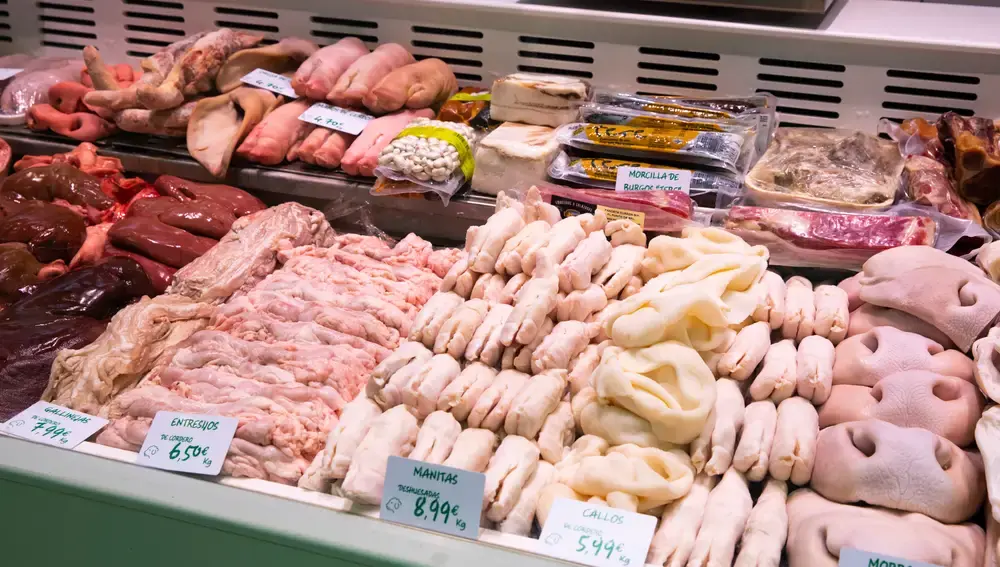
Start with the exact product name
Do not rely only on a broad word such as "meat" or "offal."
Look for a description that identifies the animal and the product as specifically as possible.
Examples include:
-
Pork small intestine.
-
Pork large intestine.
-
Beef tripe.
-
Beef liver.
-
Chicken gizzards.
-
Lamb kidney.
-
Pork stomach.
These names are not interchangeable.
For example, tripe generally refers to the stomach lining of certain animals, particularly cattle, while intestines are different parts of the digestive system.
If a package simply says "intestines," and the species is unclear, ask the retailer for more information.
Check whether the product is raw or cooked
This is especially important with offal.
Some packages contain raw intestines that need thorough cleaning and cooking. Others contain products that have been blanched, partially cooked, fully cooked, or prepared in another way.
A pale appearance does not necessarily mean that the food is ready to eat.
Read the preparation instructions carefully. If the package says the product is raw, treat it as raw meat even if it looks clean or has already been cut into small pieces.
Look for the ingredient list
For processed meat products, the ingredient list can help explain what is included.
A package may contain intestines along with water, salt, spices, preservatives, stabilizers, or other ingredients.