Noticing a small bump suddenly appear on your wrist can be unsettling.
You might wonder if it's an injury, a swollen joint, a tumor, or something more serious. Sometimes the lump may become more noticeable when you move your wrist, while at other times it may seem to disappear almost completely.
One common explanation is a ganglion cyst.
Ganglion cysts are fluid-filled lumps that commonly develop around joints or tendons, particularly in the wrist and hand. They are non-cancerous and, in many cases, harmless.
However, that doesn't mean every lump on the wrist is automatically a ganglion cyst.
Understanding what these cysts look and feel like, why they develop, when they may need treatment, and which warning signs shouldn't be ignored can help you know what to do next.
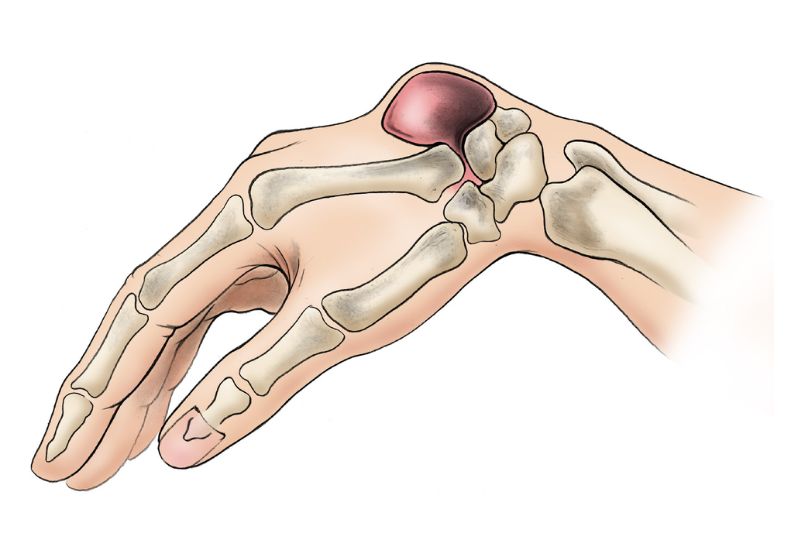
What Is a Ganglion Cyst?
A ganglion cyst is a small sac filled with a thick, jelly-like fluid.
It usually develops near a joint or tendon sheath, where connective tissue surrounds and supports movement.
The wrist is one of the most common places for these cysts to appear.
They can develop on:
-
The back of the wrist
-
The palm side of the wrist
-
The base of a finger
-
The back of a finger joint
-
Around certain tendons
A ganglion cyst may feel:
-
Smooth
-
Firm or rubbery
-
Soft in some cases
-
Round or oval
-
Slightly movable
-
Larger or smaller depending on the position of the joint
Some are barely noticeable.
Others can become large enough to be obvious.
Why Does a Ganglion Cyst Form?
The exact reason a particular person develops a ganglion cyst isn't always clear.
One theory is that the cyst develops when fluid associated with a joint or tendon pushes through a weakened area of surrounding tissue.
The resulting sac can gradually fill with thick, clear or jelly-like fluid.
Some ganglion cysts may be associated with:
-
Joint irritation
-
Repetitive wrist movement
-
Previous injury
-
Repeated stress on a joint
-
Degenerative changes around a joint
But sometimes a person develops one without any obvious trigger.
You don't necessarily need to remember an injury for a ganglion cyst to appear.
Is a Ganglion Cyst Cancer?
Ganglion cysts are non-cancerous.
That is one reason they are generally considered benign.
However, the fact that ganglion cysts are harmless doesn't mean that every lump on the wrist should be assumed to be one.
Other conditions can also cause lumps or swelling.
For example, a wrist lump could potentially be related to:
-
A lipoma
-
Arthritis
-
A tendon problem
-
A benign growth
-
An inflammatory condition
-
A previous injury
-
An infection
-
Less commonly, another type of mass
This is why a new or unexplained lump should be assessed if you're uncertain about what it is.
What Does a Ganglion Cyst Feel Like?
The texture can vary.
Some ganglion cysts feel relatively firm, while others have a softer or more compressible texture.
The cyst may become more noticeable when the wrist is held in certain positions.
Some people notice that the lump changes size over time.
It may:
-
Become larger after repetitive activity
-
Become smaller with rest
-
Remain stable for months
-
Occasionally disappear on its own
-
Return after previously shrinking
This changing behavior is one characteristic that can occur with ganglion cysts.
However, it isn't enough by itself to establish a diagnosis.
Can a Ganglion Cyst Hurt?
Yes.
Although many ganglion cysts are painless, some can cause discomfort.
Pain may occur because:
-
The cyst presses against nearby tissues
-
Movement puts pressure on the cyst
-
The surrounding joint or tendon is irritated
-
A nearby nerve becomes compressed
Some people describe the sensation as an ache or pressure.
Others may notice pain when:
-
Bending the wrist
-
Putting weight on the hand
-
Exercising
-
Typing
-
Gripping objects
-
Performing repetitive movements
A cyst located near a nerve may sometimes cause tingling, numbness, or weakness in the hand.
Those symptoms deserve medical evaluation because nerve compression can have other causes as well.
Why Does the Lump Sometimes Get Bigger?
Ganglion cysts can change in size.
Activity may influence how prominent the cyst appears, although the exact behavior varies from person to person.
Some cysts become more noticeable after repetitive wrist use.
Others remain roughly the same size.
In some cases, the cyst may temporarily shrink or disappear and later return.
This happens because the cyst communicates with a joint or tendon-related structure in some cases, allowing fluid movement between the areas.
Can a Ganglion Cyst Go Away on Its Own?
Yes, some ganglion cysts disappear without treatment.
For people who have a painless cyst that isn't interfering with movement or daily activities, doctors may recommend simply observing it.
This is sometimes called watchful waiting.
That doesn't mean ignoring it indefinitely.
It means monitoring the lump and seeking evaluation if it changes, becomes painful, interferes with movement, or develops other concerning features.
Some cysts remain for a long time without causing significant problems.
Others may fluctuate in size.
When Does a Ganglion Cyst Need Treatment?
Treatment depends on the symptoms and the individual situation.
A small, painless ganglion cyst often doesn't require treatment.
Treatment may be considered if the cyst:
-
Causes persistent pain
-
Limits movement
-
Interferes with work or daily activities
-
Causes pressure on a nerve
-
Repeatedly returns
-
Becomes particularly bothersome
The first step is usually confirming what the lump actually is.
A healthcare professional may examine the wrist and ask about when the lump appeared, whether it changes size, and whether there has been an injury.

Treatment Option 1: Observation
If the cyst isn't causing problems, observation may be all that's necessary.
Your doctor may simply recommend keeping an eye on it.
This avoids unnecessary procedures and their potential complications.
During this period, pay attention to:
-
Changes in size
-
Increasing pain
-
Reduced movement
-
Numbness
-
Tingling
-
Weakness
-
Skin changes
If any of these develop, arrange another evaluation.
Treatment Option 2: Immobilization
In some situations, a doctor may recommend temporarily limiting wrist movement or using a brace.
Reducing movement may decrease irritation and discomfort.
In certain cases, the cyst may become smaller when the affected joint is rested.
However, prolonged immobilization isn't appropriate for everyone because excessive restriction can contribute to stiffness and weakness.
Follow individualized medical advice rather than wearing a brace continuously without guidance.
Treatment Option 3: Aspiration
A healthcare professional may sometimes drain the cyst using a needle.