may aggravate symptoms in some people.
That doesn't mean you have to stop all physical activity permanently.
Instead, if an activity consistently causes pain, temporarily reducing the aggravating movement and discussing appropriate modifications with a healthcare professional may be helpful.
What About Massage?
Gentle massage around the surrounding muscles may feel relaxing for some people, but directly pressing aggressively on a wrist lump isn't necessarily helpful.
A cyst is not something that should be forcefully squeezed or manipulated.
If the lump is painful, a healthcare professional can advise whether massage, stretching, strengthening, or temporary activity modification is appropriate.
Does a Ganglion Cyst Mean Your Joint Is Damaged?
Not necessarily.
A ganglion cyst can occur around an otherwise functional joint.
In some people, it may be associated with underlying joint irritation or degenerative changes.
But simply having a ganglion cyst doesn't automatically mean your wrist is seriously damaged.
That's another reason why a proper assessment is more useful than assuming the worst.
Can Ganglion Cysts Come Back?
Yes.
Even after aspiration or surgical treatment, ganglion cysts can recur.
Recurrence depends on several factors, including the cyst's location, its connection with surrounding structures, and the treatment used.
If a cyst returns, that doesn't automatically mean something dangerous has happened.
It may simply mean that the underlying connection allowed fluid to accumulate again.
Living With a Ganglion Cyst
If your healthcare provider confirms that the lump is a ganglion cyst and it's not causing significant symptoms, you may be able to live with it without treatment.
Practical measures can include:
-
Avoiding activities that clearly aggravate pain
-
Taking breaks during repetitive wrist activity
-
Maintaining comfortable wrist positioning
-
Following any recommended exercises
-
Monitoring changes in size or symptoms
-
Seeking reassessment if symptoms change
For many people, the biggest challenge is simply the anxiety caused by seeing a lump.
Once its nature is confirmed, that uncertainty often becomes easier to manage.
The Bottom Line
A bump on your wrist can understandably make you nervous.
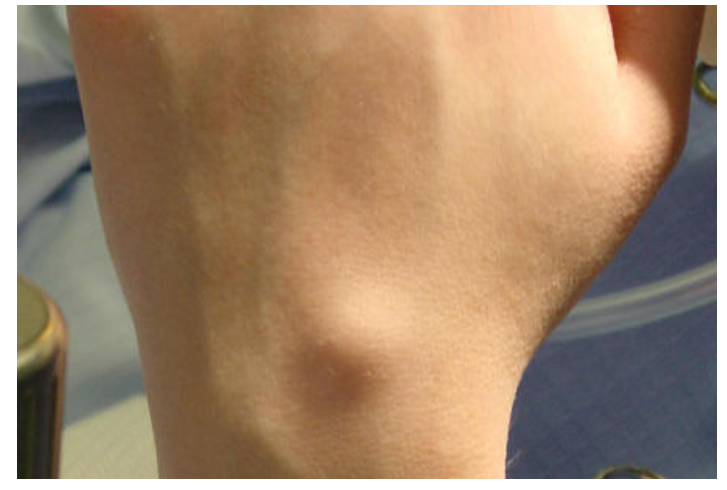
But if it turns out to be a ganglion cyst, there's reassuring news: ganglion cysts are common, benign, fluid-filled lumps and are not cancerous.
Many don't require treatment at all.
Some disappear on their own, while others remain stable for long periods.
When symptoms occur, treatment options can include observation, temporary support, aspiration, or — in selected cases — surgical removal.
The most important thing is not to assume that every wrist lump is a ganglion cyst.
If you notice a new, growing, painful, unusually hard, fixed, red, or unexplained lump, especially if it is accompanied by numbness, weakness, fever, or significant changes in movement, have it evaluated.
And remember: a lump doesn't automatically mean something dangerous.
Sometimes, what looks alarming at first is simply a small fluid-filled cyst that can be monitored or treated when necessary.