My Neighbor Gave Me a Bag of These. Anyone Know What They Are? How Are You Supposed to Eat Them?
The answer may surprise you: these fruits are not an ordinary variety of chestnut. They are the edible seeds of an unusual freshwater plant, and their hard, horn-shaped shells are part of what makes them so recognizable.
Known in different regions as singhara, ling jiao, water caltrop, and horned water chestnut, they have been eaten for generations in parts of Asia and other regions.
But before taking a bite, there are several things worth understanding. The plant has an unusual growing cycle, the fruit requires some preparation, and eating freshwater produce without proper cooking can carry health risks.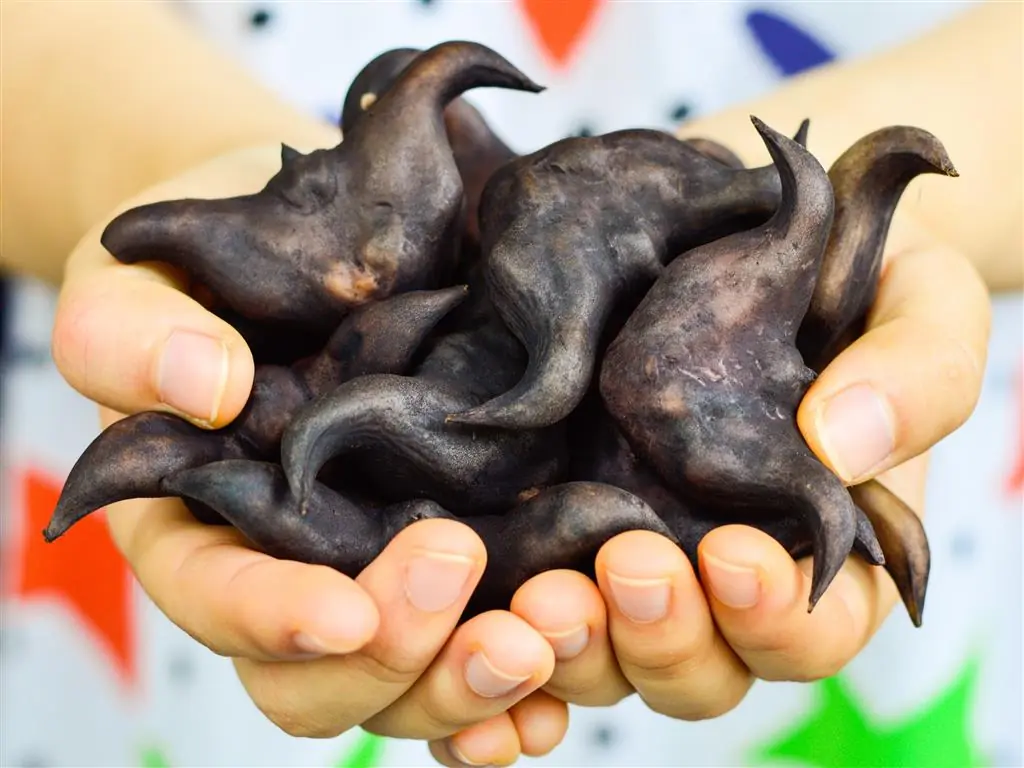
What Exactly Are Water Caltrops?
Water caltrops are the fruits of aquatic plants belonging to the genus Trapa. One commonly recognized species is Trapa natans, although several related species and varieties are also known by similar names.
Unlike the familiar chestnuts that grow on trees, water caltrops develop underwater.
The plants grow in freshwater environments such as ponds, lakes, reservoirs, and slow-moving waterways. Their roots anchor into the muddy bottom, while their stems extend upward toward the water's surface.
The leaves form distinctive floating clusters, sometimes called rosettes.
These floating leaves help the plant capture sunlight while the submerged portions remain connected to the bottom.
As the growing season progresses, small flowers develop and eventually produce fruits.
The fruit is the feature that makes the plant particularly interesting.
Instead of developing into a smooth, round nut, it forms a hard structure with two or four prominent projections.
Depending on the species and variety, the projections may look like curved horns, pointed hooks, or the sharp edges of a miniature medieval weapon.
The outside is generally dark brown, reddish-brown, or almost black when mature.
Inside is a single edible seed.
That seed is the part people traditionally eat.
The fruit's unusual appearance has inspired many different names. In some places, it is called buffalo nut because the horns resemble the shape of an animal's head. Other communities call it bat nut because the projections can look like wings.
In South Asian markets, the name singhara is especially familiar.
In Chinese-speaking regions, the fruit is often known as ling jiao.
These names can refer to different varieties, so the exact appearance may vary from one region to another.
Why Does the Fruit Have Such Strange Horns?
The horns are not decorative features.
They are part of the fruit's natural structure and play an important role in the plant's reproduction.
Water caltrops produce heavy, hard fruits that eventually separate from the plant and sink.
Their pointed projections help the fruit interact with the surrounding environment, including the muddy bottom where the seed may eventually germinate.
The hard exterior also protects the seed during its development.
This is one reason water caltrops look so different from many familiar edible nuts.
Most people are accustomed to seeing fruits with soft skins, smooth shells, or round shapes.
Water caltrops have developed a very different structure because they grow in an aquatic environment.
Their distinctive horns are especially noticeable after the fruits have been removed from the water and dried.
A freshly harvested fruit may have a slightly different color and appearance from one that has been stored for several days.
The shell can also become harder as the fruit matures.
For someone encountering these fruits for the first time, the appearance can be confusing.
They may look more like unusual seeds, small animal horns, or decorative objects than something intended for cooking.
However, their edible interior has made them an important traditional food in several regions.
How Can You Recognize a Genuine Water Caltrop?
Before preparing unfamiliar food, identification should come first.
This is particularly important when someone gives you a bag of unidentified fruits without explaining where they came from.
A typical mature water caltrop has several recognizable features.
The exterior is hard.
The shell is woody or bony rather than soft like an ordinary fruit peel.
It can be difficult to break open with your fingers.
The color is usually dark.
Mature fruits commonly appear brown, dark reddish-brown, or nearly black.
Some younger fruits may have green or reddish coloring.
The projections are prominent.
Depending on the species, there may be two or four pointed projections.
These can be curved or relatively straight.
The interior contains a pale seed.
When the shell is properly opened, the edible portion is generally white or creamy.
It has a starchy consistency rather than the juicy texture of an ordinary fruit.
The plant grows in freshwater.
The fruits develop beneath floating leaves, so their origin is an important part of identification.
Government botanical descriptions identify water caltrop as a floating, rooted aquatic plant with hard, spiny fruits containing a single seed.
There is an important distinction here: not every object with horns or an unusual shape is a water caltrop.
If the fruits are loose, unidentified, or supplied without their original packaging, ask the person who gave them to you where they were collected or purchased.
A photograph alone may not be enough for a reliable identification.
This is especially relevant to the colorful object in the supplied screenshot. Its bright green, yellow, and blue appearance is not the typical natural appearance of a mature water caltrop. It should not be identified as an edible fruit based on that image alone.
Water Caltrop Versus the Water Chestnuts Used in Asian Cooking
One of the biggest sources of confusion is the name water chestnut.
People may assume that all foods sold under this name are the same plant.
They are not.
The crunchy white pieces commonly found in Asian stir-fries, canned vegetables, and restaurant dishes generally come from a plant called Eleocharis dulcis.
This plant belongs to the sedge family.
Its edible portion is an underground corm, which is relatively round and has a brown outer covering.
Water caltrop, by comparison, belongs to the genus Trapa and produces a distinctive horned fruit.