The two plants have different growing structures and different edible parts.
The difference matters because someone searching for a recipe for one type may find instructions that are unsuitable for the other.
For example, the familiar canned water chestnuts used in stir-fries are already processed and prepared for consumption.
A freshly harvested horned water caltrop has a hard protective shell that must be handled separately.
The Florida Department of Agriculture's aquatic weed guide explicitly distinguishes Trapa natans from the edible water chestnut commonly used in Chinese cuisine.
If a neighbor gives you an unfamiliar bag of these fruits, it is worth confirming which plant they came from before deciding how to prepare them.
How Are Water Caltrops Traditionally Eaten?
This is probably the most important question for someone who has never encountered them before.
Water caltrops are not usually eaten like apples or grapes.
Their hard outer shells need to be removed, and the edible seed is generally prepared by boiling, roasting, or processing.
In several Asian communities, boiled water caltrops are enjoyed as a simple seasonal snack.
The preparation is relatively straightforward once the fruits have been correctly identified and cleaned.
Boiled Water Caltrops
Boiling is one of the traditional methods of preparing these fruits.
It softens the interior and makes the hard shell easier to open.
A practical preparation method is:
-
Select fresh, correctly identified fruits from a reliable food source.
-
Discard fruits that smell unpleasant, show signs of decay, or have damaged interiors.
-
Wash the exterior thoroughly under clean running water.
-
Use a brush to remove visible dirt from the grooves and around the projections.
-
Place the fruits in a pot of clean water.
-
Bring the water to a full boil and cook until the fruits are thoroughly heated and the kernels are tender.
-
Allow them to cool enough to handle safely.
-
Open the shells carefully and remove the white edible kernels.
Cooking time can vary according to the size, maturity, and variety of the fruit.
Do not rely on a fixed number of minutes as a guarantee that every fruit is safe.
The important point is to cook them thoroughly rather than merely warming the exterior.
Once peeled, the kernel can be eaten as a starchy snack or added to other dishes.
Its flavor is often described as mild and slightly sweet.
The texture is generally firmer than that of a cooked potato, although it can vary with maturity and preparation.
Roasted Water Caltrops
Roasting is another traditional way of preparing water caltrops.
Historical and botanical literature describes their use in a similar way to other chestnuts.
Roasting can make the hard outer shell more brittle, allowing the edible seed to be removed more easily.
The flavor may become slightly deeper and more pronounced.
However, roasting should not be treated as a shortcut that automatically makes unidentified or contaminated fruits safe.
The fruit must still be properly identified, cleaned, and heated throughout.
A reliable cooking method should be followed rather than assuming that a brief exposure to high heat is sufficient.
Water Caltrop Flour
Another interesting use is flour production.
The edible kernels contain substantial amounts of starch.
After appropriate processing, drying, and grinding, they can be turned into a fine flour.
In some traditional food cultures, this flour has been used to prepare:
-
Flatbreads.
-
Porridge.
-
Thickened soups.
-
Dumplings.
-
Pancake-style foods.
-
Sweet dishes.
-
Other starch-based recipes.
Water caltrop flour is particularly interesting because it offers an alternative source of starch.
Its use has been documented historically in parts of Europe and Asia.
A scientific review of water caltrop composition and processing describes the importance of its starch and the different ways the kernels have been processed into food ingredients.
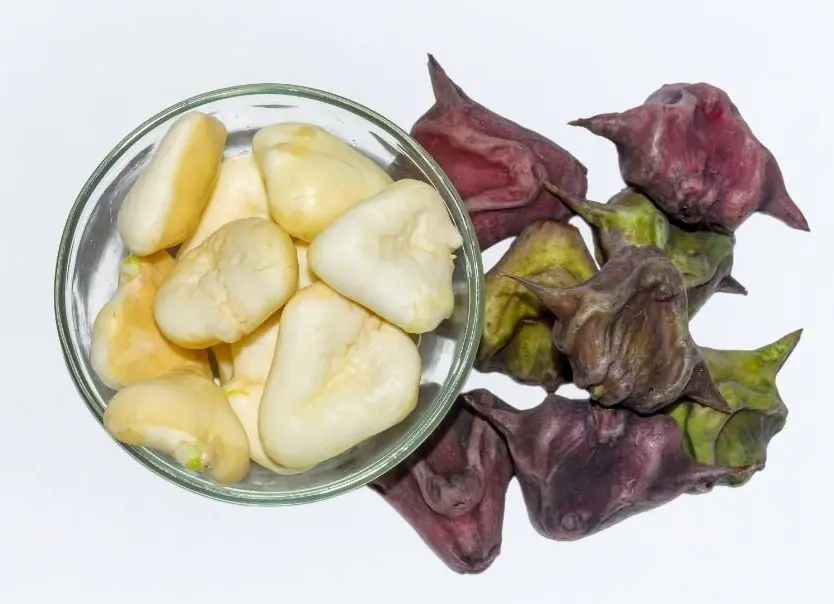
What Does a Water Caltrop Taste Like?
People who have never eaten water caltrops often wonder whether the fruit tastes like a chestnut, a potato, or something completely different.
The answer depends on the variety and how it is prepared.
The edible kernel is generally mild in flavor.
It has a starchy quality, with a slightly sweet and nutty character that some people compare to cooked chestnuts.
It is not particularly juicy.
Instead, the texture is more substantial, making it suitable for dishes that need a source of starch.
Freshly cooked kernels may be relatively firm, while more mature fruits can have a denser texture.
Roasting may bring out a deeper flavor.
Boiling tends to produce a softer, more neutral result.
This mild taste is one reason water caltrops can be incorporated into both sweet and savory recipes.
They do not necessarily dominate the flavor of a dish.
Instead, they provide substance and texture.
For people accustomed to eating potatoes, sweet potatoes, or chestnuts, the taste may feel familiar even though the appearance is unusual.
However, it is worth remembering that individual varieties can differ.
A fruit grown in one region may not taste exactly like a variety harvested elsewhere.
Why Are Water Caltrops Popular in Parts of Asia?
Water caltrops have a long history as a seasonal food in several Asian countries.
In India, the fruit is particularly associated with the name singhara.
It has traditionally been eaten boiled, roasted, or processed into flour.
In some communities, singhara flour is used in dishes prepared during religious fasting periods.
The flour can be combined with other ingredients to make pancakes, flatbreads, and sweet preparations.
In China, water caltrops are also recognized as a traditional seasonal food.
Different varieties may be sold fresh or prepared in local markets.
In Taiwan and other East Asian regions, the fruits are associated with seasonal harvests and traditional cooking.
Their popularity is partly explained by the fact that they grow naturally in freshwater environments.
In communities near ponds, lakes, and agricultural waterways, the plant can become a familiar part of the local food culture.
People who have eaten water caltrops since childhood may regard them as an ordinary seasonal snack.
For someone encountering them for the first time, however, the appearance can be surprising.
The difference between those experiences illustrates how food traditions develop around local environments.