Warning: Sleeping on Your Right Side Every Night May Affect Your Health
Your favorite sleeping position may influence nighttime reflux, breathing and comfort—but the real effects are more nuanced than many headlines suggest.
You settle into bed, turn onto your right side and close your eyes. It is a familiar position, perhaps one you have slept in for years without giving it a second thought. But what if the way you lie down each night affects more than your comfort? What if it influences whether stomach acid moves upward, whether you wake with heartburn, or whether your breathing becomes disrupted while you sleep?
The subject has attracted attention because the difference between sleeping on the right and left sides may matter for certain people, particularly those who experience acid reflux. The position of the stomach and the way gravity acts on its contents can influence how easily acid reaches the esophagus. For some people, turning onto the left side may reduce nighttime reflux symptoms.
But the headline needs an important qualification: sleeping on your right side is not automatically harmful, and there is no universal medical rule that everyone must sleep on the left. Your health conditions, pregnancy status, breathing patterns, body structure and personal comfort all matter.
To understand why doctors sometimes recommend changing sides, it helps to look beyond the position itself. The next sections explain what happens inside the digestive system when you lie down, why left-side sleeping may help with reflux, and when other positions may be more suitable. They also examine the possible disadvantages of remaining on one side all night—and the practical adjustments that may improve sleep without turning bedtime into another source of worry.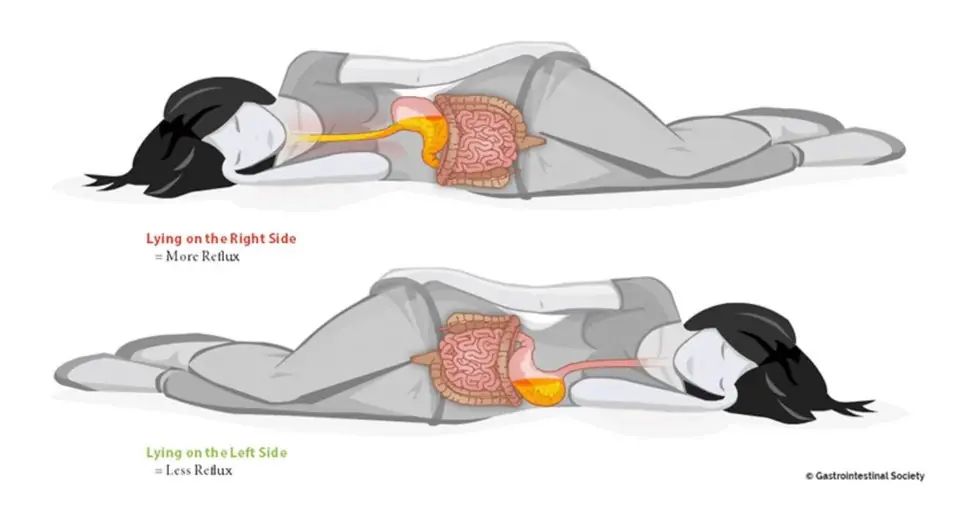
Chapter 1: What Happens Inside Your Body When You Lie on Your Right Side?
The human body does not stop working when the lights go out. While you sleep, your digestive system continues processing food, your heart keeps circulating blood, your lungs maintain breathing, and your brain moves through stages of activity that support memory and recovery.
Your sleeping position changes the way gravity acts on parts of the body. This is particularly relevant to the digestive system because the stomach is not a simple upright container. It is a curved organ, and its connection to the esophagus has a particular position within the upper abdomen.
The esophagus is the muscular tube that carries food from the mouth to the stomach. At its lower end is a ring of muscle known as the lower esophageal sphincter. It acts like a valve: it relaxes to allow food and liquid to enter the stomach and normally tightens again to help prevent stomach contents from moving backward.
When this valve does not close effectively, stomach contents can flow into the esophagus. This backward movement is called gastroesophageal reflux. The material that rises may include stomach acid and partially digested food.
A small amount of reflux can happen to healthy people. It does not necessarily mean that someone has a disease. However, repeated reflux that causes troublesome symptoms or complications may be diagnosed as gastroesophageal reflux disease, commonly known as GERD.
Body position can influence how easily reflux occurs. When a person is upright, gravity helps keep stomach contents lower. When lying down, that assistance is reduced. The relationship between the stomach and the esophagus becomes especially important.
When a person lies on the right side, the position of the stomach relative to the esophageal opening may make it easier for stomach contents to reach the area where reflux occurs. By contrast, lying on the left side may help keep the stomach contents positioned below the esophageal connection.
This is not simply a popular wellness theory. Medical research has examined the relationship between sleep position and nighttime reflux. The American College of Gastroenterology's GERD guideline discusses evidence that lying on the right side can increase nighttime reflux compared with lying on the left, and it recognizes left-side sleeping as a possible lifestyle measure for people with reflux symptoms.
The effect is most relevant to people who already experience heartburn, sour-tasting fluid in the mouth or other reflux symptoms at night. Someone who sleeps on the right side and never experiences digestive discomfort does not necessarily need to change their position.
The important point is that sleeping position can influence a physical process, but it does not affect everyone in the same way.
Chapter 2: Why Sleeping on the Right Side May Make Acid Reflux Worse
To understand the difference between the two sides, imagine the stomach as a curved pouch with an entrance connected to the esophagus. The location of that entrance and the position of the stomach contents change in relation to gravity when the body turns.
When someone lies on the right side, stomach contents may sit closer to the gastroesophageal junction, the area where the esophagus meets the stomach. This can create conditions that make reflux more likely or allow acid to remain in contact with the esophagus for longer.
The esophagus is not designed to hold stomach acid for extended periods. Its lining is different from the stomach lining, which has protective mechanisms against the digestive acid it contains. When acid repeatedly moves upward, it can irritate the esophagus and cause the familiar burning sensation associated with heartburn.
This may explain why some people notice that their symptoms become worse after going to bed. During the day, they may spend most of their time sitting, standing or walking. At night, they lie flat for several hours, and gravity no longer helps in the same way.
A person who eats a large meal shortly before bed may be particularly likely to notice discomfort. The stomach is still processing food, and lying down soon afterward can make reflux symptoms more troublesome.
The right-side position may add another factor for people who are already prone to reflux. It is not necessarily the original cause of GERD, but it may make nighttime symptoms more noticeable.
Research has compared left-side, right-side and back-sleeping positions in people with reflux. A systematic review and meta-analysis published in 2023 concluded that left-side sleeping may reduce nighttime acid exposure and improve GERD-related quality of life compared with other positions, although the number and type of studies available were limited.
PubMed
This qualification is important. The evidence supports left-side sleeping as a potentially useful measure for people with nighttime reflux, but it does not mean that every person who sleeps on the right side is damaging their digestive system.