Chapter 1: Before You Throw Those Potatoes Away, Take a Closer Look
Have you ever opened your kitchen cupboard, reached for a bag of potatoes, and discovered that several of them had begun growing tiny sprouts? Perhaps the potatoes were perfectly fine when you purchased them, but after sitting in storage for a few weeks, small shoots suddenly appeared from their surfaces.
For many people, the reaction is immediate: throw them away.
It seems like the safest and simplest solution. After all, potatoes are inexpensive, and nobody wants to take unnecessary risks with food. But before you discard every sprouted potato in your kitchen, there is something worth understanding. Depending on their condition, some sprouted potatoes may still have a useful purpose.
The appearance of sprouts is a natural process. Potatoes are living plant organs, and under the right conditions, they begin preparing for new growth. When exposed to warmth, moisture, or light for extended periods, dormant buds on the potato can begin developing into shoots.
Those small shoots are not necessarily a sign that the potato has completely spoiled. In fact, they are evidence that the potato is attempting to grow into a new plant.
However, this does not mean that every sprouted potato is safe to eat.
Potatoes naturally contain compounds called glycoalkaloids, including solanine and chaconine. These compounds help protect the plant against certain pests and other threats. They are normally present in relatively small amounts in potatoes, but their concentrations can increase in certain circumstances, particularly when potatoes become green, damaged, or heavily sprouted.
This is why the condition of the potato matters more than simply whether a sprout has appeared.
A potato with one or two small sprouts may look very different from a potato covered in long shoots, surrounded by green skin, and beginning to wrinkle or soften. These two situations should not be treated the same way.
Many people make the mistake of assuming that removing the sprouts automatically makes every potato safe. Unfortunately, that is not always true. The presence of sprouts may be accompanied by increased levels of potentially harmful compounds in the surrounding potato tissue, especially when the potato has been exposed to light or has been stored for a long time.
The important question is not simply, "Can I remove the sprouts?"
Instead, ask yourself:
How many sprouts are present? Is the potato still firm? Is the skin green? Does it look shriveled? Has it developed an unusual smell? Does it taste bitter? Has it been sitting in storage for a very long time?
These details can help determine whether the potato should be discarded rather than used as food.
But here is the part many people overlook: even when a sprouted potato is no longer a good choice for cooking, it may still have another purpose.
Instead of automatically throwing it into the trash, you may be able to use it as the starting point for growing a new potato plant.
And that simple discovery can turn what appears to be wasted food into something surprisingly useful.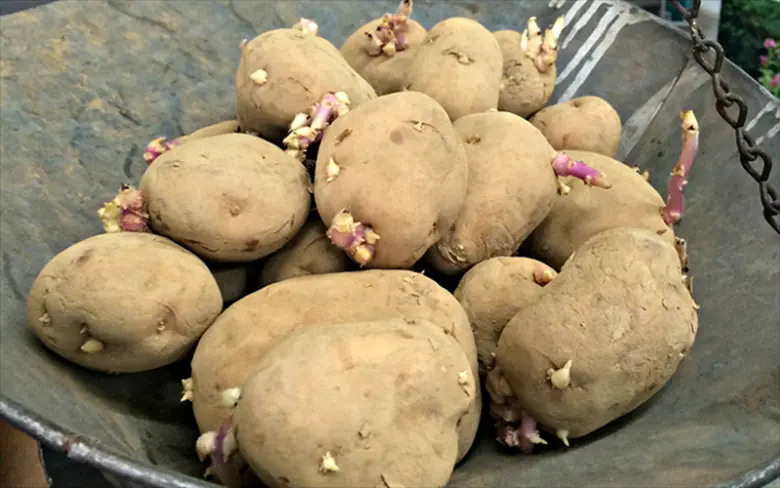
Chapter 2: Why Potatoes Begin Sprouting in the First Place
To understand what to do with sprouted potatoes, it helps to understand why they begin growing.
Potatoes are not simply pieces of food that remain completely inactive after harvesting. They are tubers, which are underground storage structures created by the potato plant. Their primary purpose is to store energy and nutrients that can support the plant's future growth.
When conditions become suitable, the potato begins activating its dormant buds. These buds are commonly known as the "eyes" of the potato. Each eye has the potential to develop into a new shoot.
Under favorable conditions, the shoots grow longer, and the potato begins using some of its stored energy to support this development.
Several factors can encourage sprouting.
Warm temperatures are one of the most important. Potatoes stored in a warm kitchen, near an oven, beside a sunny window, or in an area that experiences temperature fluctuations may begin sprouting sooner than potatoes kept in a cooler environment.
Light exposure can also influence the condition of potatoes. When potatoes are exposed to light, they may develop green coloration beneath the skin. This green color is associated with chlorophyll production. Although chlorophyll itself is not toxic, greening can occur alongside increased glycoalkaloid levels, which is why green potatoes should be treated cautiously.
Moisture and poor storage conditions may also contribute to deterioration. Potatoes stored in damp environments can become more vulnerable to decay, while potatoes kept in areas that are too warm may sprout rapidly.
This is why the way potatoes are stored after purchase can make a significant difference.
Many people place potatoes in plastic bags and leave them in cabinets without checking them for weeks. Unfortunately, tightly sealed plastic can trap moisture, while warm storage conditions encourage sprouting.
A better approach is to store potatoes in a cool, dark, dry, and well-ventilated location. A breathable bag, basket, cardboard box, or other suitable container may help, provided the potatoes are protected from light and excess moisture.
It is also helpful to inspect potatoes periodically rather than waiting until every potato in the bag has sprouted.