If one potato begins deteriorating, removing it from the rest can help prevent the spread of moisture-related decay or mold to neighboring potatoes.
Another useful habit is to avoid storing potatoes next to certain produce that may accelerate deterioration under particular storage conditions. For example, onions and potatoes are often better stored separately because their storage needs differ, and the moisture and gases produced by some produce may affect the quality of nearby items.
But even if you have already made a storage mistake, there is no need to panic.
A few small sprouts do not automatically mean the potato has become dangerous. The condition of the entire potato is what matters.
The next step is to learn how to examine a sprouted potato carefully—and how to recognize the warning signs that mean it should never be used as food.
Chapter 3: How to Tell Whether a Sprouted Potato Should Be Discarded
This is perhaps the most important part of the entire process.
A sprouted potato should never be judged by its sprouts alone. Its texture, color, smell, and overall condition all matter.
Start by examining the potato under good lighting.
Look at the skin. Is it still its normal color, or has it developed green patches? Is the potato firm, or does it feel unusually soft? Are there only a few small sprouts, or has the surface become covered with long shoots?
A potato that is firm, has no green areas, and has only a few small sprouts may sometimes be suitable for food after careful preparation. However, a potato that is heavily sprouted, green, shriveled, soft, damaged, or bitter should not be eaten.
Warning sign No. 1: Green skin
Green coloration is a reason to be cautious.
The green color itself comes from chlorophyll, but greening may occur alongside increased glycoalkaloid concentrations. These compounds can cause symptoms such as nausea, vomiting, abdominal discomfort, and other problems when consumed in excessive amounts.
If a potato has extensive green areas, it is safest to discard it.
Do not assume that peeling a heavily green potato will make it safe.
Warning sign No. 2: Numerous or long sprouts
A potato with many sprouts or long, developed shoots has been undergoing substantial growth.
As sprouting progresses, the potato may lose some of its stored energy, become less firm, and undergo changes in its chemical composition. Heavily sprouted potatoes are better discarded rather than used for cooking.
Warning sign No. 3: Soft or shriveled texture
Healthy potatoes generally feel firm.
If a potato feels unusually soft, rubbery, shriveled, or hollow, it may have lost substantial moisture or begun deteriorating. Such potatoes should not be used as food, particularly if they are also sprouted.
Warning sign No. 4: Mold, rot, or an unpleasant smell
Any potato showing signs of decay, mold, or an unusual odor should be discarded.
Do not attempt to rescue a rotten potato by cutting away only the visible damaged area. Decay can indicate that the potato is no longer suitable for consumption.
Warning sign No. 5: Bitter taste
Never taste a potato that looks suspicious simply to determine whether it is safe.
If a potato or a prepared potato dish tastes unusually bitter, stop eating it. A bitter or unpleasant taste can be a warning sign of elevated glycoalkaloids.
The safest rule is simple: when a potato has several warning signs, do not take chances.
Food safety is more important than saving a few potatoes.
If the potato is still firm, has no green coloration, shows no signs of decay, and has only a small number of short sprouts, it may be possible to use it after careful preparation. But even then, it is important to understand that removing the sprouts and peeling the potato cannot guarantee that all glycoalkaloids have been eliminated.
That is why the following preparation method should only be considered for potatoes that remain in good condition.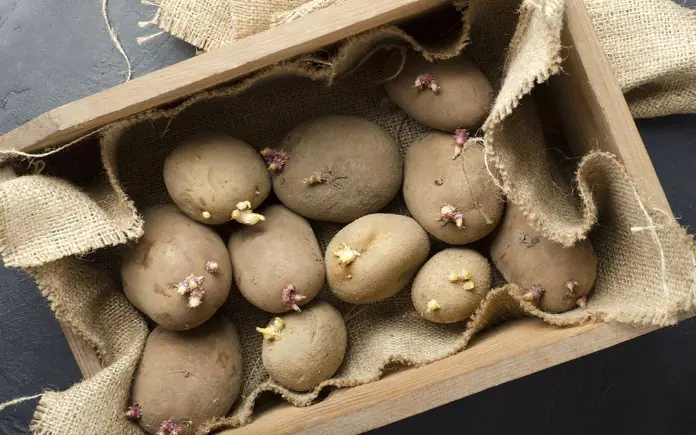
Chapter 4: What to Do With a Potato That Has Only Small Sprouts
If you find a potato with just a few small sprouts and the rest of the potato appears healthy, you may be able to use it cautiously.
First, wash your hands and clean the potato under running water. Remove dirt and debris from the surface.
Next, use a clean knife to remove the sprouts and the surrounding eyes. Do not simply pull the shoots off and leave the damaged area behind. Cut out the sprouts and their attachment points carefully.
If the potato has any small green areas, remove them generously. However, if greening is extensive, the safer choice is to discard the potato rather than attempt to salvage it.
Peeling the potato may also help remove surface areas where glycoalkaloids may be concentrated. A thicker peel is preferable to a very thin one when dealing with a potato that has begun sprouting.
After peeling, inspect the potato again.
Look for unusual discoloration, soft areas, dark patches, signs of rot, or anything that seems abnormal. If the potato still looks questionable, do not use it.
If it passes these checks, cook it thoroughly using your preferred method.