-
When did you first notice the dark spot?
-
Did the child complain of pain before the lesion appeared?
-
Was there a recent fall or injury?
-
Has the child been running or playing more than usual?
-
Has the child recently worn new shoes?
-
Could the child have stepped on a sharp object?
-
Has the lesion changed in size or color?
-
Is there any fever or swelling?
-
Can the child stand or walk normally?
These questions help narrow down possible explanations.
The doctor will then inspect the lesion.
They may examine its size, shape, color, surface, and surrounding skin.
They may also assess tenderness, swelling, warmth, and the movement of the toes.
The examination should not necessarily be limited to the dark spot.
A clinician may assess the ankle, heel, lower leg, and other joints because pain can sometimes originate somewhere other than the place where it is felt.
The child's walking pattern may also provide useful information if they can safely bear weight.
However, a child who cannot stand should not be forced to walk for examination purposes.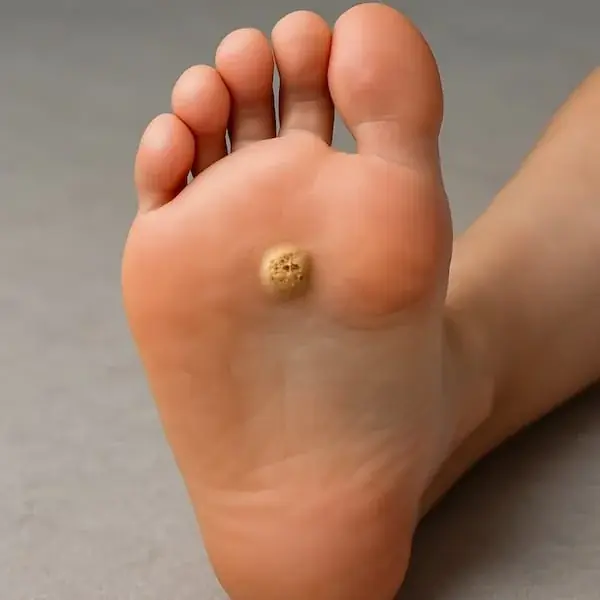
Could the child need an X-ray?
An X-ray may be considered if the doctor suspects a fracture, certain types of foreign objects, or another bone-related problem.
The decision depends on the injury history and examination findings.
Not every dark spot requires imaging.
For a typical superficial blood blister, an X-ray may not be necessary.
However, when a child has unexplained severe pain or cannot bear weight, the doctor may need to investigate beyond the visible skin lesion.
Could an ultrasound be necessary?
Ultrasound can help examine soft tissues.
Depending on the clinical situation, it may be useful when a doctor suspects a fluid collection, certain foreign objects, or an abnormality beneath the skin.
What about blood tests?
Blood tests may be considered if an infection or inflammatory condition is suspected.
The doctor may also recommend additional investigations if the child's symptoms suggest a deeper problem.
The important point is that the examination should be guided by the child's actual symptoms rather than the appearance of the photograph alone.
9. What Parents Should Do Before Reaching the Hospital
When a child has a painful dark spot on the foot, parents naturally want to do something immediately.
However, some common home remedies can make the situation worse.
The safest approach is to protect the affected area and arrange appropriate medical assessment.
Avoid pressing or squeezing the lesion.
A raised dark spot may contain blood or fluid.
Repeated squeezing can increase irritation and damage surrounding tissue.
Do not cut or puncture it.
Parents should not use needles, scissors, knives, or sharp household tools to open the lesion.
Even if it resembles a blood blister, its actual cause may be different.
Avoid applying strong chemicals.
Do not use wart-removal acids, household disinfectants, alcohol, or other irritating products on an unexplained dark lesion.
These products may damage the surrounding skin and make examination more difficult.
Reduce pressure on the foot.
If the child is in pain, do not force them to walk.
Allow the child to rest in a comfortable position while arranging medical care.
Keep the area clean.
If the skin is open, gently protect it with a clean dressing.
Do not attempt to remove deeply embedded material.
Take a photograph.
A clear photograph can help document changes in the lesion.
If possible, take one image showing the whole foot and another showing the affected area.
Include the date and time.
This can help the doctor understand whether the lesion is growing or changing.
Remember the timeline.
Try to recall when the child was last walking normally and whether any injury may have occurred.
Even details that initially seem unimportant can help a clinician.
Most importantly, do not let home treatment delay emergency assessment when the child cannot bear weight or has severe symptoms.
10. Why Parents Should Be Careful With Over-the-Counter Wart Treatments
A dark spot on the sole may resemble a plantar wart, but treating it as one without confirmation can be a mistake.
Many wart-removal products contain salicylic acid.
This ingredient helps remove layers of thickened skin over time.
However, it is not appropriate for every lesion.
If the dark area is actually a blood blister, puncture wound, infection, or another type of growth, applying wart-removal chemicals may irritate the tissue.
The same applies to attempting to scrape away the surface.
A wart may have a thickened appearance, but a parent cannot always distinguish it from a callus or another lesion.
The location also matters.
A plantar wart beneath the toes can be painful because of repeated pressure.
Even if the diagnosis is confirmed, the treatment should be selected according to the child's age, symptoms, lesion size, and medical history.
Some warts disappear without intervention.
Others need treatment because they interfere with walking or continue to spread.
The American Academy of Pediatrics recommends discussing treatment options with a pediatrician, particularly when plantar warts are large, deep, or painful.
Parents should seek a professional opinion before applying strong products to a child's foot, especially when the lesion is dark, swollen, or unexplained.
11. Can a Dark Spot on a Child's Foot Be Prevented?
Not every dark spot can be prevented.
Accidents happen, children play actively, and some skin conditions develop despite good hygiene.
However, several everyday habits can reduce the likelihood of certain foot problems.
Choose properly fitting shoes.
Shoes that are too tight can create pressure and friction.
Shoes that are too loose can allow the foot to move repeatedly inside the footwear.
Both situations may contribute to blisters.
Parents should check that their children's shoes provide enough room around the toes and fit securely around the heel.
Check the feet after outdoor activities.
After sports, playground visits, hiking, or long periods of walking, inspect the soles and spaces between the toes.
Look for cuts, blisters, redness, and unusual marks.
Encourage footwear in shared wet areas.
Plantar warts are associated with HPV, which can enter through tiny breaks in the skin.
Wearing appropriate footwear around shared swimming-pool areas and changing rooms can help reduce exposure.
Keep minor wounds clean.
Small cuts and punctures should be cleaned appropriately and monitored.