In April 2014, the provincial police announced the initiation of a criminal case concerning serious violations of construction regulations that had caused significant consequences.
The investigation was intended to identify the organizations and individuals directly connected to the failure.
This step reflected the seriousness of the technical findings. A bridge collapse that kills eight people and injures 38 cannot be treated only as an unfortunate accident if evidence indicates that construction requirements were not followed.
Investigators examined the broken component and other relevant technical evidence. The findings helped establish how the anchor turnbuckle had failed and why its manufacture did not meet the approved design.
The legal process then considered the responsibilities of those involved in the project.
The case demonstrated that infrastructure safety is not only an engineering matter. When serious violations occur, they can also become questions of legal responsibility and public accountability.
A Court Case and the Question of Responsibility
The legal proceedings continued after the initial investigation.
In 2015, a court in Lai Chau convicted individuals connected with the construction and supervision of the bridge. The director of the construction company received a ten-year prison sentence, while other defendants were also punished for their roles in the failures.
The court's findings concerned the failure to follow the approved design and the shortcomings in construction supervision.
This legal outcome was significant because it established that the disaster was not simply an unexplained structural accident. The failure had been linked to specific shortcomings in the construction process and in the responsibilities of those involved.
For the families affected, a court decision could not undo the loss. No legal judgment could return the people who died or remove the injuries and memories carried by those who survived.
But accountability matters because public infrastructure is built for people who depend on it. When a structure fails because required standards have not been followed, those responsible must answer for their actions under the law.
The Chu Va 6 case also served as a warning to construction companies, project owners, and supervisory bodies that technical requirements must be taken seriously.
A bridge is not safe simply because it has been completed and opened. It is safe only when the design, materials, construction, inspection, and maintenance all meet the necessary standards.
The Bridge Was Removed After the Investigation
After the technical examination of the site and the collection of relevant evidence, authorities arranged for the damaged bridge to be dismantled.
The removal was necessary because the structure had suffered severe damage and could no longer be considered safe for public use.
The dismantling process also marked a visible change in the community's landscape. The crossing that had once connected the settlements was no longer available.
For residents, this meant more than losing a familiar route. They had to find other ways to move between villages while authorities considered how to restore access.
The bridge's removal also represented the end of a structure that had become inseparable from the memory of the disaster.
The twisted deck and damaged cables had served as visible evidence of the failure. Once the structure was taken apart, the focus shifted toward rebuilding access and ensuring that any replacement would be safer.
The investigation and dismantling process were important, but the community still needed a practical way to cross the stream.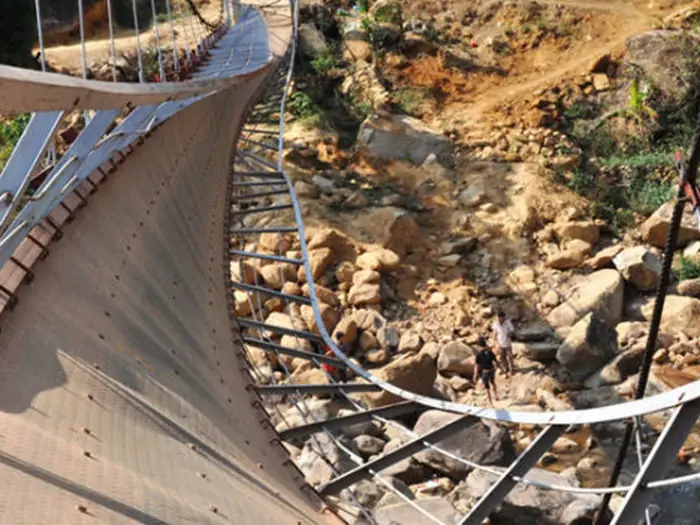
Restoring Access for the Villages
The collapse affected daily movement between Chu Va 6 and Chu Va 8. The bridge had served people who needed to travel between the settlements for ordinary activities.
When it failed, residents faced a sudden loss of access.
Authorities therefore arranged for a temporary crossing to be built while longer-term solutions were considered. The temporary bridge was intended to restore a practical connection for local households.
The need for a replacement was especially important in a mountainous area where rivers, streams, and steep terrain can make alternative routes difficult.
For people living in remote settlements, a bridge may be essential for reaching schools, markets, healthcare, and administrative services. A damaged crossing can affect far more than convenience.
It can increase travel time, make it harder for children to attend school, and complicate access to medical assistance.
The response after Chu Va 6 therefore had two connected priorities: caring for the victims and restoring safe movement for the wider community.
A temporary crossing could help address the immediate problem, but it also needed to be constructed and checked carefully. After such a serious failure, residents had every reason to expect that any replacement would receive proper technical attention.
The Wider Safety Review of Suspension Bridges
The Chu Va 6 disaster prompted calls for other suspension bridges and temporary crossings, particularly in remote and mountainous areas, to be inspected.
This was a necessary response because many rural communities rely on bridges that may be exposed to difficult weather, heavy use, and challenging terrain.
An inspection should not be limited to looking at whether a bridge appears stable from a distance. Engineers need to consider the condition of cables, anchors, connections, towers, decks, and other components.
They also need to compare the actual construction with the approved design and assess whether the bridge is being used within its intended capacity.
The Chu Va 6 findings showed that defects can exist in components that ordinary users cannot easily examine.
A bridge may appear complete while a critical connection has been manufactured incorrectly. A support structure may look solid while construction details do not match the design documents.
This is why inspection and quality control must be systematic.
Authorities also need to make sure that communities understand any restrictions that apply to a crossing. Clear signs can inform users about capacity limits, temporary closures, or other safety requirements.
But warning signs cannot replace proper construction. A bridge designed and built correctly should be able to serve the public within its approved operating conditions.
Why Rural Communities Depend So Heavily on Bridges
The story of Chu Va 6 also highlights the importance of small bridges in mountainous regions.
In major cities, a bridge may be one of many routes connecting different neighborhoods. If one crossing closes, people may have other roads or public transportation options.
In remote villages, the situation can be very different.
A single bridge may provide the most direct connection between settlements separated by a stream or steep valley. It can become part of the daily routine for families, students, farmers, and people traveling to local services.
The loss of such a bridge can isolate residents or force them to take longer routes.
For children, a bridge may be part of the route to school. For adults, it may provide access to markets or workplaces. For older residents, it may be essential for visiting relatives or receiving medical care.
This makes the quality of rural infrastructure especially important.
Remote communities should not have to accept lower safety standards simply because they are far from major urban centers. The engineering principles that protect a large city bridge also apply to a small pedestrian crossing in a mountainous village.
A structure used by ordinary people must be designed, constructed, and inspected with the same seriousness.
What the Tragedy Revealed About Infrastructure Oversight
The most important lesson from Chu Va 6 was not simply that a bridge component had broken.
It was that a defect in a critical component had passed through a series of processes that were supposed to prevent unsafe construction from reaching the public.
The design must be accurate. The contractor must follow it. Materials and components must meet the required standards. Supervisors must verify the work. The project owner must ensure that the structure is properly completed and accepted.
If these responsibilities are treated as formalities, the public can be exposed to risks they cannot see.
Infrastructure oversight is often invisible when everything works as intended. People cross a bridge without thinking about the inspection reports or manufacturing procedures behind it.
But when a structure fails, those unseen responsibilities become central to understanding what happened.
The Chu Va 6 investigation showed why technical documentation, independent inspection, and accountability are essential. A small deviation in a metal component can have consequences for an entire community.