Chapter 1: An Ordinary Morning Turns Into a Nightmare
At first, nobody in the coastal city of Miyako understood what was happening. It was an ordinary morning. Families were preparing breakfast, workers were getting ready for their daily routines, and children were heading to school. The streets were beginning to fill with traffic, while the ocean remained calm beyond the coastline.
Then came a strange vibration.
A glass trembled on a kitchen table. Hanging lights began to swing, and dishes rattled inside cupboards. Some residents initially thought a heavy truck was passing nearby. But within seconds, the movement became stronger.
The floor shifted beneath people's feet. Windows shook violently, furniture moved across rooms, and objects fell from shelves. Suddenly, the entire city was overwhelmed by the deep roar of a powerful earthquake.
In this fictional scenario, the earthquake registered an extraordinary magnitude of 9.1 beneath the Pacific Ocean. Its force was so overwhelming that people struggled to remain standing. Parents grabbed their children, elderly residents held onto furniture, and neighbors shouted to one another through the noise.
Outside, utility poles swayed, power lines twisted, and parked vehicles bounced against the pavement. Glass shattered across sidewalks. Some buildings suffered visible damage, while others lost electricity almost immediately.
For what felt like an eternity, ordinary life disappeared beneath the shaking ground.
Then the strongest movement gradually weakened.
A frightening silence followed.
People slowly stepped outside, looking at damaged buildings and trying to understand what had happened. Some immediately called relatives. Others searched for neighbors who might need help. But communication networks were already becoming overloaded.
Before residents could fully assess the earthquake damage, emergency sirens began sounding across the city.
A tsunami warning had been issued.
For people living near the coast, the message was terrifyingly clear. The earthquake might have been only the beginning of a much larger disaster.
Emergency announcements instructed residents to move immediately toward higher ground. Parents gathered their children, neighbors helped elderly people leave their homes, and drivers abandoned vehicles when roads became crowded.
Many people took only essential belongings: medicine, documents, drinking water, and emergency bags. Others left with nothing but the clothes they were wearing.
One fictional family, the Tanakas, had been eating breakfast when the earthquake struck. Their youngest daughter, Hana, was terrified. Her father took her hand while her mother grabbed an emergency bag they had prepared months earlier.
The apartment elevator was no longer working, so the family rushed down the stairs. Outside, neighbors were already moving toward the evacuation route. An elderly man struggled to walk, and two younger residents stopped to help him.
Hana looked back toward their apartment.
"Are we coming back?" she asked.
Her mother hesitated before answering.
"We're going somewhere safe first."
Nobody knew what would happen to their home. At that moment, survival was the only priority.
Along the coastline, the ocean began behaving strangely. The water slowly pulled away from the shore, exposing wet sand and areas that were normally underwater. Small boats tilted awkwardly, while fish appeared in places where seawater had been only moments earlier.
Some people stopped to look. Others began recording the unusual sight.
But those who understood the danger immediately urged everyone to run.
A tsunami was approaching.
In the distance, a broad wall of water was moving toward the coast. It did not resemble an ordinary ocean wave. It was darker, wider, and carried an enormous amount of energy.
The first wave was about to reach Miyako.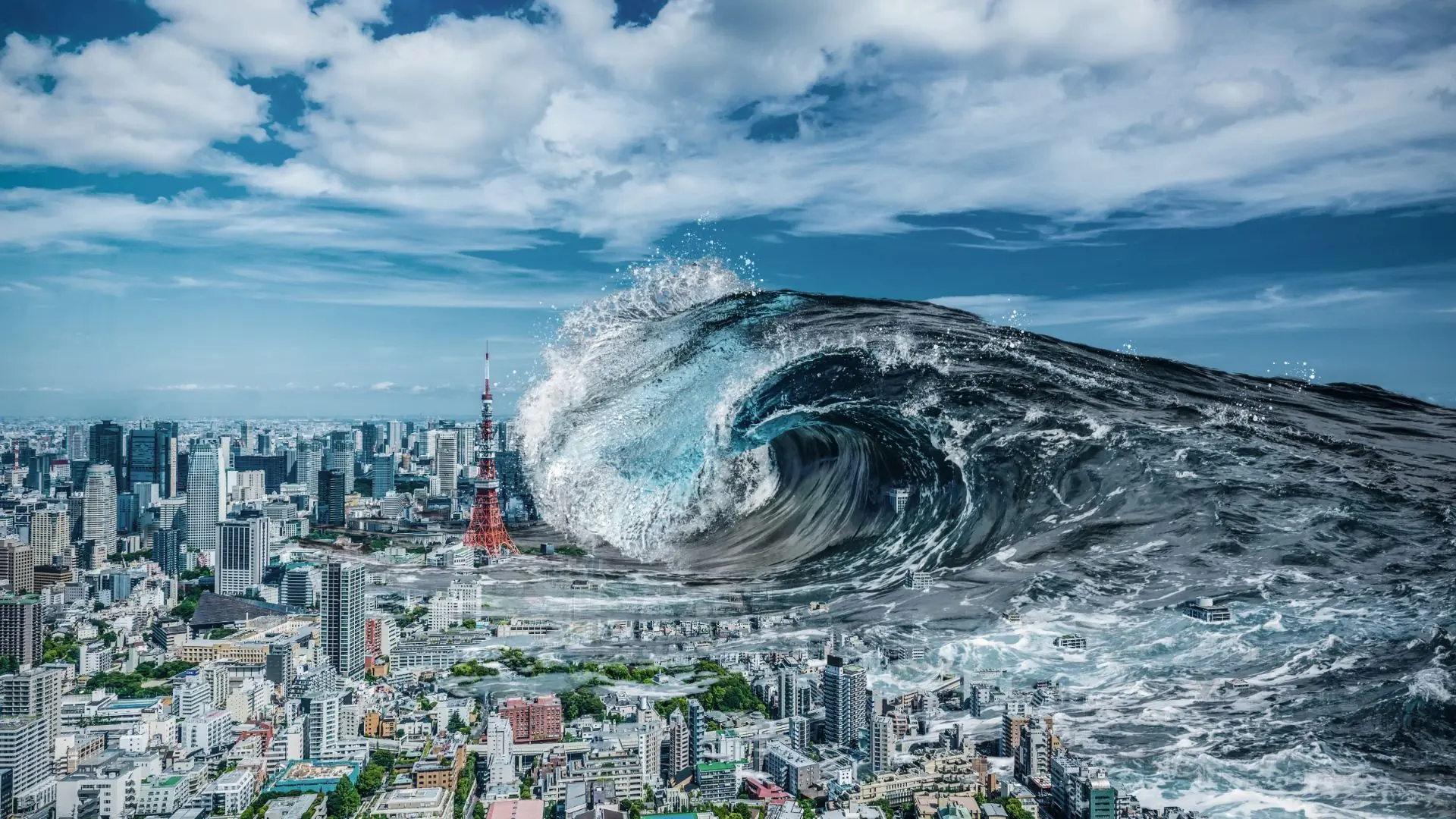
Chapter 2: The Ocean Swallows the Coastline
The approaching tsunami reached the seawall with tremendous force. For a brief moment, the barrier appeared to hold. Then the water surged higher, spilling over and rushing into the streets.
The sound was deafening.
Vehicles began moving across flooded roads. At first, parked cars rolled slowly. Moments later, they floated, collided, and spun through intersections. A small truck was pushed sideways while debris from buildings and damaged structures moved through the water.
The coastline became almost unrecognizable.
Water poured into low-lying neighborhoods, filling streets and entering homes. Residents who had not evacuated quickly enough scrambled toward staircases, upper floors, and any available high ground.
Emergency workers continued shouting instructions, directing people away from dangerous areas. The city had become a maze of muddy water, debris, damaged buildings, and confusion.
The Tanaka family continued climbing toward higher ground. Hana's father held her hand tightly while her mother carried the emergency bag. Behind them, the sound of rushing water grew louder.
They passed people helping elderly neighbors and children who had become separated from their parents. Nobody stopped to collect unnecessary belongings. Everyone understood that returning toward the coast could be deadly.
Meanwhile, another crisis was developing across the city.
The earthquake had damaged electrical infrastructure. Traffic signals stopped working, streetlights disappeared, and entire neighborhoods were plunged into darkness. Some emergency facilities managed to activate backup generators, but other buildings lost power completely.
Elevators stopped. Pumps struggled to operate, and communication equipment became unreliable.
Thousands of residents attempted to contact relatives simultaneously. Calls failed, messages remained unsent, and some phones displayed no signal at all.
For many families, not knowing whether loved ones were safe became almost as frightening as the physical destruction.
At one evacuation center, a woman named Keiko stood near the entrance, repeatedly checking her phone. Her husband had been working near the waterfront when the earthquake struck.