It’s one of those tiny habits most people barely think about.
You finish charging your phone, unplug the cable, put your phone in your pocket—and leave the charger sitting in the wall.
Maybe it stays there for hours. Maybe days. Sometimes it never gets unplugged at all.
Because the charger is no longer connected to your phone, it can seem as though it is doing absolutely nothing.
But is leaving a phone charger plugged into an outlet really harmless?
Not necessarily. While a modern, high-quality charger typically consumes only a very small amount of electricity when it is not actively charging a device, leaving chargers permanently connected can still have some downsides. The bigger concern is often not your electricity bill but charger quality, heat, physical damage, and electrical safety.
That doesn't mean every plugged-in charger is an emergency waiting to happen. Rather, it means that a simple habit - unplugging chargers when they are not needed - can eliminate a small amount of unnecessary energy use and reduce exposure to certain avoidable risks.
Here’s what you should know.
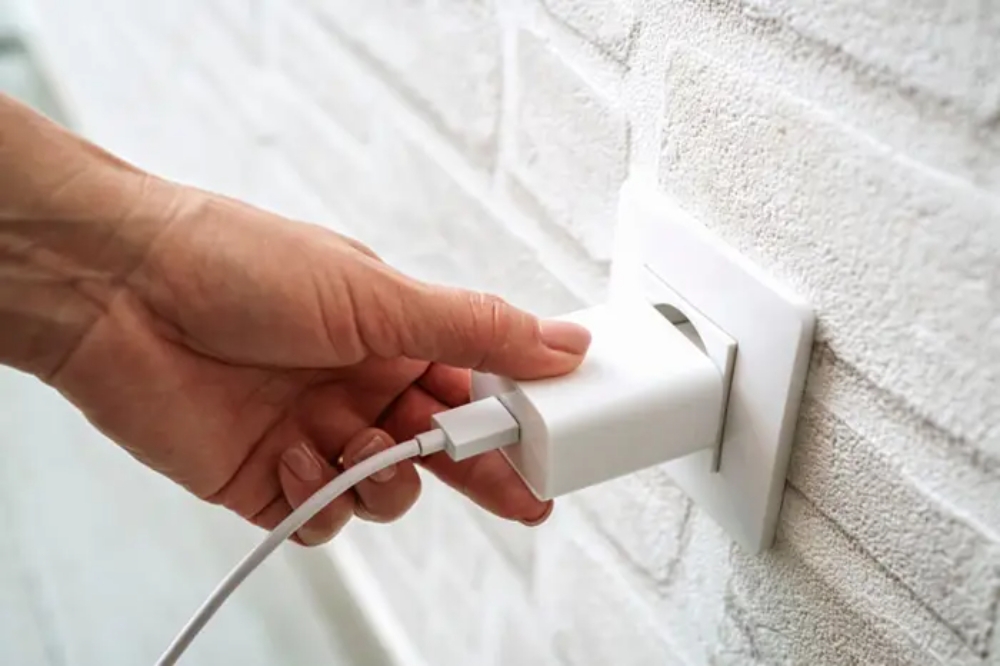
1. A Charger Can Still Use Electricity When Nothing Is Connected
One of the most common misconceptions is that a charger uses no electricity simply because your phone isn't attached to it.
In reality, a charger plugged into an outlet is still connected to the electrical supply.
Inside the charger are electronic components that convert household AC electricity into the lower-voltage DC electricity needed by your phone.
Even when your phone isn't connected, those components may consume a small amount of power.
This is sometimes called standby power, idle power, or no-load power.
For a modern, efficient charger, the amount is generally very small.
So if you're imagining that an unplugged phone charger is secretly adding hundreds of dollars to your annual electricity bill, that's not realistic.
However, the principle remains:
If an electrical device doesn't need to be powered, turning it off or unplugging it eliminates its standby consumption entirely.
One charger won't make a dramatic difference.
But households often have many devices plugged in continuously—chargers, televisions, computers, game consoles, speakers, appliances, and other electronics.
Small amounts of standby consumption can accumulate across many devices and over long periods.
2. The Bigger Issue Is Often Safety, Not Electricity
This is where the conversation becomes more important.
A high-quality charger that is in good condition and used correctly is generally designed to remain plugged in safely.
But not every charger is high quality.
Some chargers are:
- old and damaged,
- counterfeit,
- poorly manufactured,
- missing appropriate safety protections,
- physically cracked,
- equipped with frayed cables,
- exposed to moisture,
- or used with incompatible electrical equipment.
A damaged charger can create a much greater concern than the tiny amount of standby electricity it consumes.
Electrical faults can cause overheating, short circuits, sparks, or—in unusual circumstances—fire.
That's why the question shouldn't simply be:
"Does the charger consume electricity when it's not charging my phone?"
A better question is:
"Is this charger in good condition, from a reputable manufacturer, and being used safely?"
That matters much more.
3. Cheap or Counterfeit Chargers Deserve Extra Caution
Not all chargers are created equal.
Reputable manufacturers design chargers with safety features intended to protect against conditions such as excessive current, overheating, and short circuits.
Poorly made or counterfeit chargers may not provide the same level of protection.
They can also have inferior insulation, components, or construction.
This doesn't mean every inexpensive charger is dangerous.
Price alone isn't a reliable safety test.
But buying an unknown charger simply because it is extremely cheap can be a false economy.
A charger is connected directly to your home's electrical supply.