Therefore, the most accurate conclusion is not that people should immediately stop eating a particular fish.
The accurate conclusion is that the image requires verification before it can support a food-safety claim.
Is a fish with eggs inside its mouth safe to eat?
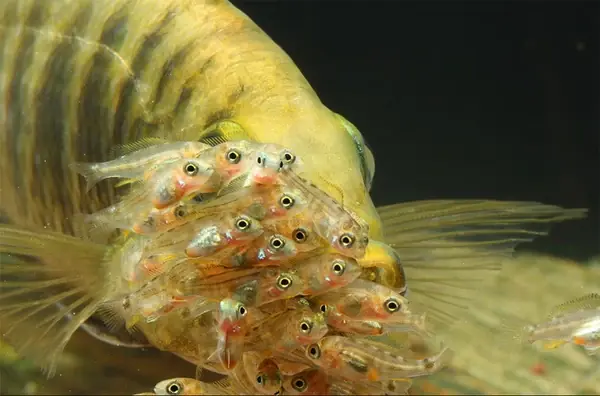
The presence of eggs or young fish inside a mouthbrooding fish does not, by itself, prove that the parent fish is unsafe to eat.
Fish eggs are a natural reproductive product. Many varieties are consumed as food, although their safety depends on species, handling, processing, and preparation.
If a fish is carrying eggs or fry as part of its reproductive behavior, that is a biological condition rather than evidence of contamination.
However, the fish should still be handled and prepared properly.
A fish that has been damaged, improperly stored, or exposed to contaminated water may present food-safety risks regardless of whether it is mouthbrooding.
The distinction is important: natural reproductive behavior and food contamination are not the same thing.
If a fish appears abnormal, has a strong unpleasant odor, shows signs of decomposition, or contains unexplained material that cannot be identified, consumers should avoid eating it until it has been assessed by a qualified fish seller, inspector, or appropriate authority.
What makes fish unsafe to eat?
There are several recognized seafood hazards, and they are not all visible.
1. Bacterial contamination
Fish can become contaminated by bacteria during harvesting, processing, transportation, storage, or preparation.
Some bacteria multiply rapidly when seafood is kept at temperatures that are too warm.
This is why refrigeration and proper handling are essential.
A fish may look normal while still carrying microorganisms that can cause illness. Appearance alone cannot guarantee safety.
2. Parasites
Certain fish species can carry parasites that may infect people if the fish is eaten raw or inadequately cooked.
The FDA identifies several groups of parasites that are important in seafood safety, including roundworms, tapeworms, and flukes.
Some infections are associated with particular fish species and preparation practices.
fda.gov+1
The risk is especially relevant when fish is eaten raw, lightly cured, marinated, or only partially cooked.
3. Spoilage
Fish is highly perishable.
If it is stored improperly, its quality can deteriorate quickly. Spoiled fish may develop an unpleasant sour, rancid, or ammonia-like smell.
The FDA advises consumers not to eat seafood with these warning odors.
4. Chemical contamination
Fish may also be affected by environmental contaminants, depending on the species and where it was caught.
Some contaminants accumulate in fish over time. This is one reason public health authorities sometimes issue species-specific or location-specific seafood advisories.
Such concerns cannot be evaluated from a close-up photograph of a fish's mouth.
How to recognize fresh fish when shopping
Consumers do not need to become marine biologists to make safer seafood choices.
A few practical observations can help when purchasing fish.
Fresh fish should generally have a mild smell rather than a strong sour or ammonia-like odor.
The flesh should appear reasonably firm and should not look excessively mushy or deteriorated.
Whole fish may have clear, bright-looking eyes, although eye appearance alone is not a perfect indicator of freshness.
The gills should not appear excessively slimy or decomposed.
If the fish is sold on ice, the ice should be clean and the fish should be kept properly chilled.
Consumers should also pay attention to the seller's handling practices.
Fish displayed in a warm environment for long periods may deteriorate even if it initially looked fresh.
If something seems wrong, it is better to choose another fish.
Should you remove the fish's mouth before cooking?
Some people prefer to remove the gills, internal organs, or head before cooking fish.
The choice often depends on the recipe, the fish species, and local culinary traditions.
Removing the mouth or head may be part of preparation, but it should not be treated as a universal safety requirement.
If a fish contains an unusual object that cannot be identified, removing the object does not automatically make the fish safe.
The concern may involve contamination elsewhere in the fish, or the fish may be unsuitable for consumption for another reason.
A consumer should not assume that cutting away one visible area eliminates every possible hazard.
When a fish appears abnormal, the safer approach is to seek an assessment rather than trying to solve the problem by removing a single part.