As people grow older, the walls and valves of veins may gradually lose some of their strength and elasticity. The muscles that help push blood upward may also become less active if a person spends much of the day sitting.
These changes can make visible veins more likely to develop.
However, aging is not the only factor. The way you spend your day can also influence circulation.
Sitting for long periods
Many people spend hours sitting at desks, driving, watching television, or using electronic devices.
When the legs remain still for extended periods, the calf muscles do not contract as frequently. This reduces the muscular pumping action that helps move blood back toward the heart.
It does not mean that sitting for an hour will automatically cause varicose veins. Rather, repeated inactivity may contribute to circulation difficulties, particularly when combined with other risk factors.
Standing for long periods
People who work in retail, hospitality, healthcare, manufacturing, and other occupations may spend much of the day standing.
Standing still for long periods can increase pressure in the veins of the lower legs. Some people notice aching, heaviness, or swelling toward the end of a shift.
This is not a reason to abandon a job or assume that standing will inevitably damage your veins. It is a reminder that changing position and moving regularly can be helpful.
Extra body weight
Carrying excess body weight can increase pressure on the veins in the lower body. This may make it harder for blood to return efficiently, particularly in someone who already has weakened vein valves.
Weight is only one part of a person's health, and visible veins should never be used to judge someone's lifestyle or personal habits.
If weight management is appropriate, gradual changes in eating habits and physical activity are generally more sustainable than extreme diets.
Why the combination matters
A person may have several contributing factors at once.
For example, someone may have a family history of varicose veins, be approaching an older age, and spend most of the working day sitting. Another person may have hormonal risk factors and a job that involves standing.
The appearance of purple veins is therefore rarely explained by one simple cause.
The most useful approach is to look at the complete picture: family history, age, pregnancy history, daily activity, symptoms, and whether the veins are changing.
Purple Veins, Spider Veins, and Varicose Veins: How Can You Tell the Difference?
Although the terms are sometimes used interchangeably, they describe different appearances.
|
Feature |
Spider veins |
Varicose veins |
|---|---|---|
|
Appearance |
Thin, branching lines |
Larger, twisted or bulging vessels |
|
Color |
Red, blue, or purple |
Often blue or dark purple |
|
Position |
Close to the skin surface |
Usually larger veins beneath the skin |
|
Texture |
Usually flat |
May feel raised or cord-like |
|
Symptoms |
Often none |
May cause aching, heaviness, itching, or swelling |
|
Common locations |
Thighs, calves, ankles |
Legs, calves, ankles, and feet |
There is also an important difference between a visible vein and a circulation disorder.
A small cluster of spider veins may be harmless. But if visible veins appear alongside persistent swelling, skin discoloration, or discomfort, an assessment can help determine whether an underlying problem is present.
It is not possible to make a reliable diagnosis from color alone. Lighting, skin tone, skin thickness, and the depth of the blood vessels can all affect how veins look.
When Purple Veins May Be a Warning Sign
Most small, stable spider veins do not require emergency treatment. Nevertheless, certain symptoms should not be ignored.
The following situations deserve particular attention.
1. One leg suddenly becomes swollen
Sudden swelling in one leg, especially when accompanied by pain, warmth, or redness, can be a sign of deep vein thrombosis, a blood clot in a deep vein.
A clot can interfere with blood flow and may become life-threatening if part of it travels to the lungs.
Do not attempt to diagnose this at home or wait for the swelling to disappear. Seek urgent medical assessment.
2. A vein becomes painful, red, warm, or hard
A superficial vein that becomes tender, red, warm, or feels like a firm cord may be inflamed or affected by a superficial blood clot.
This is different from an ordinary flat spider vein. It should be assessed by a healthcare professional, particularly if symptoms are spreading or becoming more severe.
3. The skin around the ankle becomes darker or irritated
Persistent brownish discoloration, itching, scaling, or thickening around the lower legs may occur with chronic venous disease.
These changes can develop gradually. They may be mistaken for ordinary dry skin, especially when the discomfort is mild.
If the skin continues changing or becomes inflamed, arrange an examination.
4. An open sore develops near the ankle
A wound that does not heal, particularly around the lower leg or ankle, may be a venous ulcer.
These sores need professional assessment because they can become infected and may require specialized wound care.
5. A visible vein begins bleeding
Varicose veins close to the skin can sometimes bleed if the surface is injured.
If bleeding occurs, lie down if possible, raise the leg, and apply firm direct pressure with a clean cloth or dressing. Seek urgent medical care, particularly if the bleeding does not stop promptly or is heavy.
6. Chest pain or sudden difficulty breathing occurs
If leg symptoms are accompanied by sudden shortness of breath, chest pain, fainting, or coughing up blood, call emergency services immediately.
These symptoms may indicate a pulmonary embolism, which occurs when a blood clot travels to the lungs.
The most important lesson is that a purple vein itself is not necessarily an emergency. The associated symptoms and the speed at which they develop are much more important.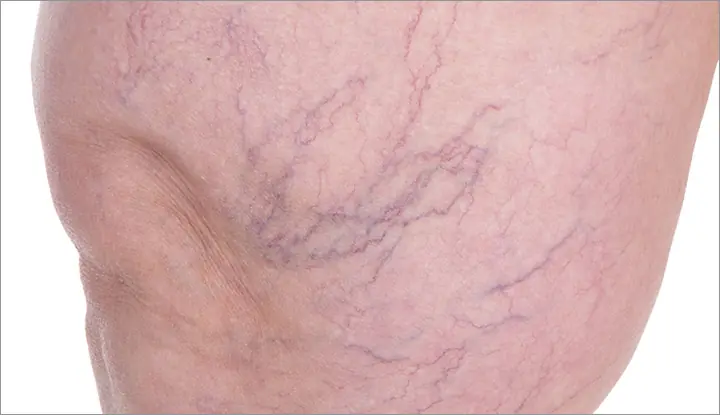
What Can a Doctor Do to Find the Cause?
If you are concerned about new purple veins, a healthcare professional will usually begin by asking questions and examining your legs.
They may want to know:
-
When did you first notice the veins?
-
Have they become more visible over time?
-
Do you experience pain, itching, or heaviness?
-
Does swelling occur in one leg or both?
-
Do symptoms become worse after standing?
-
Do you have relatives with varicose veins?
-
Have you previously experienced a blood clot?
-
Have you been pregnant or used hormonal medication?
-
Have you noticed skin discoloration or wounds?
These details help determine whether the veins are mainly a cosmetic concern or whether there may be an underlying circulation problem.
The role of a duplex ultrasound
A duplex ultrasound is commonly used to assess blood flow in the leg veins.
It combines ordinary ultrasound imaging with Doppler technology, which can show the direction and speed of blood movement.
The examination can help identify whether blood is flowing backward through a vein, whether the valves are functioning properly, and whether a blood clot is present.
The test is noninvasive and does not involve surgical incisions.
Not everyone with spider veins needs an ultrasound. A clinician decides whether testing is appropriate based on the appearance of the veins, symptoms, and medical history.
Nine Practical Ways to Support Healthy Leg Circulation
Although no lifestyle change can guarantee that spider veins or varicose veins will never develop, certain habits can support circulation and help reduce discomfort.