When You Go to the Beach and See a Spot With No Waves, Stay Away: The Hidden Danger of Rip Currents
A calm-looking patch of ocean may be more dangerous than the crashing waves around it. Before stepping into the water, learn how to recognize a possible rip current, why it can pull swimmers away from shore, and what to do if you suddenly find yourself caught in one.
Imagine arriving at a beautiful beach on a warm afternoon. The sun is shining, families are relaxing on the sand, and waves are rolling gently toward the shore. You look out at the ocean and notice something unusual: while white waves are breaking on both sides, one narrow section appears strangely smooth.
There is no obvious foam. The water looks darker and quieter. Compared with the rough water nearby, this small opening seems like the perfect place to enter the sea.
You might even think it is safer than swimming where the waves are crashing.
But that assumption can be dangerous.
A calm-looking gap between breaking waves may sometimes indicate a rip current—a powerful, narrow flow of water moving away from the shoreline. These currents can carry swimmers away from shallow water surprisingly quickly, even when the surrounding beach looks peaceful.
The danger is not always obvious. A rip current may appear as a darker channel, a gap in the breaking waves, or a stream of foam and debris moving seaward. It can form near sandbars, piers, jetties, and other features along the coast. Its appearance can also change as waves, tides, and underwater sand formations change.
The most frightening part is what happens when someone enters the water without recognizing the current. They may suddenly find themselves farther from shore than expected. Their first instinct is often to swim directly back toward the beach, fighting against the moving water until they become exhausted.
That is exactly the reaction safety experts warn against.
Understanding the signs of a possible rip current—and knowing how to respond—can make a life-saving difference. The following guide explains why apparently quiet water deserves attention, how these currents work, what beachgoers should look for, and the safest actions to take if someone is caught in one.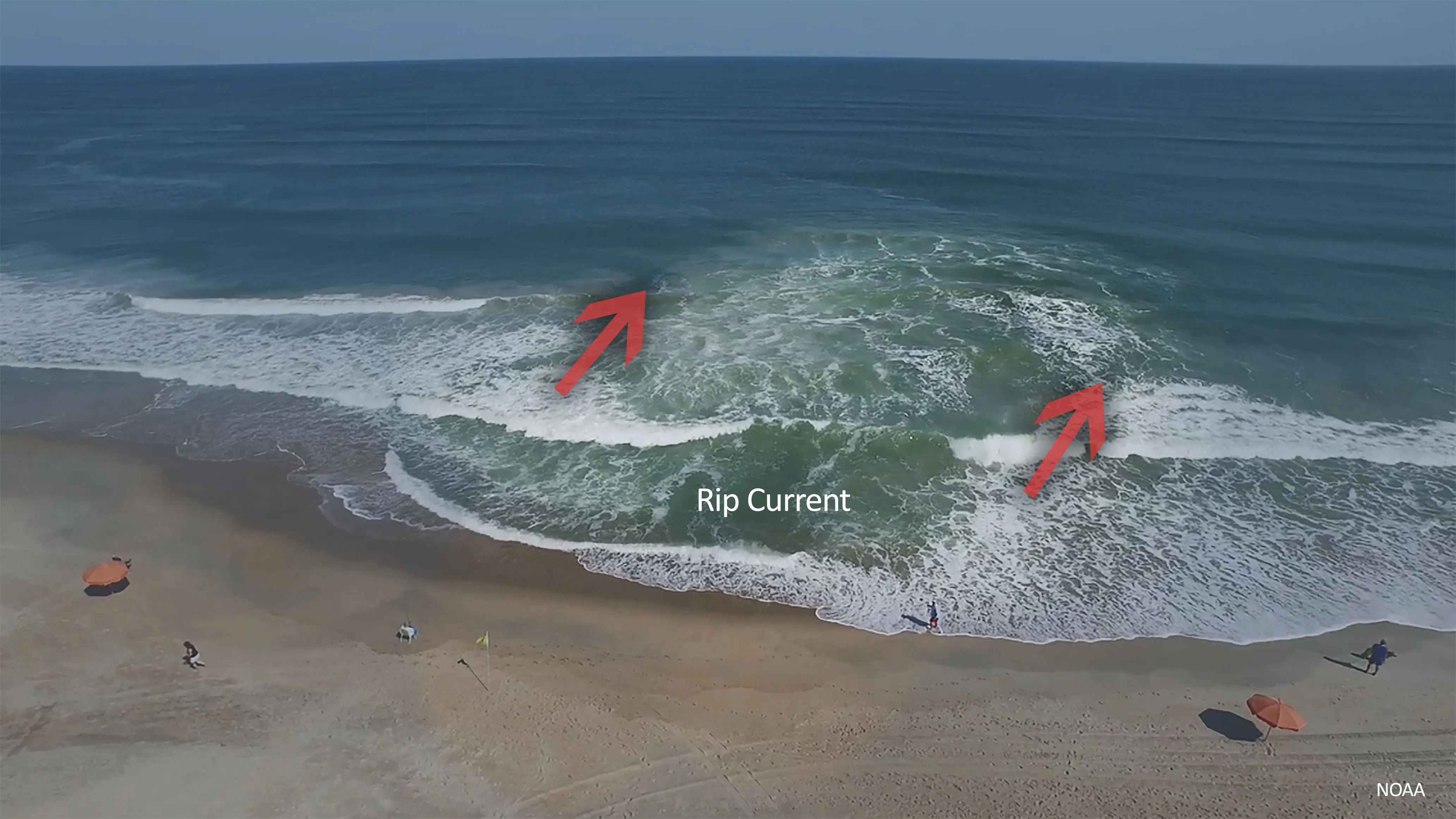
What Is a Rip Current, and Why Can It Be So Dangerous?
A rip current is a relatively narrow channel of water that flows away from the beach through the surf zone. It carries water from the area near the shoreline toward deeper water beyond the breaking waves.
To understand why it forms, imagine waves repeatedly moving toward the beach. Each wave pushes water into the shallow area near the shore. That water must eventually move somewhere, and it often returns seaward through particular channels.
When the returning flow becomes concentrated in a narrow path, it can form a rip current.
The result is a fast-moving stream of water that travels away from the shoreline.
Unlike a breaking wave, which usually pushes water toward the beach, a rip current moves in the opposite direction. A swimmer who enters it may feel as though the ocean is carrying them away, even when they are trying to stay in the same place.
Rip currents are not underwater whirlpools that suck people down. This is one of the most important misunderstandings to correct.
Their main danger is that they transport swimmers away from shallow water. People may become frightened when they realize they are moving farther offshore, and they often try to swim directly back against the flow.
That can lead to exhaustion.
A person who becomes tired may struggle to keep their head above water, particularly if waves are breaking nearby or they are not confident in their swimming ability.
The current itself is not necessarily pulling someone beneath the surface. The combination of distance, panic, fatigue, and difficult surf conditions creates the greatest danger.
According to the National Oceanic and Atmospheric Administration, rip currents account for more than 80 percent of rescues performed by surf-beach lifeguards in the United States. The United States Lifesaving Association also reports more than 100 rip-current-related deaths annually in the country. These figures demonstrate how serious the hazard can be, although the exact risk varies between beaches and countries.
The danger is not limited to inexperienced swimmers. Even strong swimmers can struggle when a current moves faster than they can comfortably swim.
That is why the safest response is not to challenge the ocean's strength. It is to recognize the hazard, avoid entering the current, and know how to respond if caught.
Why a Spot With No Waves May Be a Warning Sign
The central warning in the supplied image is that a section of beach with no obvious breaking waves may not be as safe as it looks.
This observation has a scientific explanation.
Along many surf beaches, waves break as they travel over shallow sandbars. The water then moves back toward deeper water through gaps in those sandbars.
If a concentrated flow develops through one of these gaps, it can create a channel where fewer waves break.
From the beach, that channel may appear darker, smoother, or calmer than the surrounding water.
Imagine looking at the shoreline from above.
On one side, white waves are breaking in repeated lines. On the other side, similar waves are rolling toward the sand. Between them, there is a narrow section where the surface looks unusually quiet.
That opening may be a rip-current channel.
The water can look inviting because there is less visible whitewater. Someone who does not understand the pattern might believe it is an easy place to enter the sea.
But the absence of breaking waves does not mean the water is still.
It may mean that water is moving through the channel toward the open ocean.
There is an important qualification: not every calm patch is a rip current, and not every rip current looks calm. Some appear as churning or choppy channels, while others carry foam, sand, or seaweed away from the beach. The signs can be difficult to identify, particularly when the sea is rough or lighting conditions change.
A quiet-looking area should therefore be treated as a possible warning sign, not as a definitive diagnosis.