Ask before swimming. Lifeguards can point out rip currents and explain which areas should be avoided.
Check the warning flags. Follow the beach's specific flag system and posted restrictions.
Observe the surf for several minutes. Currents can be difficult to recognize, and conditions can change.
Avoid swimming near piers and jetties. These structures can influence current patterns.
Never swim alone. A companion may be able to alert lifeguards if you experience difficulty.
Be realistic about your swimming ability. Being comfortable in a pool does not necessarily mean you are prepared for surf conditions.
Keep children under close supervision. Do not allow them to enter the water without an adult nearby.
If you cannot identify a safe swimming area, stay out of the water.
The ocean will still be there another day.
Can Rip Currents Be Prevented?
Rip currents are natural coastal processes. They cannot simply be switched off or removed from a beach.
However, the risks they create can be reduced.
Lifeguard patrols, warning systems, public education, beach design, and improved forecasting all help protect swimmers.
Some beaches use signs and flags to identify dangerous areas. Others provide maps or information boards showing locations where rip currents frequently form.
Scientists also study beach shape, wave conditions, and changing sandbars to improve their understanding of where currents may develop.
Technology can help, but it cannot replace observation.
A beach may change significantly after storms or periods of strong wave activity. Sandbars can shift, channels can appear in new places, and familiar swimming locations may become dangerous.
That is why advice from local lifeguards remains valuable even for people who visit the same beach regularly.
A person who has swum safely at a particular location for years should not assume that the conditions will always remain the same.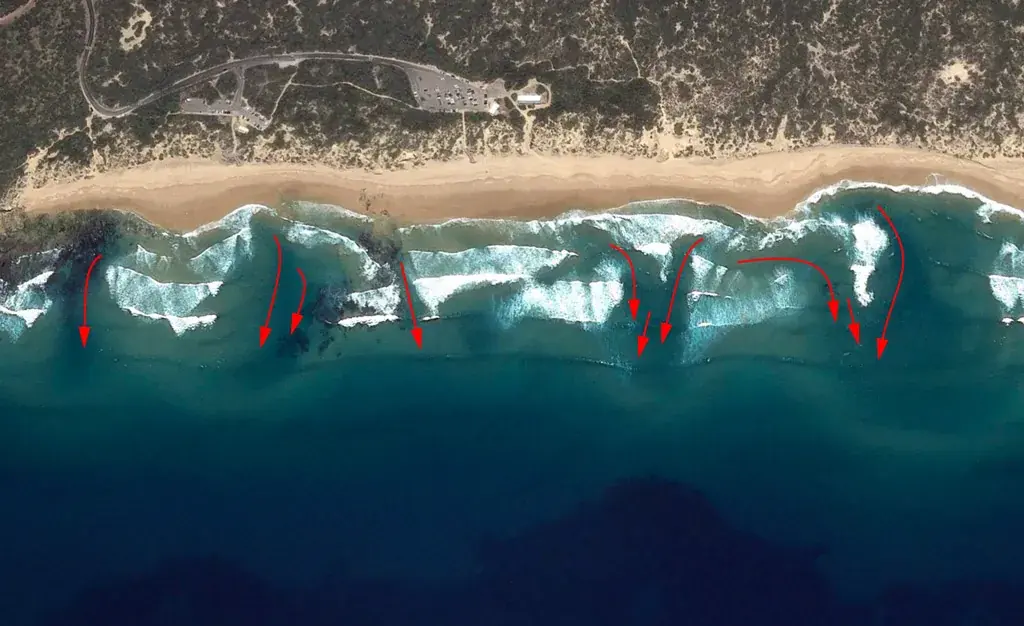
Common Myths About Rip Currents
Misunderstandings can make people less prepared for the ocean. Here are some of the most common myths.
Myth 1: Rip currents only occur during storms.
False. They can occur on sunny days whenever waves break and the coastal conditions allow concentrated offshore flow.
Myth 2: A calm patch of water is always safe.
False. A gap in breaking waves may indicate a deeper channel where a rip current is present.
Myth 3: Rip currents pull swimmers underwater.
Generally false. They primarily carry swimmers away from shore. Panic, exhaustion, waves, and difficulty staying afloat create the main danger.
Myth 4: Strong swimmers can always swim straight back to shore.
False. A strong current may move faster than a swimmer can make progress against it.
Myth 5: Swimming parallel to shore always guarantees escape.
Not necessarily. The width, direction, and strength of currents vary. If you are unable to escape safely, float and signal for help.
Myth 6: Lifeguards can see every dangerous current immediately.
False. Rip currents can change, appear suddenly, or be difficult to distinguish from ordinary wave patterns. Lifeguards reduce risk but cannot guarantee that every hazard will be identified instantly.
Myth 7: If other people are swimming, the water must be safe.
False. Other swimmers may not recognize the danger, and conditions can change rapidly.
The most useful rule is simple: do not assume that the absence of large waves means the water is safe.
A Simple Beach-Safety Checklist Before You Enter the Water
A few minutes of preparation can make a beach visit much safer.
Before swimming, ask yourself these questions:
-
Is there a lifeguard on duty?
-
Are swimming conditions permitted by the beach warning flags?
-
Have I checked the local surf and weather conditions?
-
Can I see any unusual gaps in the breaking waves?
-
Is there foam, seaweed, or discolored water moving offshore?
-
Am I staying away from piers, jetties, and other structures?
-
Am I swimming with someone rather than alone?
-
Do I have the swimming ability needed for the conditions?
-
Are children being supervised closely?
-
Do I know how to signal for help if something goes wrong?
If you answer no to the first three questions, reconsider entering the water. If you notice suspicious currents or cannot confidently identify a safe swimming area, stay out and ask a lifeguard.
Remember that even a beach with a low rip-current risk can still have dangerous conditions. Waves can knock people off their feet, sudden changes in depth can surprise inexperienced swimmers, and currents can develop in places that looked safe earlier.
Why the Calmest-Looking Water May Be the Place to Avoid
The warning in the original headline is worth remembering because it challenges a very common assumption.
People naturally associate danger with movement. Large waves look powerful, rough water looks intimidating, and crashing surf makes visitors cautious.
Quiet water, on the other hand, appears inviting.
But the ocean does not always reveal its strongest currents through dramatic waves. Sometimes a narrow channel of water moving away from shore appears as a darker, smoother opening between two areas of breaking surf.
That opening may be a rip current.
It is not possible to identify every rip current simply by looking for a calm patch. Some currents are turbulent, some carry visible foam or sand, and others are difficult to see. Nevertheless, an unusual gap in the wave pattern is a reason to stop and assess the conditions rather than immediately entering the water.
The safest beach visitors are not necessarily the strongest swimmers. They are the people who understand the environment, respect warning signs, and know when not to enter the sea.
A beautiful beach should be a place to relax, enjoy the sunshine, and spend time with family. It should never become a place where someone feels pressured to take unnecessary risks.
The next time you arrive at the shoreline, take a moment to watch the waves.
Look at the water between the breaking surf. Notice whether foam or debris is moving away from the beach. Check the warning flags and ask the lifeguard about local conditions.
And if one section of the ocean looks strangely calm while the water around it is breaking, remember the most important advice:
Do not assume that the quietest-looking water is the safest. Stay out of suspicious channels, swim near lifeguards, and never enter the ocean when conditions are unsafe.