If you notice a suspicious gap in the waves, do not enter it to investigate. Ask a lifeguard, observe the beach from a safe position, and choose a designated swimming area.
This is especially important for families with children, older adults, and people who are not confident swimmers.
A few extra minutes spent observing the water may prevent a dangerous situation.
6 Signs That a Rip Current May Be Present
Rip currents can be difficult to identify from the shoreline. The National Weather Service recommends looking for differences in water color, movement, foam, and the pattern of incoming waves.
No single sign guarantees that a rip current is present. Several clues may appear together, while some currents may be difficult to see at all.
1. A Narrow Gap Between Breaking Waves
One of the most recognizable signs is a break in the lines of waves.
Imagine a beach where waves are breaking in several parallel rows. In one section, the whitewater appears to stop, leaving a narrow opening that extends away from the shore.
This gap may indicate a channel through which water is flowing seaward.
The opening can look like a quiet path through the surf.
From the perspective of someone standing on the sand, it may seem like an easier route into the water. But the gap may be exactly where the outgoing current is strongest.
The safest decision is to stay away from the suspicious channel and use an area recommended by lifeguards.
2. A Darker Strip of Water
A darker patch can sometimes indicate deeper water.
Sandbars create shallow areas where waves break. A gap between sandbars may be deeper, allowing fewer waves to break in that location.
The deeper channel can appear darker than the surrounding water.
However, water color is influenced by many factors, including sunlight, cloud cover, the angle of observation, underwater vegetation, sediment, and the depth of the seabed.
A dark patch is therefore a clue, not proof.
If the darker area also appears as a narrow gap between breaking waves, it deserves additional caution.
3. Foam or Seaweed Moving Away From the Beach
Look for a line of foam, seaweed, or floating debris that appears to travel steadily away from the shoreline.
This movement can reveal the direction of the current.
A rip current may carry floating material from the shallow surf zone toward deeper water. From the beach, you might see a stream of foam moving outward through an otherwise active surf area.
This can be easier to recognize than a difference in color, especially when the current is carrying visible material.
Do not enter the water to test whether the material is moving. Observe from a safe position and alert a lifeguard if you believe a dangerous current is present.
4. A Channel of Churning or Choppy Water
Not all rip currents look smooth.
Some produce a narrow region of disturbed water with a different surface texture from the waves around it.
You may notice churning, irregular ripples, or a turbulent strip moving away from shore.
This happens because the current interacts with incoming waves, creating a pattern that can look different from the surrounding surf.
A beach can therefore contain both apparently calm rip-current channels and visibly turbulent ones.
The absence of a smooth gap does not mean the beach is safe.
5. Sand or Discolored Water Moving Offshore
A rip current can carry sand and sediment away from the beach.
When this happens, the water may appear cloudy, sandy, or discolored in a narrow stream extending beyond the breaking waves.
This can be particularly noticeable after periods of stronger wave activity.
From an elevated position, the stream may look like a plume extending from the shoreline into deeper water.
Again, this is a warning sign rather than a guarantee. Other coastal processes can also create discolored water.
6. A Sudden Change in the Wave Pattern
Pay attention to how waves approach and break along the beach.
If waves break repeatedly on both sides of a particular area but appear to lose their pattern in the middle, a rip-current channel may be present.
The opening can change shape as waves arrive and as water moves over the seabed.
Some rip currents are persistent and remain in roughly the same location for hours or days. Others form temporarily and change rapidly.
That is why looking at the ocean for only a few seconds may not provide enough information.
Spend several minutes observing the surf from a safe position. Better still, ask a lifeguard to explain the local conditions.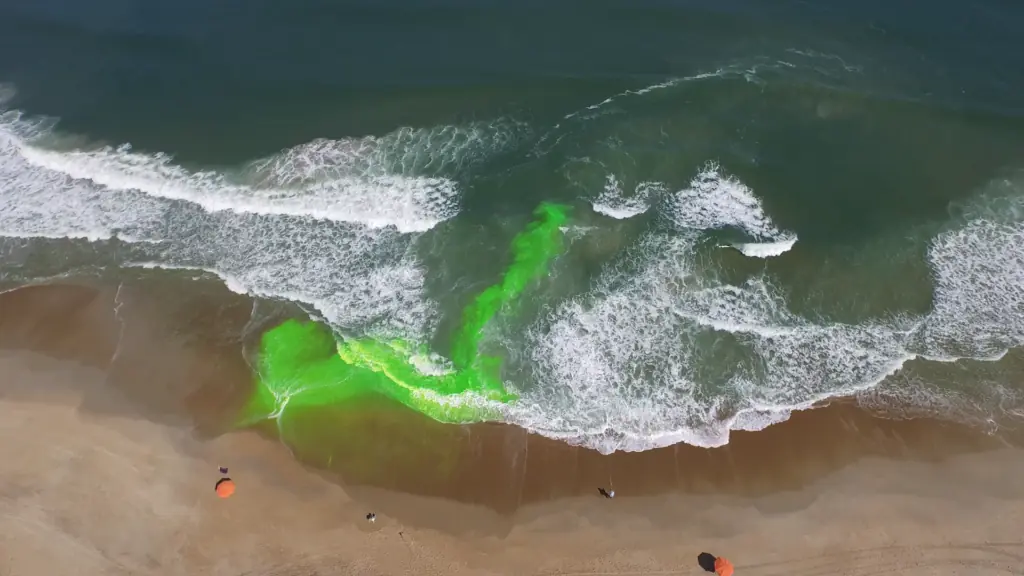
Why Rip Currents Form Even on Sunny, Beautiful Days
Many people associate dangerous ocean conditions with storms, dark skies, strong winds, and enormous waves.
But rip currents do not require a storm to exist.
They can form on a sunny day when the beach appears suitable for swimming. This is one reason they catch so many visitors by surprise.
The process is related to wave movement and the shape of the seabed.
As waves approach the beach, they break over shallow areas. Water accumulates near the shoreline and must return toward deeper water. When the seabed creates a channel or gap, some of that returning water can become concentrated into a narrow current.
The beach may look peaceful because the waves are not particularly large. Yet the current can still be strong enough to carry a swimmer away from the shore.
Several conditions can influence the formation and strength of rip currents.
Wave height: Larger waves can push more water toward the beach, increasing the amount of water that must return offshore.
Wave period: The time between waves can influence how much water accumulates near the shoreline and how strongly it flows back.
Sandbars: Gaps in underwater sandbars can provide channels through which water flows back toward deeper water.
Tide: Changes in water level can alter where waves break and how water moves across the beach. Some locations experience stronger rip currents around particular tidal stages, but rip currents are not limited to low tide.
Coastal structures: Piers, jetties, groins, rocks, and seawalls can influence water movement and create hazardous current patterns nearby.