It would therefore be misleading to treat an early body-type classification as a permanent prediction.
The more useful question is not "Which type am I forever?" but "What is my current body composition, what are my goals, and what habits will help me achieve them safely?"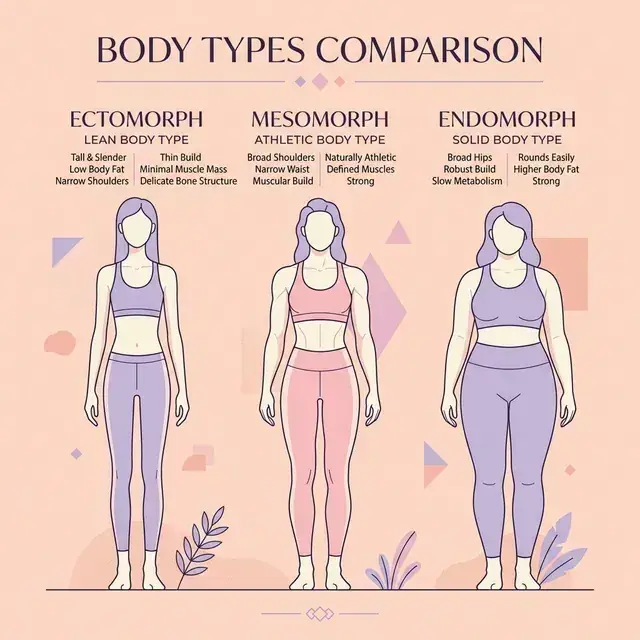
Does Your Body Type Determine Your Metabolism?
This is one of the biggest claims associated with the three-category system.
Popular fitness advice often describes ectomorphs as fast metabolizers, endomorphs as slow metabolizers, and mesomorphs as having a metabolism somewhere between the two.
It sounds logical at first. A naturally slim person may appear to stay lean without much effort, while someone with a broader build may feel that weight gain happens easily.
But appearance alone cannot establish metabolic rate.
Metabolism refers to the many chemical processes that allow the body to function. When people talk about metabolism in relation to body weight, they are often referring more specifically to energy expenditure: the amount of energy the body uses over time.
That expenditure is influenced by several components.
Resting Energy Expenditure
The body uses energy even when a person is resting. It needs energy to support breathing, circulation, brain activity, temperature regulation, and other essential functions.
This is commonly described as resting metabolic rate or resting energy expenditure.
Body size, body composition, age, sex, genetics, and other biological factors can influence how much energy a person uses at rest.
A larger body generally requires more energy to maintain than a smaller body, although the relationship is not identical for everyone.
Muscle tissue also contributes to resting energy expenditure, but it is misleading to assume that adding a small amount of muscle will dramatically transform metabolism.
Physical Activity and Daily Movement
Energy expenditure also includes movement.
Some people exercise regularly, while others spend much of the day sitting. Beyond formal exercise, everyday movement can make a difference.
Walking to work, climbing stairs, standing while doing household tasks, moving around during the day, and other routine activities all contribute to energy use.
This is one reason two people of similar size may have different daily energy requirements.
A person who appears naturally slim may move frequently throughout the day without considering it exercise. Another person may spend more time sitting, even if both attend the gym for similar periods.
The difference is not necessarily explained by an ectomorph or endomorph label.
Food Intake, Appetite, and Eating Patterns
People also differ in how much they eat and how they respond to food.
Some individuals naturally feel hungry more often. Others become full quickly. Meal timing, food availability, habits, stress, sleep, and the energy density of meals can all influence total intake.
A person who struggles to gain weight may believe they eat a great deal, but a consistent record of meals sometimes reveals that their average intake is lower than expected.
Similarly, someone who gains weight may not necessarily have a slow metabolism. Their overall energy intake, activity level, medication, sleep, and other circumstances may contribute.
This is why a wrist measurement cannot provide an accurate explanation for weight changes.
Genetics and Individual Variation
Genetics influence body proportions, appetite, fat distribution, muscle characteristics, and many other aspects of physiology.
However, genetic influence does not mean that every outcome is predetermined.
People with similar genetic backgrounds can develop different physiques because their training, nutrition, health, environment, and life circumstances differ.
The American Heart Association identifies a range of factors that influence weight, including age, genetics, metabolism, medication use, sleep, stress, access to nutritious food, and opportunities for physical activity. This is a much more realistic picture than assigning metabolic speed according to wrist size.
American Heart Association+1
Can Your Body Type Tell You How Easily You Will Build Muscle?
Another popular claim is that mesomorphs naturally build muscle more easily than ectomorphs or endomorphs.
There may be individual differences in muscle-building potential, but the three labels do not reliably predict how a particular person will respond to strength training.
Muscle development depends on several interacting factors.
Training Experience and Consistency
A person who has never performed resistance training may experience noticeable improvements when they begin a structured program.
This is often called the beginner response. Early progress can include improvements in coordination, technique, and the ability of the nervous system to recruit muscles effectively.
Over time, further progress generally requires an appropriate training stimulus and sufficient recovery.
Someone who trains consistently for several years may have a very different starting point from someone who has only recently entered a gym.
Comparing their physiques without considering training history can lead to inaccurate conclusions about genetics or body type.
Progressive Overload
Muscles adapt when they are exposed to an appropriate training challenge.
Progressive overload involves gradually increasing the demands placed on the body. This can be achieved through changes in weight, repetitions, sets, exercise difficulty, movement control, or training volume.
The progression should be manageable. Increasing the load too quickly can compromise technique and increase injury risk.
A person does not need a special routine simply because they believe they are an ectomorph, mesomorph, or endomorph. They need a program that matches their current ability and goals.
Protein and Overall Nutrition
Muscle development requires more than lifting weights.
The body needs sufficient energy and nutrients to support training and recovery. Protein provides amino acids used in muscle repair and growth.
People who want to build muscle often benefit from including protein-rich foods throughout the day. Examples include eggs, fish, poultry, dairy products, tofu, beans, lentils, and other suitable sources.
The exact amount needed depends on factors such as body weight, training, age, health, and total food intake.
Carbohydrates also matter because they provide energy for exercise. Dietary fats contribute to normal biological functions, including hormone production and the absorption of certain vitamins.
A balanced diet is more useful than eliminating entire food groups based on an assumed body type.
Sleep and Recovery
Muscle growth does not happen only during the workout.
Recovery allows the body to adapt to the demands of training. Inadequate sleep, excessive training volume, insufficient food, and insufficient rest can interfere with progress.