American Airlines Flight 191: The Takeoff from Chicago O’Hare and the Catastrophic Failure That Followed Seconds Later
On May 25, 1979, a routine departure from Chicago became one of the deadliest aviation disasters in American history. The investigation would reveal that the catastrophe began not with a sudden pilot error, but with damage caused during aircraft maintenance.
The aircraft was already accelerating down the runway when something went terribly wrong. Witnesses saw the left engine separate from the wing and fall away as the McDonnell Douglas DC-10 lifted into the air. For a few seconds, the aircraft continued climbing. From a distance, it might have appeared that the pilots were still managing to keep the damaged jet airborne.
But the most dangerous consequences were unfolding out of sight. The engine separation had damaged more than the aircraft's external structure. It had also affected hydraulic lines and electrical systems that played essential roles in controlling the airplane and warning the crew about an approaching stall. The pilots were suddenly facing an emergency whose full nature was not apparent from the cockpit.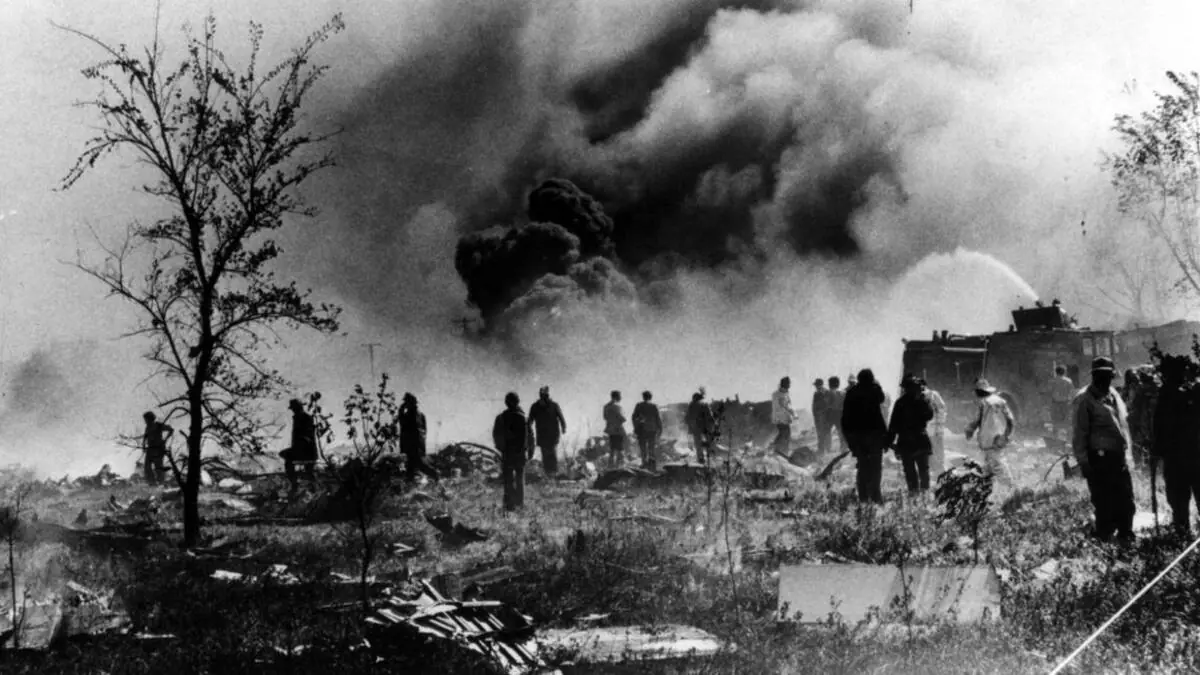
The jet began to roll left. Its nose dropped, and the aircraft descended before it could recover. It crashed in an open field near the airport, with the wreckage scattering toward a nearby trailer park. The impact and ensuing fire killed everyone aboard and two people on the ground.
The flight was American Airlines Flight 191, scheduled to travel from Chicago O’Hare International Airport to Los Angeles. The tragedy claimed 273 lives and raised difficult questions about aircraft maintenance, engineering design, airline procedures, and aviation oversight.
Yet the most important part of this story is not simply that an engine detached during takeoff. It is how a maintenance decision made before the flight created a chain of failures that the crew had almost no time to understand or overcome. The investigation would uncover a sequence of events that changed how the aviation industry thought about maintenance safety and the risks hidden inside seemingly routine procedures.
To understand why Flight 191 crashed, it is necessary to look beyond the dramatic photographs of the burning wreckage and reconstruct what happened in the seconds before impact—and the decisions made long before the aircraft reached the runway.
1. A Routine Departure from Chicago O’Hare
On the afternoon of May 25, 1979, American Airlines Flight 191 was preparing to leave Chicago O’Hare International Airport for Los Angeles. The aircraft was a McDonnell Douglas DC-10-10, a wide-body passenger jet designed for long-distance commercial travel. It carried 258 passengers and 13 crew members, making a total of 271 people on board.
The flight was a scheduled service, not a special operation or an unusual test. Passengers had boarded, the crew had completed the preparations for departure, and the aircraft taxied toward Runway 32R. The weather was clear, with visibility reported at approximately 15 miles. Nothing in the official investigation suggested that poor visibility or severe weather played a role in the accident.
The DC-10 was a recognizable aircraft of its era. It had three engines: one beneath each wing and a third mounted at the base of the vertical tail. This configuration gave the aircraft the power required for long-distance operations and made it a familiar sight at major airports.
Like every commercial departure, the takeoff required a precise sequence. The aircraft had to accelerate along the runway, reach the required speeds, rotate its nose upward, and climb while maintaining enough lift and control authority. The pilots were trained to respond to engine failures and other emergencies, but those procedures depended on the aircraft behaving in ways that the designers and operators had anticipated.
Flight 191's takeoff roll initially appeared normal. The engines were producing power, the aircraft accelerated, and the crew made the expected speed calls. But shortly before the aircraft became airborne, the left engine and its supporting pylon separated from the wing.
The separation happened at a particularly dangerous moment. The aircraft was already moving at high speed, and the crew had very little time to identify the problem. The engine assembly did not simply stop working while remaining attached to the airplane. It physically tore away, taking with it a section of the wing's leading edge and damaging systems routed through the surrounding structure.
The aircraft continued forward and lifted off. According to the official investigation, it climbed to approximately 325 feet above the ground before beginning its fatal left roll.
That brief climb is one of the most striking details of the accident. The aircraft did not immediately fall back onto the runway after losing the engine. It became airborne, and the pilots initially appeared to retain enough control to keep the wings close to level. Yet the damage had changed the aerodynamic condition of the left wing in a way that made continued controlled flight increasingly difficult.
The passengers and crew had no opportunity to understand the full chain of failures unfolding around them. The aircraft was only seconds into its flight, and the emergency was developing faster than the crew could diagnose it.
2. The Moment the Left Engine Tore Away
The left engine of Flight 191 was identified as the No. 1 engine. It was attached to the wing by a structural assembly commonly described as the engine pylon or strut. The pylon was not merely a bracket holding the engine in place. It was a critical structural connection that transferred enormous forces between the engine and the wing.
During takeoff, engines and their supporting structures are subjected to substantial loads. The aircraft accelerates, the engines produce thrust, and aerodynamic forces increase as the airplane approaches liftoff. The pylon must remain secure under these changing conditions.
On Flight 191, the pylon structure failed during the takeoff rotation. The engine and pylon assembly separated from the left wing and traveled over the wing before falling onto the runway. Approximately three feet of the wing's leading edge also separated with it.
This was an extraordinary structural failure. The loss of an engine is already a serious event during takeoff, but the physical separation of the engine assembly can cause damage far beyond the loss of thrust. In this case, the separation damaged hydraulic lines and electrical systems located near the pylon.
The distinction is essential to understanding the crash. If the engine had simply failed while remaining attached, the pilots would have faced a conventional engine-out emergency. The aircraft was designed to continue flying after losing one engine, provided the crew followed the appropriate procedures and the remaining systems continued functioning.
But Flight 191 did not experience an ordinary engine failure. The engine's separation damaged other parts of the aircraft and changed the behavior of the left wing. It also disrupted some of the systems that would normally help the pilots recognize and respond to a developing stall.
The pilots initially treated the event as an engine failure. That response was understandable because the cockpit did not provide them with a complete picture of what had happened outside. They could recognize a problem with the left engine, but the separation had also caused damage that was not necessarily obvious from their instruments.
The aircraft's design and the procedures available to the crew did not adequately prepare them for this exact combination of failures. The emergency was therefore not simply a test of pilot skill. It was a situation in which the aircraft's systems, the maintenance history, and the operating procedures interacted in a way that left very little margin for recovery.
3. Why the Aircraft Could Not Maintain Lift
To understand the final moments of Flight 191, it helps to understand a basic principle of flight: an airplane must generate enough lift to support its weight.
The wings produce lift as air flows around them. During takeoff, aircraft use high-lift devices such as flaps and leading-edge slats to increase the amount of lift the wings can generate at relatively low speeds.
Slats are movable surfaces located along the front edge of a wing. When extended, they help the wing maintain smoother airflow at higher angles of attack and lower speeds. They are particularly important during takeoff and landing, when the aircraft is operating closer to its aerodynamic limits.
The DC-10's leading-edge slats were designed to remain in their commanded positions through hydraulic pressure. On Flight 191, the engine separation severed hydraulic lines in the affected area. The loss of hydraulic pressure allowed several slats on the outboard portion of the left wing to retract unexpectedly.
This created an asymmetric configuration. The left wing no longer had the same high-lift characteristics as the right wing. The two sides of the aircraft were no longer producing lift in the same way.
That imbalance was critical. With the left wing's slats retracted, its stall speed increased. The aircraft was therefore more vulnerable to a stall on the damaged side, even though the right wing retained its normal configuration.