For nearby residents, the event was a frightening reminder that an aviation emergency can affect communities beneath flight paths. Airports are essential transportation hubs, but they operate near populated areas, making safety and emergency planning important not only for passengers but also for people on the ground.
The response required coordination among firefighters, police, medical personnel, airport authorities, and federal investigators. The crash site had to be managed as both an emergency scene and an accident investigation site. Evidence needed to be protected while responders addressed the immediate hazards.
For families, the consequences were permanent. Anniversaries of the accident have continued to bring renewed attention to the people who died and the lessons that emerged from the investigation.
Memorials and public remembrance serve an important purpose. They ensure that the victims are not reduced to a statistic and that the safety improvements associated with the accident remain connected to the lives lost.
Aviation safety often advances through the study of disasters. But the value of those lessons depends on remembering why they matter. The goal is not simply to make aircraft more reliable as machines; it is to protect the people who place their trust in them.
18. Why Flight 191 Still Matters Today
More than four decades after the accident, American Airlines Flight 191 remains an important case in aviation safety education. Its lessons are relevant because commercial aviation depends on a complex relationship among aircraft design, manufacturing, maintenance, airline operations, pilot training, and regulatory oversight.
Modern aircraft are equipped with sophisticated systems, and maintenance procedures have evolved considerably since 1979. But the basic safety principles remain the same.
First, maintenance must follow approved procedures. A task that appears routine can have serious consequences if it introduces hidden structural damage. The equipment used to support or move heavy components must be appropriate, and the process must protect the integrity of the aircraft.
Second, inspection programs must be capable of detecting damage in critical areas. A visual check is not sufficient if the relevant structural surfaces are hidden or inaccessible. Inspection methods must match the failure modes that engineers know are possible.
Third, technical information must be shared. If an operator discovers a damaging maintenance practice or an unusual failure, that information should be communicated to the manufacturer, regulators, and other operators when relevant. A safety warning has limited value if it does not reach the people who need it.
Fourth, aircraft systems should be designed to tolerate failures where possible. The loss of one component should not create an uncontrolled chain of secondary failures. Engineers must consider how hydraulic, electrical, structural, and aerodynamic systems interact.
Finally, pilots need procedures that address realistic emergency scenarios. Training and checklists should reflect the actual behavior of the aircraft under abnormal conditions, including situations in which the failure affects more than one system.
Flight 191 also remains a reminder that the visible moment of a disaster may be far removed from the original cause. The engine separated during takeoff, but the chain began earlier, during maintenance. The crash happened in seconds, but the conditions that made it possible developed over a much longer period.
That is perhaps the most important answer to the question raised by the headline. The catastrophic failure that followed takeoff was not simply an unpredictable explosion or a sudden act of fate. It was the result of a series of technical and organizational failures that investigators were able to reconstruct.
The aircraft's left engine and pylon assembly separated at a critical moment. The damage affected hydraulic and electrical systems. The left wing's slats retracted, changing its ability to generate lift. The warning systems that could have helped the pilots recognize the developing stall were lost. The aircraft rolled left and crashed before the crew could regain control.
The tragedy of Flight 191 is remembered not only because of the number of lives lost, but because the investigation revealed how preventable weaknesses can combine in a complex system. Its legacy is a continuing reminder that aviation safety is built long before a passenger boards an aircraft—and that every maintenance procedure, inspection, design decision, and safety report matters.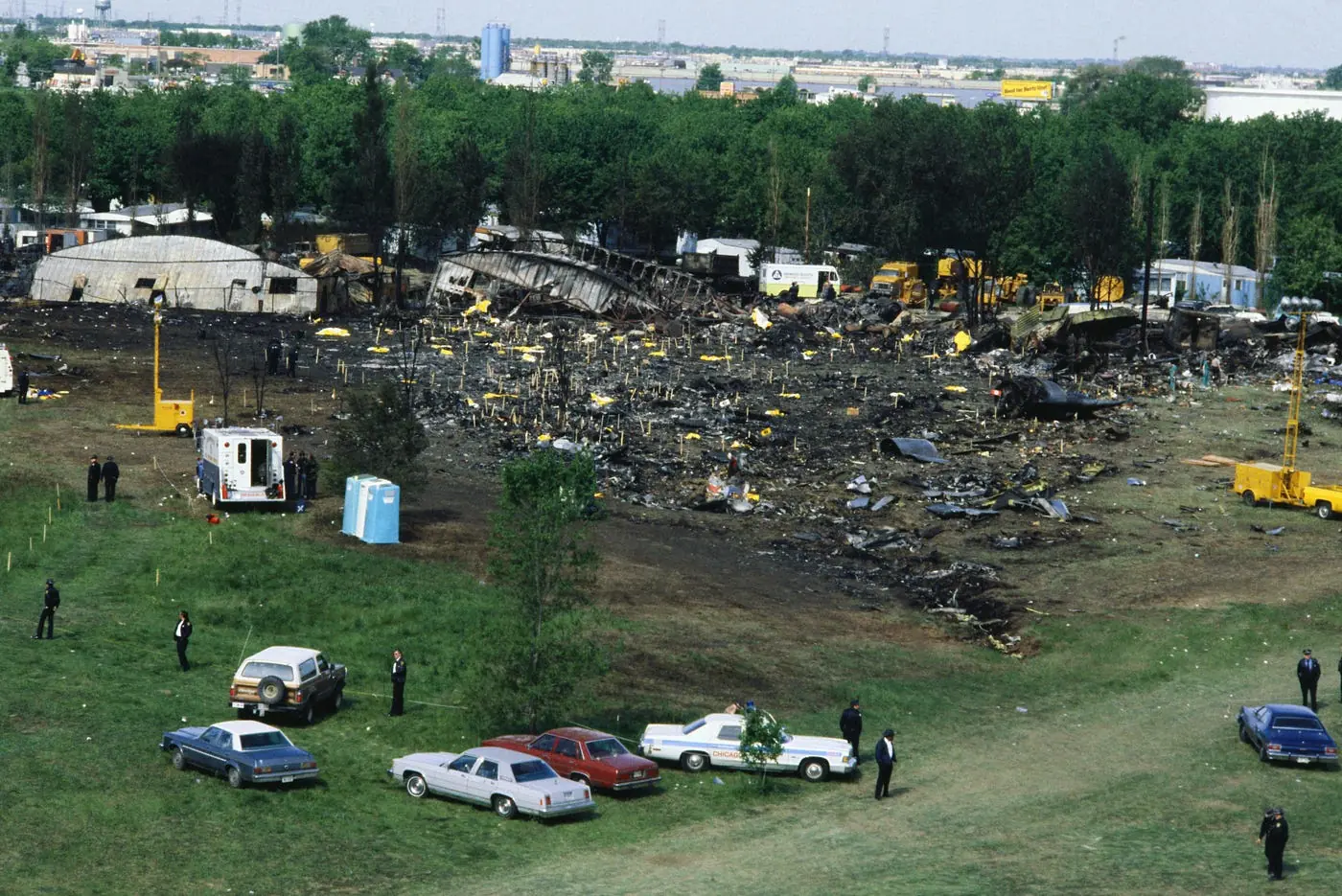
19. The Difference Between an Engine Failure and an Engine Separation
One reason Flight 191 is still studied is that it demonstrates the difference between losing engine power and losing the engine assembly itself.
A conventional engine failure can be serious, but a multi-engine aircraft is designed to continue flying after one engine stops producing thrust. Pilots train for this possibility, and performance calculations establish the speeds and procedures needed to maintain control and climb safely.
An engine separation is fundamentally different. When the engine and its supporting structure detach from the aircraft, they can damage the wing, nearby control systems, hydraulic lines, electrical wiring, and other equipment. The airplane may therefore lose more than propulsion.
In Flight 191, the left engine's separation created an aerodynamic problem that was not present in an ordinary engine-out scenario. The left wing's slats retracted, increasing its stall speed. The crew's response to what appeared to be an engine failure was therefore not sufficient to address the altered wing configuration.
This distinction is important for understanding the investigation. The accident was not evidence that a DC-10 could not fly with one engine inoperative. It showed that the aircraft had suffered a much more complex structural and systems failure at a critical stage of flight.
The difference also helps explain why emergency procedures must be precise. A checklist designed for one failure mode may not be appropriate when several systems have been damaged by the same event. The aircraft's actual condition must be considered, and the design must provide pilots with reliable information whenever possible.
20. Why the Takeoff Phase Leaves So Little Time to Recover
Takeoff is one of the most demanding phases of a flight. The aircraft is accelerating close to the ground, and the crew must manage engine power, airspeed, configuration, direction, and the transition from runway to climb.
At low altitude, there is very little time to diagnose an unexpected problem. A failure that might be manageable at cruising altitude can become catastrophic if it occurs during rotation or immediately after liftoff.
The aircraft also has limited height available to recover from a loss of lift or control. Pilots cannot simply descend to gain speed or spend several minutes troubleshooting. They must maintain a safe flight path while reacting to the emergency.
Flight 191 experienced its engine separation at almost the worst possible moment: during the transition from takeoff roll to flight. The airplane had not climbed high enough to provide a meaningful recovery margin. Its aerodynamic configuration changed almost immediately, and the crew's warning systems were compromised.
The short interval between liftoff and impact is therefore central to understanding the tragedy. The aircraft climbed, began rolling, and crashed within roughly half a minute after becoming airborne. The investigation found that the crew was responding according to the available engine-failure procedures, but those procedures did not account for the full chain of damage.
The accident illustrates why takeoff procedures, aircraft design, and maintenance inspections must work together. Pilots cannot compensate for every hidden structural defect, especially when the failure produces multiple effects at once and leaves only seconds to respond.
21. The Lasting Lesson: Safety Depends on Every Link in the Chain
The story of American Airlines Flight 191 is often told through the dramatic image of an aircraft losing an engine during takeoff. But the more important story lies in the links between maintenance, engineering, oversight, and flight operations.
A structural component was damaged during maintenance. The damage weakened the pylon. The pylon failed during takeoff. The engine separation damaged hydraulic and electrical systems. The left wing's slats retracted, creating an asymmetric stall. The aircraft rolled and crashed before the crew could recover.
Each event contributed to the next. Preventing the accident required more than improving one part of the aircraft or changing one pilot procedure. It required identifying weaknesses across the entire safety system.
That is why the NTSB's conclusions included not only the maintenance-induced damage but also design vulnerabilities, regulatory surveillance, information-sharing deficiencies, and the limits of the operational procedures in use at the time.
For passengers, the lesson may be less visible than the aircraft itself. A safe flight depends on thousands of tasks performed before departure: inspections, maintenance records, engineering reviews, component checks, and communication among people who may never meet the passengers whose lives depend on their work.
Flight 191 remains a solemn reminder that these tasks cannot be treated as routine paperwork. They are essential parts of aviation safety. The aircraft's final seconds were tragic, but the investigation made those seconds valuable to future generations by revealing how the disaster developed and what needed to change.